
In Practice
Roast 2kg veal bones (knuckle and shin for collagen-rich) at 220°C for 45-60 min until deep brown, with tomato paste smeared the last 15 min. Build 200g brown roux separately. Sweat mirepoix (200g onion, 100g carrot, 100g celery) in fat, deglaze with 3L brown veal stock, add bones, bouquet garni (parsley stems, thyme, bay, peppercorns). Simmer at 85°C — never boiling, which clouds the sauce — for 4 hours, skimming albumin foam every 30 min. Strain through chinois lined with muslin. Failure modes: boiling emulsifies fat into the sauce (greasy, gray); under-skimming traps off-flavors; using only beef bones (no veal) yields too little gelatin for proper nappe.
Background
In the opulent kitchens of 17th-century France, during the reign of Louis XIV, chefs sought to elevate cuisine to match the grandeur of the Sun King's court. It was here that Sauce Espagnole emerged, a sophisticated response to the era's culinary ambitions. As French nobility demanded more complex and refined meals, chefs like François Pierre La Varenne began documenting methods that moved beyond simple roasting or boiling, establishing a foundation for the rich sauces that would become a hallmark of the cuisine.
The codification of Sauce Espagnole came with Auguste Escoffier in the early 20th century, who simplified and systematized French culinary practices. While the name suggests a Spanish influence, the sauce is distinctly French, part of Escoffier's 'mother sauces'. Its technique spread globally, setting the stage for countless derivatives and adaptations. Unlike its Spanish counterpart, sofrito, Sauce Espagnole relies heavily on a dark roux and veal stock, creating a distinctly velvety base.
How It Works
A long-simmered triple build: brun roux at chocolate stage delivers dextrinized starch + pyrazines; roasted veal bones (200-220°C oven) contribute collagen that hydrolyzes into gelatin at 60-70°C plus Maillard-browned bone-marrow lipids; mirepoix and tomato paste add glutamate and pectin-bound body. Reduced by half to two-thirds over 4-6 hours, the sauce concentrates to ~10-12% gelatin by weight, giving the spoon-coating nappe consistency.




Through Time
Codified by Marie-Antoine Careme in his 1833 *L'Art de la Cuisine Francaise au XIXe Siecle* as one of the four mother sauces. The 'Espagnole' name traces to Spanish-style tomato use under Anne of Austria's 17th-century French court influence. Auguste Escoffier streamlined the formula in his 1903 *Le Guide Culinaire*, reducing Careme's 24-hour build to a more workable 4-6 hours. The modern derivative demi-glace (Espagnole reduced 50% more with additional veal stock) became the canonical restaurant base; Thomas Keller and Daniel Boulud carry the contemporary lineage.
Related cooking knowledge
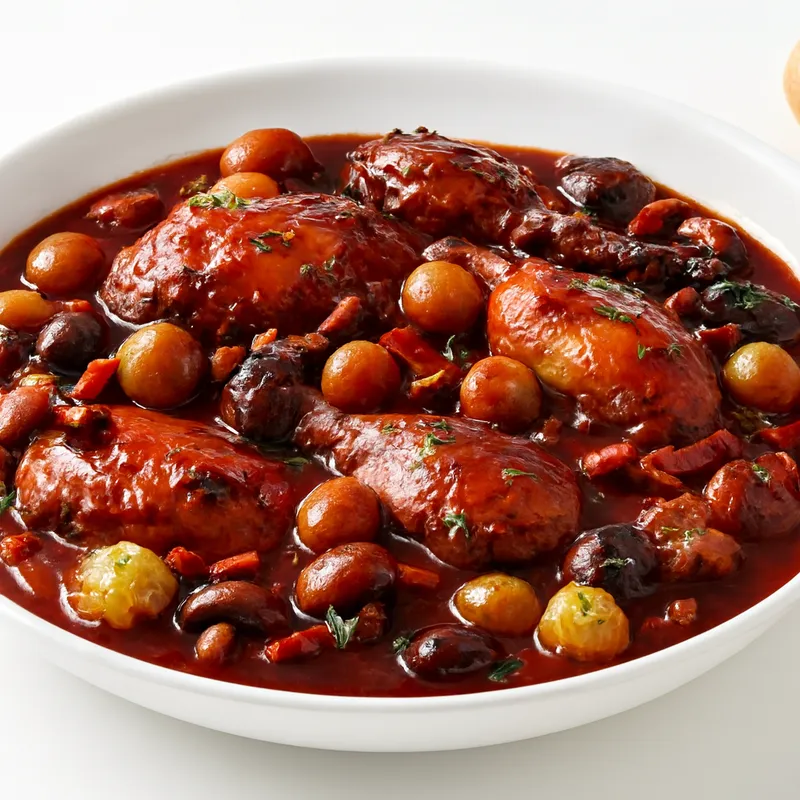
Demi-glace is Espagnole reduced further with veal stock — twice the body, deeper Maillard load. Bordelaise, Robert, and chasseur are Espagnole's classical daughter sauces, each adding a distinct finishing element (red wine + marrow / mustard + onion / shallot + mushroom). Velouté is the white-stock mother-sauce sibling. Hong Shao master stock shares the long-reduction collagen-extraction logic on the Chinese side.


