
Traditions
In the 17th century, amidst the rolling vineyards of Burgundy, wine-braising emerged as a method to elevate the rustic flavors of local meats. This was a time when the region's bold, robust wines were increasingly celebrated, and the technique naturally evolved from a need to extend the bounty of the autumn harvest into the colder months when fresh produce was scarce.
The method traveled beyond Burgundy as French cuisine gained prestige across Europe. While similar techniques existed—such as the Italian brasato with Barolo wine—Burgundy's approach was distinct for its reliance on the terroir-specific Pinot Noir. Over time, this method became synonymous with iconic dishes like Boeuf Bourguignon, where the wine's character is integral to the dish's identity.
How It Works
Red wine — typically Pinot Noir, Gamay or Bourgogne — provides acidic medium (pH ~3.4), ethanol that extracts fat-soluble aromatics from aromatics and spices, plus anthocyanin pigments and tannins that bind to protein. Acidity softens collagen sheath structure before heat finishes the hydrolysis; ethanol evaporates by 78°C, leaving behind concentrated phenolics. Reduction concentrates glutamate from beef and umami-precursor amino acids into nappe consistency.
In Practice
the craftMarinate beef overnight in wine + mirepoix + bouquet garni; strain marinade, dry meat thoroughly, sear in lardon-rendered fat for crust. Reduce marinade by half to drive off harshness, return with stock. Braise covered 2.5-3 hr at 150°C oven; finish with butter-mounted reduction and pearl onion / mushroom garniture (the bourguignon canon). Use young, structured wine — never cooking wine. Failure modes: thin Pinot under-reduces; chalky cheap wine leaves astringency; lid kept fully sealed during reduction phase leaves sauce thin.


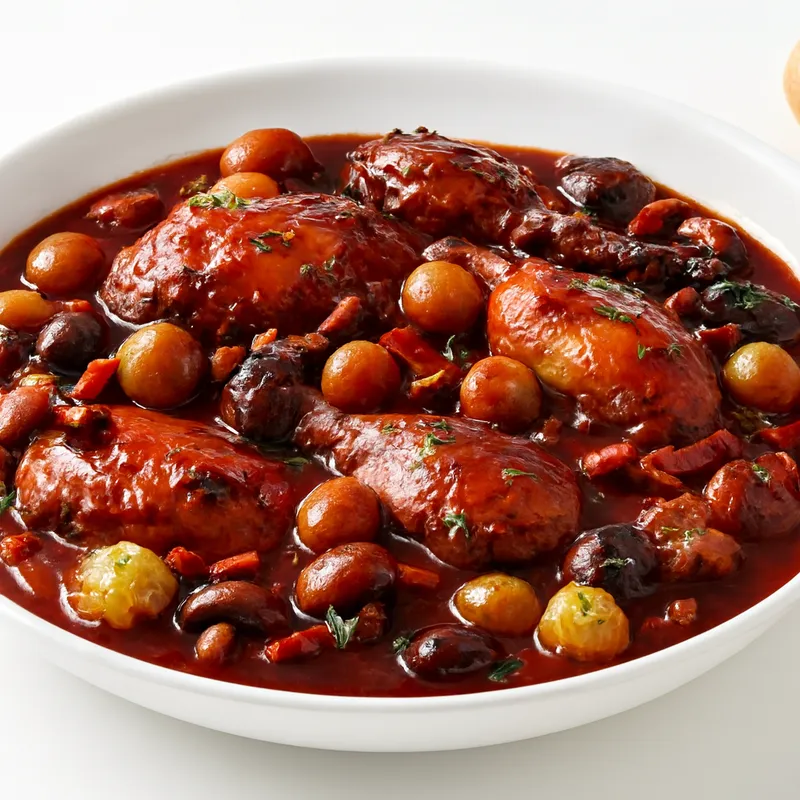
Through Time
Burgundian rustic origin obscured but codified by Auguste Escoffier's 1903 *Le Guide Culinaire* recipe for boeuf bourguignonne; further popularized by Julia Child, Simone Beck and Louisette Bertholle's 1961 *Mastering the Art of French Cooking*. Bernard Loiseau and Paul Bocuse perpetuated the technique in regional grande cuisine; Daniel Boulud carries the contemporary professional canon in *Daniel: My French Cuisine* (2013).
Related cooking knowledge
Braising is the parent class — wine simply replaces neutral stock as the acid-bearing liquid. Hong Shao and Kho Braising are the East Asian sister techniques using soy/caramel and palm-sugar/fish-sauce respectively. Simmering is the second-stage backbone. Marinating supplies the overnight wine-immersion step.


