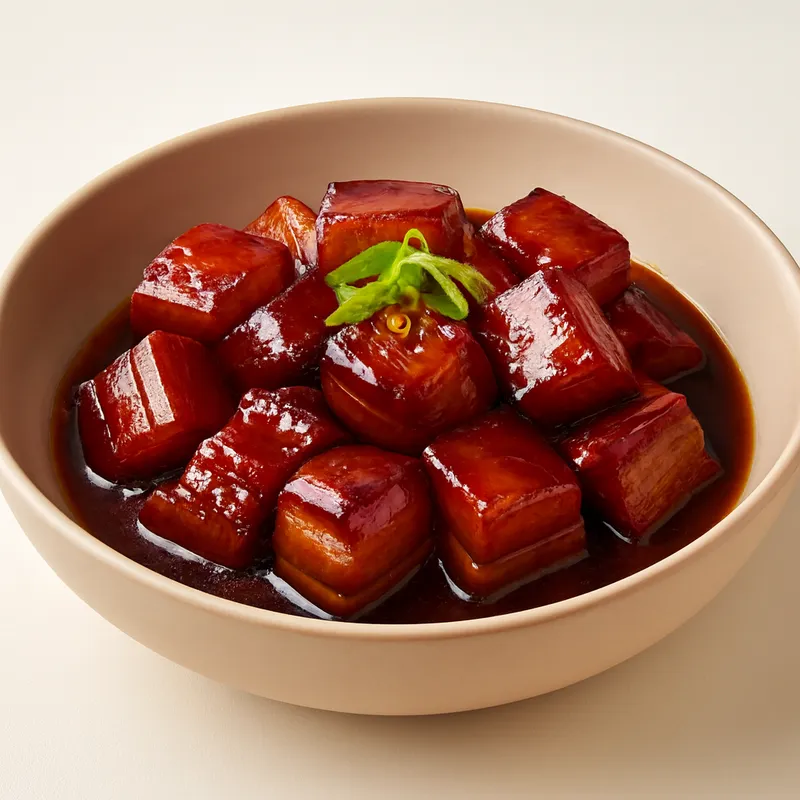
In Practice
Render pork belly fat first, drain, then caramelize rock sugar in clean wok or sand pot. Stages: 冰糖炒色 (sugar caramelize) → 上色 (coat meat) → 加料酒 (deglaze with wine) → 加水加酱油 (stock + soy) → 慢炖 (90 min low simmer) → 收汁 (reduce uncovered last 10 min for lacquer). Failure modes: caramel taken to dark stage burns and turns the whole pot bitter — pull at amber; covering through the reduction step leaves the glaze thin and pale.
Background
The origins of Hong Shao trace back to the bustling markets of 19th-century Shanghai, a time when the city was a melting pot of trade and culinary innovation. As international merchants arrived, bringing with them foreign ingredients and ideas, local chefs began to experiment with new techniques and flavors. The humid climate and abundant availability of soy sauce, sugar, and rice wine from nearby Zhejiang province made Shanghai an ideal birthplace for this braising method, which required slow cooking to infuse deep, savory notes.
Hong Shao's technique traveled along with the diaspora of Chinese migrants and merchants, finding its place in family kitchens and banquet halls across Southeast Asia. While the core ingredients remained, adaptations began to emerge: in Taiwan, the addition of star anise adds complexity, whereas in the Sichuan version, a hint of dried chili brings a subtle heat. Despite these variations, the Shanghai original remains revered for its balance of sweet and savory, perfectly encapsulated in dishes like Red Braised Pork Belly.
How It Works
Sucrose is dry-melted to 165-170°C amber caramel — past the diacetyl-furan stage into deep bitter-sweet notes — then quenched with hot stock. Soy sauce contributes glutamate and acidic amino-acid Maillard precursors; Shaoxing wine adds esters and ethanol that pulls fat-soluble aromatics from spices. Long simmer at 85-90°C melts collagen while sugar-protein bonds re-form into the signature lacquered glaze.


Through Time
Shanghai's Benbang cuisine codified hong shao rou in 19th-century Songjiang district; Mao Zedong's purported preference for the dish gave it twentieth-century national status. Yuan Mei's 1792 *Suiyuan Shidan* records earlier red-cooking variants. Fuchsia Dunlop's *Land of Plenty* (2001) and *Land of Fish and Rice* (2016) brought scholarly precision to English readers.
Related cooking knowledge
Braising is the Western parent class. Kho Braising is the Vietnamese caramel-fish-sauce sibling using palm sugar instead of rock sugar. Wine-braising shares the deglaze-with-alcohol mechanic. Simmering is the second-stage backbone that finishes the dish.


