Milan's ingenious leftover technique: day-old risotto alla milanese pressed into a flat cake and pan-fried in butter until a compact, deep-gold crust encases a trembling saffron interior — flipped in a single decisive wrist movement, the salto.
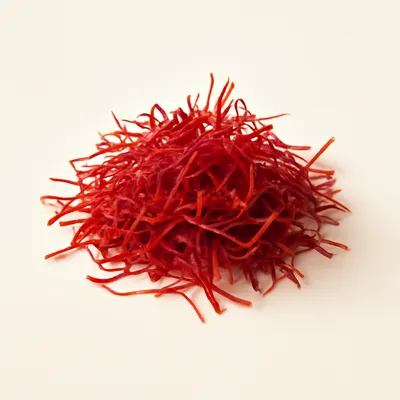




Risotto al salto is inseparable from risotto alla milanese, whose origin is traditionally traced to 1574: legend holds that the Milanese workshop colleagues of Belgian glazier Valerio di Fiandra, then glazing the Duomo, added saffron to butter-fried rice to celebrate his daughter's wedding. The tale is undocumented, and the first written recipes appear only in the early 19th century; by 1829 Giovanni Felice Luraschi's cookbook gave the base risotto its modern name. The salto — frying the cooled, compacted mass into a pan cake — arose from the thrift of Milanese bourgeois and trattoria kitchens: nothing of the saffron-gilded risotto was wasted. The Savini restaurant in the Galleria Vittorio Emanuele II, under chef Giuseppe Fontana from 1905, became closely associated with the technique as a refined preparation, and the dish remains a benchmark of the Milanese trattoria repertoire.
The golden crust cracks on first contact — brittle, butter-rich, faintly saffron-scented — then yields to a warm, custardy interior where individual rice grains have dissolved into a unified mass that trembles on the fork.
Chilled risotto compacts as amylopectin retrogrades — the gelatinised starch re-crystallises, binding rice grains together without any added binder. In the pan, butter fat sears the flat surface at 160–170°C: surface starch undergoes Maillard browning and dextrinisation, forming a rigid, mahogany crust. The starchy mass insulates the interior, which heats slowly by conduction and remains moist and soft. The flip (salto) completes crust formation on the second side without steam-softening the already-set first crust.
Variations
An egg beaten into the cooled risotto before shaping helps bind leaner, drier leftover batches. Smaller individual discs about 10cm across are easier to flip cleanly. A restaurant finish may include a drizzle of marrow-enriched braising jus and shaved aged Parmigiano. Some versions press sautéed mushrooms into the centre as a filling before frying.
On the Palate
Where Risotto al Salto (Milanese) sits in the Italian flavor cloud
Ingredients
Serves 2How it's made
7 steps · 5 min
- 1120 min
Spread freshly made risotto alla milanese on a plate or tray; smooth flat and allow to cool to room temperature, then refrigerate uncovered for at least 2 hours until the mass is compact and cold.
Watch outChill the risotto until it's cold and truly compact — a warm or loose mass won't hold together as a disc and will break apart in the pan.
- 23 min
With damp hands or a spatula, press the cold risotto into a disc about 2–3cm thick; it should hold its shape cleanly without crumbling.
- 32 min
Melt butter in a heavy, flat pan over medium-high heat until the foam subsides; carefully slide the risotto disc in.
- 46 min
Cook undisturbed for 5–6 minutes; the crust is ready when it pulls cleanly from the pan and the underside is deep mahogany gold.
Watch outDon't touch it for those first 5-6 minutes — the crust is ready only when the disc slides free on its own and the underside is deep mahogany.
- 51 min
Perform the salto: grip the pan handle firmly and flip the disc with one decisive wrist movement, or invert onto a plate and slide back into the pan.
Watch outCommit fully to the flip — one decisive wrist snap, or slide it onto a plate and back; a half-hearted flip cracks the disc.
- 65 min
Cook the second side undisturbed for 4–5 minutes until equally golden and the crust feels rigid.
- 71 min
Slide onto a warmed plate and serve immediately — the crust softens within minutes as interior steam migrates outward.


