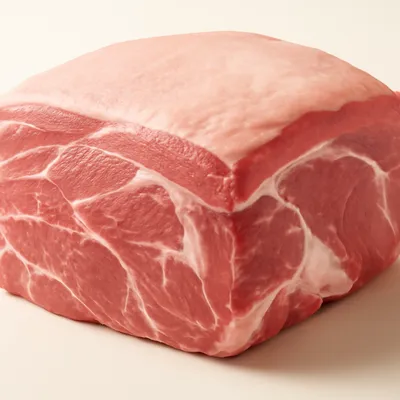
Salt-cured air-dried pig hindquarter from Jinhua, Zhejiang — China's oldest ham, sliced thin as a cold starter or shaved into stocks.



Jinhua city in central Zhejiang has cured pig hindquarters since the Tang dynasty (8th century). The technique requires the local two-headed black pig (两头乌), Jinhua's specific humidity profile, and 8-18 months of cool-season air curing. PGI-protected since 2003 — only ham produced inside the designated Jinhua region can carry the name. Predates Italian Parma ham by roughly 600 years.
Cured since the Tang dynasty (8th century), 600 years before Parma. PGI-protected since 2003 — only the two-headed black pig (两头乌), the local humidity, and 8-18 months of cool-season air do it.
Translucent slices, deep rose at the lean and amber at the rim of fat. Cold, the texture is almost like cured beef — dense, slightly chewy. Salt hits first, then a slow-rolling umami that coats the back of the tongue, then a faintly funky sweetness from 12+ months of fermentation. With a sip of warm Shaoxing the saltiness rounds out. Stringy or shoe-leather toughness means under-aged or sliced with the grain.
The flavor's depth comes from controlled enzymatic breakdown — over a year, muscle proteins cleave into free glutamates and IMPs, the same compounds that make MSG and dashi taste of umami. Jinhua's two-headed black pig has higher intramuscular fat than commercial breeds; that fat, slowly oxidizing, produces the nutty top note. Substituting Western prosciutto in soup gives saltiness but no third-flavor depth.
Variations
Shangtui (上腿) is the upper hindquarter, considered the prime cut; Zhongtui is the middle cut for soup-stock; Anhui's similar Tunxi ham is shorter-aged and saltier; Yunnan's Xuanwei ham runs smokier from open-fire curing.
On the Palate
Where Jinhua Ham sits in the Chinese flavor cloud
Ingredients
Serves 4How it's made
5 steps · 15 min active + 5 min waiting
- 15 min
Buy a section from the upper-middle (上方) of an aged Jinhua ham — that's the prime cut, leanest with the deepest cure. Avoid the hock end for cold slicing.
- 25 min
Trim the hard outer skin and any rancid yellow fat with a sharp knife. Save trimmings for stock. The clean rose-red flesh underneath is what you want.
Watch outCut away every trace of the yellowed fat — that rancid layer tastes bitter and off; the clean rose-red flesh underneath is what you slice.
- 320 min
Steam the trimmed block for 20 minutes over medium heat to soften the salt and bring out aroma. Cool completely — chill 30 minutes in the fridge.
Watch outChill it right down after steaming — a cold, firm block slices into paper-thin sheets, a warm soft one just crumbles.
- 43 min
With a long thin blade, slice against the grain into 1.5mm sheets. Each slice should be translucent at the fat edge.
Watch outSlice against the grain and hold it thin enough to see light through the fat edge — that's the mark of a proper cut.
- 52 min
Arrange overlapping on a cool plate. Serve with a small dish of rice wine or as part of a cold platter. For stock use: 30g cubed ham + chicken stock simmered 30 min.
Archive tool suggestions — not reviewed
These legacy suggestions have not been evidence-reviewed and are not presented as required tools.