Thick slabs of fresh raw foie gras (today around 97% duck rather than goose) seared in a hot dry pan until crusted brown outside, melted to molten centre — served with Sauternes reduction on toasted brioche.



Foie gras production traces to ancient Egypt (force-feeding migratory geese with figs, around 2500 BCE); the technique passed to Rome, was preserved chiefly by Jewish communities after Rome's fall, and re-emerged in France (notably Alsace) from around the 16th century, with southwest France — Gascony and Périgord — becoming the heartland. The duck-based version emerged in the 19th century in southwest France — duck is more cost-effective than goose and the resulting liver is more strongly flavoured. Pan-searing of fresh raw lobes (rather than terrine or torchon) became a restaurant technique in the late 20th century, popularized by the new bistronomie movement. AOC protections cover specific regional preparations but not poêlé itself.
Force-feeding traces to ancient Egypt c. 2500 BCE; duck-based version emerged in 19th-century southwest France because duck was cheaper and stronger-flavoured than goose. Pan-searing fresh raw lobes is a late-20th-century bistronomie technique. Liver is 50-60% fat by weight — melt point 30-35°C.
Cut through the dark crust and the centre flows out — a buttery near-liquid pool of fat the colour of weak tea. On the tongue: instant dissolve, body-temperature melt, a flavour somewhere between rendered duck fat and warm cream with iron underneath. The Sauternes syrup spikes the bite with sweet acidity that cuts the richness for one mouthful before the fat closes back over. Eat in 4-5 bites then stop — the dish is a one-flash experience, not a portion to linger over.
Foie gras is 50-60% fat by weight — the highest fat ratio of any organ meat. Fat melts at 30-35°C (close to body temp), which is why the centre flows on the plate. The dry hot pan is non-negotiable: any added oil creates a fat layer that fries the surface evenly and prevents the rapid Maillard crust formation. Slow heat melts the lobe entirely into the pan before a crust can form. Knife must be hot when slicing or the lobe smears and the fat comes out before cooking. Two minutes too long and the slab becomes a flat puddle.
Variations
Sauternes-glazed (the Périgord standard); Pommeau-glazed Norman version; Bocuse-style with truffle slice between two seared slabs; Daniel Boulud serves it with rhubarb compote — non-French but widely copied.
On the Palate
Where Foie Gras Poêlé sits in the French flavor cloud
Ingredients
Serves 4How it's made
5 steps · 10 min active + 20 min waiting
- 15 min
Take a 500g lobe of fresh duck foie gras (Grade A, deveined) out of the fridge. Slice into 4 slabs of 1.5-2cm thick with a hot dry knife (run under hot water and wipe). Salt and pepper both sides lightly.
- 23 min
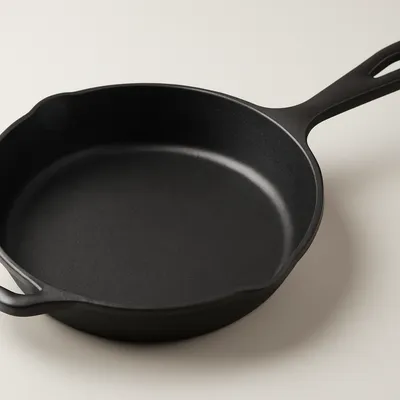
Heat a heavy non-stick or carbon-steel pan over high heat — empty, no oil, no butter. The pan must be hot enough that a drop of water sizzles instantly off (around 220°C).
Watch outGet the dry pan ripping hot before the liver goes in — a flick of water must skitter and vanish at once; any oil and you fry it soft instead of searing a crust.
- 33 min
Lay slabs in the pan — they should hiss loudly. Sear 60-90 seconds — a dark brown crust forms; fat begins to render and pool. Flip with a spatula. Sear the second side 45-60 seconds. Total time in pan: under 3 minutes.
Watch outIt should hiss loudly the second it lands and build a dark crust in 60–90 seconds — keep the whole thing under 3 minutes or the slab melts to a flat puddle.
- 43 min
Lift slabs to warm plates immediately. Pour off rendered fat (save for cooking). Deglaze pan with 80ml Sauternes or Armagnac, reduce to a syrup over high heat — 2 minutes.
Watch outWatch the reduction closely; it can burn quickly if the heat is too high.
- 51 min
Place each slab on a slice of toasted pain de mie or brioche. Spoon the reduction over. Crack pepper, pinch of fleur de sel. Serve immediately — foie gras cools within 90 seconds and the centre stiffens.
Watch outPlate and serve within seconds — foie gras cools in about a minute and a half and the molten center firms up.
Archive tool suggestions — not reviewed
These legacy suggestions have not been evidence-reviewed and are not presented as required tools.