
Fermented cassava root paste wrapped in banana leaves and steamed for 5 hours into a dense, slightly sour, slightly chewy bread-substitute — the universal Congolese starch alongside rice and fufu. The 3-day fermentation gives it a tangy depth that fresh cassava cooking lacks. Eaten with pondu, moambé, fish stew, or any sauce. The Lingala-speaking world's bread substitute and one of Central Africa's oldest preparations.
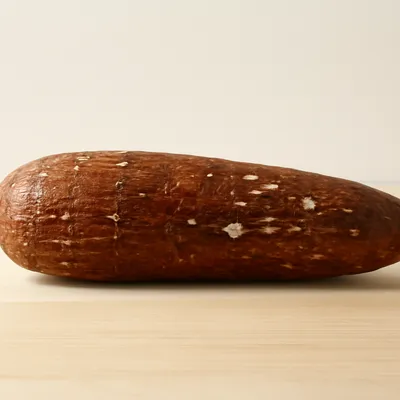

Chikwangue (also called kwanga, chikoangué, or chikwange) is the DRC's pre-colonial cassava-bread substitute, with parallels across Central Africa (Cameroon's bobolo, Gabon's kwanga, Equatorial Guinea's chiwawngue). The 3-day fermentation by lactic-acid bacteria (Lactobacillus species naturally present on cassava) removes residual cyanogens, develops the characteristic sour-tangy flavor, and partially predigests the starch. The dish must be made in batches because of its long preparation; it keeps 1-2 weeks at room temperature, which made it the traveling food of riverside merchants. Chikwangue is sold by women vendors throughout DRC markets, wrapped in colored ribbons indicating origin and price.
Pinch off a piece of chikwangue — it's dense, slightly elastic, slightly tangy. Dip into pondu or moambé sauce; the chikwangue absorbs the rich sauce while contributing its own fermented-cassava sourness. The texture is somewhere between bread and a steamed dumpling — chewable but not rubbery. The 3-day fermentation gives it a yogurty edge that fresh cassava cooking can't match. With Congolese stew alongside, this is the Lingala home-table.
Cassava roots contain cyanogenic glycosides (linamarin) which release hydrogen cyanide on hydrolysis — toxic at high levels. The 3-day soak + ferment activates the cassava's own linamarase enzyme, which breaks down linamarin into glucose + acetone + HCN; the HCN evaporates during the long fermentation and subsequent steaming. Lactobacillus bacteria produce lactic acid, lowering pH and contributing the sour-tangy flavor. Long steaming completes any residual detoxification and sets the starch into the dense bread-like texture.
Variations
Banana-leaf-only chikwangue (no parchment lining) gives more vegetal aroma. Sweet chikwangue adds sugar before steaming — dessert variant. Modern chikwangue uses cassava flour instead of fresh roots — faster (1 day instead of 3), less complex flavor. Diaspora chikwangue uses gari (toasted cassava granules) + water + lactic-acid culture — close approximation. Coastal chikwangue uses palm-wine fermentation instead of natural — distinctly winey.
On the Palate
Where Chikwangue sits in the Congolese flavor cloud
Give the peeled cassava its full 3-day soak-and-ferment before you steam it — that time isn't for flavor alone, it lets the root's own enzyme break down the natural cyanogens so the bread is safe as well as pleasantly sour.
Ingredients
Serves 8How it's made
11 steps · 1 hour 30 min active + 2 days 22 hours 30 min waiting
- 12885 min
Day 1: peel 1.5 kg fresh cassava roots. Cover with water in a deep bowl or bucket. Cover loosely. Soak 2 days at room temperature.
- 21 min
Day 3: cassava will be softened and slightly fermented (you should smell a mild sour aroma). Drain.
Watch outAfter the soak the cassava gives off a mild sour smell and mashes easily — that's fermentation starting, not spoilage.
- 311 min
Mash: in a food processor or with a strong potato masher, mash the soaked cassava into a smooth, sticky paste — like cookie dough.
- 4721 min
Cover the paste; rest 12 hours at room temperature for the fermentation to mature. (Total fermentation: 3 days. Tangy aroma will develop strongly.)
Watch outBy now the tangy aroma should be strong and unmistakable before you shape the paste.
- 56 min
Day 4: knead the fermented paste with hands or wooden spoon 5 minutes — should be smooth and uniform. Add 1 tsp salt; knead to incorporate.
- 67 min
Prep banana leaves: 8-10 large banana leaf squares (30 cm × 30 cm each), passed over open flame 5 seconds each.
- 717 min
Shape: form chikwangue into log shapes (about 15 cm long × 5 cm wide × 5 cm thick). Wrap each log tightly in banana leaves, twisting the ends like a sausage. Tie with kitchen string or banana-leaf strips at both ends and middle.
- 8302 min
Steam: arrange wrapped logs in a large steamer or pot with rack. Add water below. Cover; steam 5 hours, replenishing boiling water as needed.
- 961 min
Cool: remove from steamer; cool to room temperature in their wraps (1 hour). The chikwangue should be firm, dense, and pull cleanly away from the leaves.
Watch outCooled properly, the log is dense and peels away from the leaf in one clean piece.
- 105 min
To serve: unwrap; slice into 2-cm thick rounds. Serve at room temperature alongside pondu, moambé, or any stew. Diners pinch off pieces with their hands and dip into sauce.
- 111 min
Store: wrapped chikwangue keeps 1-2 weeks at room temperature.


