
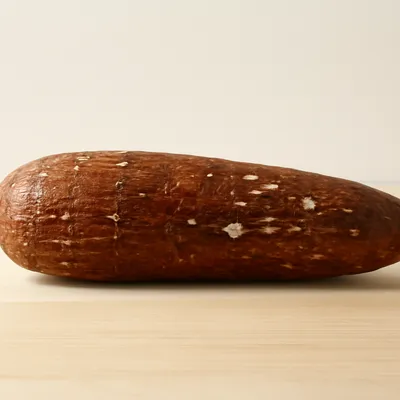


Dumboy is the Liberian boiled-cassava pounded starch, distinct from fufu (which uses fermented dried cassava). The dish is the everyday Liberian starch base, eaten with palm butter soup, cassava leaf, or palaver sauce.
Tear a piece of dumboy — pure white-cream, smooth and silky, slightly sticky-elastic. Bring to your mouth: don't chew, just swallow. Dumboy is denser and slightly stickier than fufu (which uses dried-fermented cassava); the texture is distinctly Liberian. Plain dumboy is mild; it transforms when dipped into palm butter soup — the dense starch absorbs the rich palm oil flavor, becoming an intensely-flavored bite. The right-hand-only eating tradition with dumboy and soup is the universal Liberian meal.
Using FRESH (not dried) cassava is what distinguishes dumboy from fufu. The boiled-then-pounded process develops the characteristic dense, sticky-elastic texture. Hot temperature during pounding is essential — cool dumboy hardens. Modern stand-mixer technique approximates the traditional but doesn't fully replicate the texture.
Variations
Cassava dumboy (most common). Mixed cassava-and-plantain dumboy. Dumboy with palm oil mixed in. The dish has slight variations across Kpelle, Bassa, and Kru kitchens.
On the Palate
Where Dumboy sits in the Liberian flavor cloud
Ingredients
Serves 4How it's made
9 steps · 50 min active + 40 min waiting
- 110 min
Peel 1.5 kg fresh cassava (or substitute with frozen). Cut into 5-cm chunks.
- 238 min
Place in a large pot with cold water to cover. Bring to a boil; cook 30-40 min until completely tender (test with fork — should slide through easily).
Watch outBoil the cassava until a fork slides straight through — any firm core left and it won't pound down smooth, it stays lumpy.
- 34 min
Drain; reserve 1 cup cooking water.
- 45 min
While still hot, place chunks in a wooden mortar (or sturdy bowl). Pound with a wooden pestle in a circular motion.
Watch outPound it while it's piping hot — heat is what keeps it stretchy and workable; let it cool and it stiffens up on you.
- 520 min
Two-person traditional method: one person pounds, another folds the dough between pounds, adding splashes of reserved water as needed.
- 618 min
Continue pounding 15-20 min until the dough is smooth, elastic, and lump-free.
Watch outKeep pounding and folding until it's glossy-smooth and lump-free, splashing in a little water as needed — that elastic pull is the mark of good dumboy.
- 79 min
Modern method: place hot cassava in a stand mixer with dough hook; mix on medium 8-10 min with splashes of water until smooth.
- 83 min
Shape: with a wet spoon, scoop portions into smooth round mounds onto serving plates.
- 95 min
Serve immediately, hot. Eat by tearing off small pieces with the right hand; dip into palm butter soup, cassava leaf stew, or any Liberian soup.


