A cheeseburger crowned with crisp strips of bacon — the default American upgrade, ordered so often it reads less as a variation than as the standard burger's richer twin. A griddled or grilled beef patty, a slice of melting cheese, and two or three planks of rendered bacon stack on a toasted bun with the usual lettuce, tomato, onion, pickle, and a smear of mayo or ketchup. The bacon adds salt, smoke, and a brittle snap the soft patty lacks, and it is the single most common add-on in American burger culture.





The cheeseburger itself is most often credited to Lionel Sternberger, who as a teenage fry cook is said to have laid a slice of American cheese on a frying patty at his father's stand, The Rite Spot, in Pasadena, California, around the mid-1920s — though the claim is contested and several other origin stories circulate. Adding bacon was a natural next step. The bacon cheeseburger is popularly credited to Dale Mulder, who put it on the menu of his A&W franchise in Lansing, Michigan, in 1963 after a regular kept asking for it; earlier menu evidence exists, however, including a 1941 listing from a Harrisburg, Pennsylvania, restaurant, so the dish is best understood as a folk addition that no one person clearly invented.
The contrast of textures is the whole point. The patty is juicy and yielding, the cheese slick and molten, and across the top run shards of bacon that shatter between the teeth with a salty, smoky, faintly sweet hit. Toasted bun gives way to soft beef; the bacon's crunch and the patty's give alternate in every bite. Salt is layered — in the seasoned crust, the cheese, and the cure — so the burger reads bigger and bolder than a plain cheeseburger.
Two browning reactions stack here. The patty develops its savory crust through the Maillard reaction — amino acids and sugars rearranging into hundreds of roast-flavor compounds when the surface hits roughly 150°C (300°F) and above on a hot griddle or grate. The bacon does the same while its own fat renders out and water boils off, which is what turns flabby strips brittle; cook it just past the point where the fat runs clear but before the lean scorches. The cheese melts because heat unwinds its protein network and frees the fat and water it held; a slice laid on the patty during the last minute, ideally under a cover, melts evenly into the crust.
Variations
Cheese is most often American for its smooth melt, but cheddar, Swiss, or pepper-jack all appear; smashed thin or kept thick, single or double, the patty style varies by cook. Bacon may be flat-griddled, oven-baked, or candied with brown sugar; some stack a fried egg on top, others add barbecue sauce, avocado, or fried onions. The constant is bacon plus cheese on a beef patty in a bun.
On the Palate
Where Bacon Cheeseburger sits in the American flavor cloud
Ingredients
Serves 4

How it's made
6 steps · 20 min
- 18 min
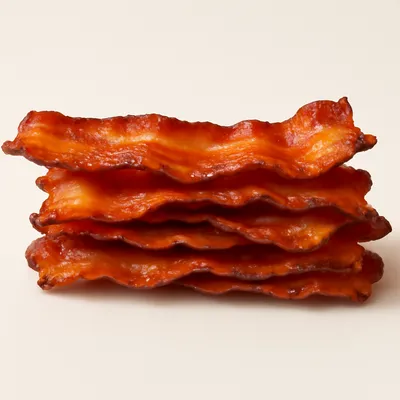
Lay the bacon in a cold skillet or on a sheet pan and cook over medium heat, or bake, until the fat renders and the strips are crisp; drain on paper.
Watch outStart the bacon in a cold pan and cook slowly until the fat runs clear but the lean isn't scorched — that's the window where flabby turns brittle.
- 23 min
Form the ground beef into four patties slightly wider than the buns and season both sides well with salt and pepper.
- 33 min
Sear the patties on a hot griddle or grill until a deep crust forms, then flip.
Watch outDon't move the patty until a deep brown crust forms, then flip once — pressing or flipping early squeezes out the juices and kills the crust.
- 42 min
Lay a slice of cheese on each patty, cover briefly, and cook until the cheese melts and the patty is done to taste.
Watch outLay the cheese on and cover for just the last minute so it melts over the hot patty without the meat overcooking.
- 51 min
Toast the cut faces of the buns on the griddle until golden.
- 61 min
Spread the buns with mayonnaise or ketchup, set a patty on each, top with bacon, lettuce, tomato, onion, and pickle, and close.
Archive tool suggestions — not reviewed
These legacy suggestions have not been evidence-reviewed and are not presented as required tools.