The gold standard of Chinese mooncakes — lotus paste in a signature golden-bronze tender crust that softens to glossy perfection over two days of oil return, born in 1889 Guangzhou.


In 1889 (Guangxu 15th year, 光绪十五年), a pastry shop in Xiguan (西关), the merchant quarter of Guangzhou, began filling pastries with lotus seed paste (莲蓉), creating a refined sweetness unlike anything then available. The shop later renamed itself Lianxianglou (莲香楼), which remains one of Guangzhou's most iconic establishments today. During the Republican era, old-name teahouses Tao Tao Ju (陶陶居) and Guangzhou Restaurant (广州酒家) made mooncakes a prestige product; using Guangzhou's open-treaty-port commercial networks, Cantonese mooncakes spread nationally and eventually displaced the older Suzhou-style (苏式月饼) as China's dominant mooncake style. Today, the finest lotus paste comes from Xiangtan, Hunan, and the salted egg yolks from Gaoyou, Jiangsu.
The crust yields with barely any resistance, almost dissolving — not flaky, not chewy, but something in between, softened and oiled by two days of rest. Inside, the lotus paste is smooth, subtly fragrant, and not too sweet; the sandy, saline yolk at the center is the payoff.
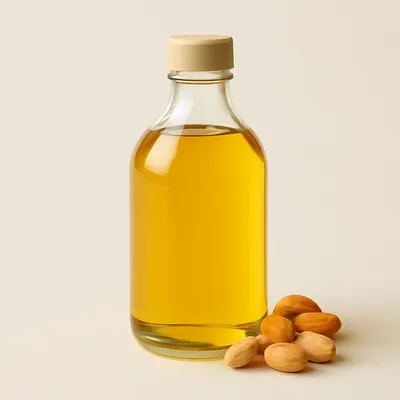
The syrup crust consists of flour, inverted sugar syrup (78–82% concentration), lye water (枧水, a solution of potassium and sodium carbonate, pH ~10–12), and peanut oil. The lye water neutralizes residual acidity in the syrup and raises the crust pH to 6.5–7.8, accelerating Maillard browning during baking to produce the characteristic golden-bronze color. Fructose and glucose (from the inverted syrup) are more hygroscopic than sucrose, preventing the crust from hardening during storage. After baking, the high fat content in the lotus paste (from added oil during making) migrates through the thin crust over 1–2 days — the 'oil return' (回油) process — plasticizing the gluten network and transforming the crust from slightly firm to soft, glossy, and pliable.
Variations
Traditional fillings: pure lotus paste (纯莲蓉), red lotus (红莲蓉), five-nut (五仁). Contemporary: custard (奶黄), durian (榴莲蓉), snow-skin (冰皮, no-bake glutinous rice wrapper). The optimal skin-to-filling ratio is 2:8 — a thicker crust is considered inferior in the Cantonese tradition.
On the Palate
Where Cantonese Mooncake sits in the Chinese flavor cloud
Ingredients
Serves 8How it's made
8 steps · 1 day 2 hours
- 160 min
Mix inverted sugar syrup, lye water, and peanut oil until combined; sift in flour and fold gently until a soft dough forms. Cover; rest at room temperature for 1 hour — this step is essential for gluten relaxation and even oil absorption.
- 215 min
If using salted egg yolks, bake at 180°C for 5 minutes until barely set; cool. Divide lotus paste into 50g portions; wrap a yolk in the center of each and seal. Divide rested dough into 20g portions.
- 310 min
Flatten each dough piece between palms into a thin disc. Place a lotus-paste ball in the center; wrap the pastry up and around, pressing steadily to ensure full coverage with no gaps.
Watch outWrap so the paste is even all around with no gaps — a bare patch or air pocket cracks and leaks lotus paste in the oven.
- 410 min
Roll each filled ball smooth; dust lightly with flour. Press firmly into a mooncake mold; release onto a lined baking tray.
- 57 min
Preheat oven to 200°C. Mist the mooncakes lightly with water; bake 5 minutes to set the pattern and dry the surface.
- 617 min
Remove; brush a very thin layer of egg wash (yolk + small amount of water). Return to oven at 180°C; bake 12–15 minutes until deeply golden-bronze.
Watch outBrush the egg wash whisper-thin — a heavy coat pools in the pattern and blurs the mold's carving to mush.
- 7120 min
Cool completely on a wire rack for at least 2 hours before packaging.
- 81440 min
Store in an airtight container at room temperature for 1–2 days; the 'oil return' (回油) process will soften and gloss the crust to its ideal texture before serving.
Watch outGive it a day or two to 'return oil' — straight from the oven the crust is stiff; it softens and turns glossy on resting, and only then is it right.
Archive tool suggestions — not reviewed
These legacy suggestions have not been evidence-reviewed and are not presented as required tools.

