A year-round Shanghai savoury pastry: dozens of flaky, laminated Suzhou-style pastry layers encasing a juicy ball of seasoned fresh pork, best eaten hot from the oven when the shell still shatters and the pork juices run.





Fresh meat mooncakes belong to the su-style mooncake tradition, a pastry lineage that traces to Tang and Song dynasty cake culture. The Qing dynasty household manual Zhong Kui Lu by Zeng Yi documented the water-oil-skin lamination technique (shui you pi bao you su, fan fu zhe die) in terms essentially identical to those used by Shanghai pastry cooks today. The Jiangnan region produced both sweet and savoury su-style variants, but the specifically Shanghainese habit of selling fresh-meat mooncakes year-round — rather than reserving them for the Mid-Autumn Festival — was a twentieth-century development as city bakeries standardised and mass-produced the form. Guangming Cun restaurant and Xin Ya teahouse became famous for seasonal queues stretching into the street; the mooncake is now formally recognised as a representative Shanghai local specialty food.
The pastry shatters audibly on first contact, its dozens of pale-golden layers peeling outward like pages of a book — the outermost bone-dry and crumbly, the innermost softened by pork juices that have seeped in during baking. Then the meat: dense, savoury-sweet, slightly springy, with a trailing perfume of sesame and ginger that lingers after the pastry has dissolved.
Suzhou-style laminated pastry uses two doughs with opposing properties: a water-oil skin (flour, lard, water) whose gluten network can stretch without tearing, and an oil paste (flour, lard, no water) that is essentially hydrophobic. Encasing the oil paste inside the skin and rolling-and-folding the combined dough repeatedly creates hundreds of alternating gluten layers and fat barriers. In the oven, moisture in the gluten layers vaporizes and expands, but the fat barriers prevent adjacent sheets from fusing — each layer puffs independently, producing the thousand-layer separation. The pork filling's collagen-rich juices seep outward only as far as the innermost pastry sheets, creating a gradient from bone-dry and crumbly at the surface to moist and tender at the core.
Variations
Premium variants add shrimp roe or crab-roe powder to the filling; some old-style bakeries blend in crumbled salted egg yolk for depth. A pan-fried version is common at home when no oven is available. Vegetarian adaptations substitute diced shiitake mushroom and bamboo shoot. The same laminated shell is used for sweet su-style mooncakes filled with red bean, lotus paste, or matcha bean.
On the Palate
Where Fresh Pork Meat Mooncake sits in the Chinese flavor cloud
Ingredients
Serves 6


How it's made
8 steps · 1 hour
- 125 min
Make water-oil dough: combine 120g flour, 30g lard, and 60ml warm water; knead until smooth and slightly elastic. Make oil paste: mix 80g flour with 50g lard until a cohesive dough forms. Cover both and rest 20 minutes.
- 225 min
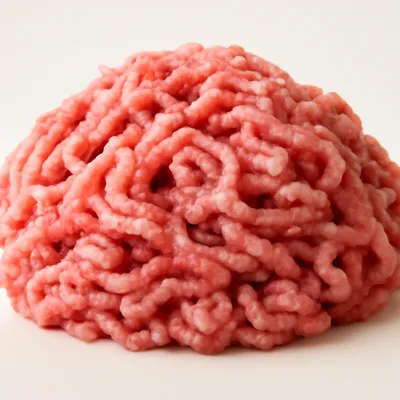
Season 250g ground pork with soy sauce, Shaoxing wine, grated ginger, salt, sugar, sesame oil, and white pepper; stir vigorously in one direction until the mixture becomes tacky and springs back slightly. Chill for 20 minutes.
Watch outStir the pork one direction until it turns tacky and springs back — that bound, springy filling stays juicy; a loose mix weeps and goes dry.
- 35 min
Divide the water-oil dough into 6 equal portions and the oil paste into 6 equal portions. Flatten one water-oil portion into a disc and wrap one oil-paste portion inside, pinching the seam completely shut.
- 48 min
Roll the wrapped parcel into a long oval; roll it up tightly from one short end like a swiss roll. Rotate 90° and roll out again into a long oval; roll it up once more. This double-roll builds the layered structure inside.
- 55 min
Press each double-rolled cylinder gently flat, then roll into a round disc about 10cm across. Place a ball of chilled pork filling in the centre, pleat the pastry edges upward to seal, and place seam-side down.
- 62 min
Brush the tops with beaten egg yolk; arrange seam-side down on a parchment-lined baking tray.
- 724 min
Bake in a preheated 200°C oven for 22–25 minutes until deeply golden and the pastry layers visibly separate and fan outward.
Watch outBake at 200°C until the pastry layers visibly fan apart and the top is deep gold — pull it while pale and the flake never sets, staying doughy.
- 83 min
Cool on a rack for 3 minutes before eating — the pork filling reaches dangerously high temperatures straight from the oven.
Archive tool suggestions — not reviewed
These legacy suggestions have not been evidence-reviewed and are not presented as required tools.


