


From the Lorraine region of northeastern France, near the German border — the word 'quiche' comes from the German Kuchen ('cake'). First written reference dates to the 16th century in Nancy. The original was a bread-dough crust filled with eggs, cream, and smoked bacon (lardons fumés); short-crust pastry came in the 19th century, and cheese was a Parisian addition that purists in Lorraine still resist.
Lorraine farm-kitchen savory tart — originally just bread dough, eggs, cream, and lardons. Cheese is a 20th-century addition that purists in Metz still resist. The custard must just-set; over-baked quiche is rubber.
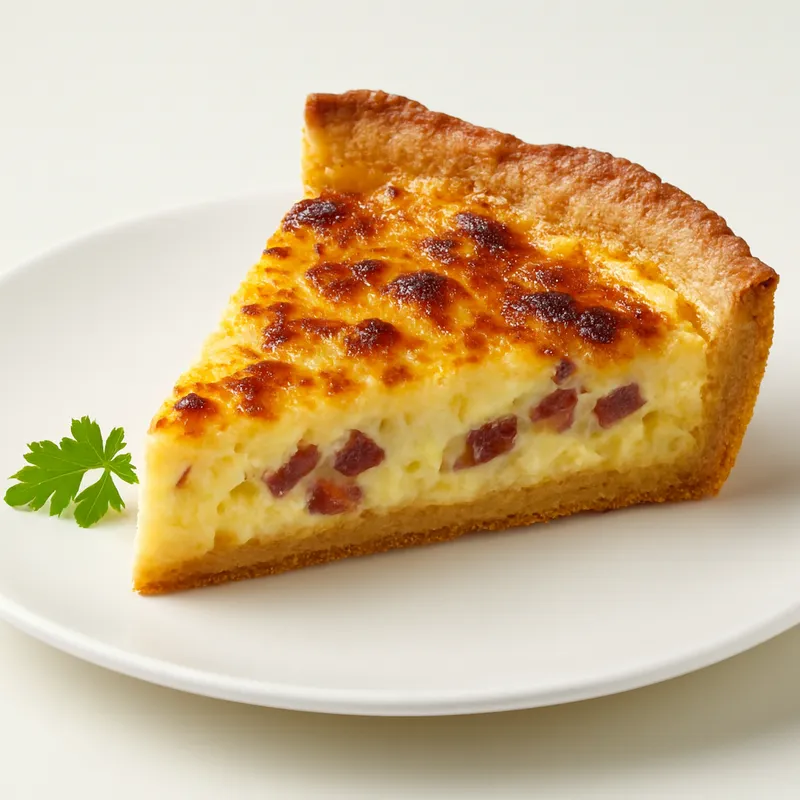
A short-pastry shell holding a pale-yellow custard set with smoked lardons. Cut: filling jiggles slightly, doesn't pour. The texture is custard, not cake — eggs and cream only, no flour in the filling. The original Lorraine quiche has no cheese; the Gruyère version is a 20th-century Parisian variant. Eat warm with a green salad and acidic dressing to cut the fat.
Blind-bake the crust until fully cooked before adding filling — wet custard against raw dough makes the bottom soggy. The custard ratio is one egg per 100 ml of dairy (heavy cream, or cream-milk mix); too many eggs sets it like an omelet, too much cream and it won't set at all. Bake at 160–170°C until the center barely jiggles; carryover heat finishes it on the rack.
Variations
Quiche Lorraine (lardons, no cheese — purist); Quiche au fromage (with Gruyère, modern); Quiche Alsacienne (with onions); Quiche Vosgienne (with potatoes); Quiche aux poireaux (leeks, the Burgundy take).
On the Palate
Where Quiche Lorraine sits in the French flavor cloud
Everything rests on a fully blind-baked shell plus a loose custard: bake the crust dry and set before it ever meets liquid, and hold the ratio near one egg per 100 ml of dairy so it sets like silk, not rubber — wet custard on raw dough gives you a soggy bottom every time.
Ingredients



How it's made
5 steps · 1 hour 5 min active + 30 min waiting
- 15 min
Roll out the pastry on a lightly floured surface and line a tart tin, trimming any excess. Prick the base with a fork and chill in the refrigerator for 30 minutes.
- 220 min
Preheat the oven to 375°F (190°C). Blind bake the pastry by lining it with parchment paper and filling with baking beans. Bake until the edges are golden, about 15 minutes. Remove the beans and paper, and bake for another 5 minutes until the base is dry.
Watch outThe blind bake is done when the rim is set golden and, after the beans come out, the base looks dry and matte rather than damp and shiny.
- 310 min
In a skillet, cook the bacon until crisp. Remove and drain on paper towels. In the same skillet, sauté the onions until soft and translucent.
Watch outRender the bacon until crisp and the onions until soft and translucent with no raw bite — wet, undercooked aromatics weep into the custard.
- 45 min
In a bowl, whisk together the eggs and cream until smooth. Stir in the cheese, cooked bacon, and onions. Pour the mixture into the prepared pastry shell.
Watch outMix thoroughly to ensure the eggs and cream are fully combined for a smooth filling.
- 525 min
Bake the quiche in the oven until the filling is set and lightly golden on top, about 25 minutes. The quiche should be slightly wobbly in the center when done.
Watch outPull it when the outer filling is set but the very center still wobbles like soft jelly; a fully firm middle means it's already overbaked.
Archive tool suggestions — not reviewed
These legacy suggestions have not been evidence-reviewed and are not presented as required tools.