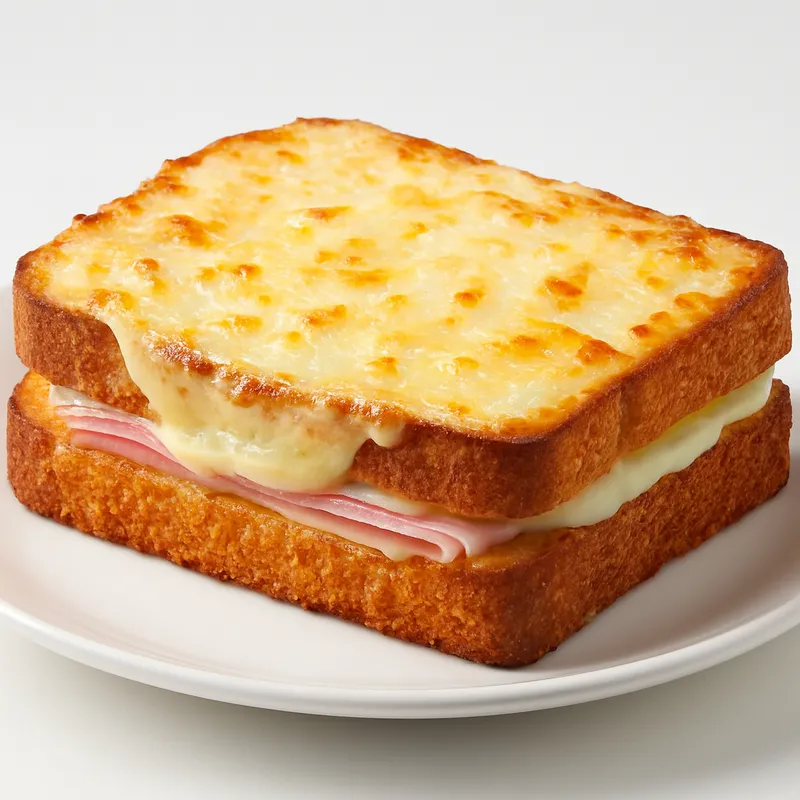
This toasted ham and cheese sandwich, oozing with béchamel and Gruyere, is the epitome of Parisian café indulgence.





Popularly said to have been created around 1910 at the Le Bel Âge café on the Boulevard des Capucines in Paris, though the dish predates this — it appears in print earlier, including an 1891 mention in La Revue Athlétique. The name ("Mister Crunch") was café slang. The dish was a quick savory snack for between-meal hours, designed to use day-old pain de mie and the kitchen's standing béchamel. Proust mentions it in À l'ombre des jeunes filles en fleurs (1918), confirming its café status by then.
First on a Paris café menu in 1910 at Le Bel Âge on the Boulevard des Capucines; Proust mentioned it in 1918's À l'ombre des jeunes filles en fleurs. Béchamel is the trick — without it, it's just grilled cheese.
Two slices of pain de mie pressed around ham and Gruyère, the whole thing capped with béchamel and more grated Gruyère, then broiled until the top is brown and bubbling. The béchamel keeps the inside molten; the bread underneath turns dark and butter-fried on the bottom. Add a fried egg on top and it becomes a Croque-Madame.
Béchamel is the trick. Without it, the sandwich is just grilled cheese with ham; with it, you get the gratin top and an internal sauce that keeps the cheese from going stringy. Use Gruyère, not Emmental — Gruyère browns; Emmental melts but stays pale. Butter both outer faces of the bread before pan-toasting, then finish under the broiler so the top crusts before the inside dries.
Variations
Croque-madame adds a fried egg on top; croque-provençal swaps tomato for ham; croque-norvégien (smoked salmon, dill, crème fraîche) is the late-20th-century Paris brasserie variation.
On the Palate
Where Croque-Monsieur sits in the French flavor cloud
Ingredients



How it's made
4 steps · 28 min
- 15 min
Preheat your oven to 400°F. Spread butter evenly on one side of each bread slice. Arrange the slices, buttered side down, on a baking sheet.
- 28 min
In a small saucepan, melt butter over medium heat. Stir in wheat flour to form a roux, cooking for about 2 minutes until it turns a pale golden color. Gradually whisk in milk, bringing the mixture to a simmer until it thickens.
Watch outThe roux should be pale gold and smell nutty after about 2 minutes — pull it before it darkens.
- 35 min
Season the béchamel with nutmeg and black pepper, then spread a thin layer over the unbuttered side of each bread slice. Layer ham and a touch more béchamel on half of the slices, then top with the remaining slices, béchamel side down.
Watch outSpread the béchamel thin — a heavy layer steams the bread soft instead of letting it crisp.
- 410 min
Bake in the oven for 10 minutes until the bread is golden and the cheese inside is melted. Serve hot, optionally garnished with a touch of Dijon mustard on the side.
Watch outPull it when the top is golden and blistered and the cheese is molten — a minute under the broiler finishes the crust.
Archive tool suggestions — not reviewed
These legacy suggestions have not been evidence-reviewed and are not presented as required tools.

Flat rectangular metal pan (sheet pan, half-sheet, quarter-sheet), 33×23 cm to 45×33 cm, with a low rim. The flat surface gives even heat for cookies, biscuits, roasted vegetables, sheet-pan dinners. Heavy aluminum sheets conduct heat fastest; non-stick coatings make cleanup easier but can warp over 200°C; rimmed half-sheet is the modern American restaurant standard.

Hand-held wire loop tool for beating eggs, whipping cream, emulsifying dressings, and incorporating air into batters. Balloon whisks (large round head) for whipping cream and meringues; French whisks (narrow tear-drop) for sauces in pots; flat whisks (gravy) for pan sauces. Stainless steel is universal; silicone-coated for non-stick pans.

Round metal pot, 14-26 cm diameter, with vertical walls and a long handle, designed for sauces, soups, oatmeal, rice, boiled vegetables. The vertical walls minimize evaporation (vs. a sauté pan). Sizes: 1 qt for melting butter, 2-3 qt for sauces, 4 qt for soups. Stainless-steel-clad aluminum or copper is best for conduction; cast-iron is too thick for delicate sauces.