
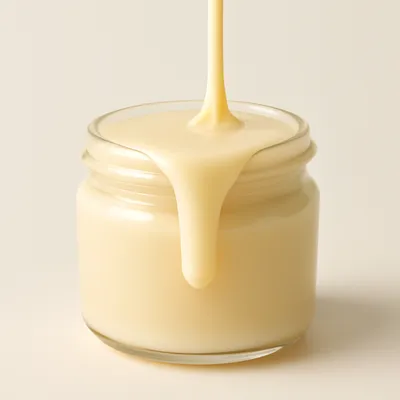




Scottish tablet is one of the oldest recorded confections of Scotland, first noted in the Household Book of Lady Grisell Baillie, begun in 1692, where it appears as a sweet made from sugar, cream and butter boiled together. In its earliest form tablet was a smooth, hard confection of cream and sugar, but the modern grainier version emerged in the early 20th century with the widespread use of sweetened condensed milk, which gave the tablet its characteristic pale colour, milky sweetness and crumbly, grainy texture. Tablet is distinct from fudge and toffee, its texture is deliberately granular and crumbly, the result of beating the cooling sugar mixture to crystallise it into fine grains rather than leaving it smooth. The recipe is notoriously finicky, the sugar must be boiled to soft-ball stage, condensed milk added, then the whole beaten off the heat until it thickens and turns matte, a moment easy to miss. Tablet is a fixture of Scottish home baking, tearooms and Hogmanay, the Scottish New Year, and is sold in every tourist shop in the country, often flavoured with whisky.
A small pale square that crumbles and melts on the tongue into sweet, buttery, milky grit, intensely sugary with a faint burnt edge. Eaten in tiny pieces with a cup of tea; very moreish and very sweet.
The texture of tablet depends on controlled crystallisation. Sugar, butter and a little milk are boiled to the soft-ball stage, around 115 degrees C, then condensed milk is added and the mixture boiled again briefly. The crucial step is beating: off the heat, the mixture is stirred vigorously as it cools, which forces the sugar to crystallise into countless tiny grains rather than setting smooth, this is what gives tablet its characteristic grainy, crumbly, melt-in-the-mouth texture, distinct from the smooth chew of fudge or the brittle snap of toffee. Beating too little leaves the tablet smooth and chewy, beating too late or pouring into the tin too soon makes it gritty and stony. The mixture is poured into a lined tin just as it thickens and turns matte, then left to set fully before cutting. The condensed milk, a 20th-century addition, is what gives the modern tablet its pale colour and creamy flavour compared with the dark original.
Variations
Whisky is the classic flavouring, a spoon stirred in before setting. Vanilla, crystallised ginger or chopped nuts are folded through. A darker version uses golden syrup or brown sugar.
On the Palate
Where Scottish Tablet sits in the British flavor cloud
Ingredients
Serves 24How it's made
7 steps · 15 min
- 13 min
Grease and line a 20cm square tin; have a whisk or wooden spoon ready.
- 25 min
Put 900g caster sugar, 100g unsalted butter, a 397g tin of condensed milk and 100ml milk into a large heavy-based pan; heat gently, stirring, until the sugar has fully dissolved.
- 38 min
Bring to the boil and boil steadily, stirring often, until the mixture reaches 115 degrees C on a sugar thermometer, the soft-ball stage.
Watch outBoil to exactly the soft-ball stage, around one hundred fifteen degrees — undershoot and it never sets, overshoot and it turns hard and brittle.
- 43 min
Off the heat, add a pinch of salt and a few drops of vanilla (and a tablespoon of whisky if using).
- 58 min
Beat vigorously with the spoon for 5 to 10 minutes as the mixture thickens, turns matte and loses its gloss; stop as soon as it starts to set.
Watch outBeat off the heat until it thickens, turns matte and loses its shine, then stop — too little beating stays fudgy-smooth, too much sets in the pan before you can pour.
- 65 min
Pour quickly into the lined tin, smooth the top, and leave to set firm for 2 hours.
- 73 min
Cut into small squares with a sharp knife; store in an airtight tin.
Archive tool suggestions — not reviewed
These legacy suggestions have not been evidence-reviewed and are not presented as required tools.



