
The original French confiserie praline is a whole almond — sometimes a hazelnut — coated in cooked, crystallised, caramelised sugar, leaving a crunchy brown crust around the toasted nut. The nuts are heated in sugar syrup that is stirred until it 'sands' into a dry, sandy crust, then partly re-melts to caramel. It is the ancestor of praliné, the ground praline paste used throughout French pâtisserie and chocolate work. It should not be confused with the Lyonnais 'pralines roses', the pink sugar-coated almonds baked into tarts and brioche.
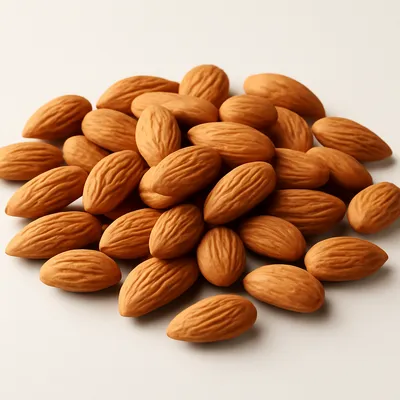



The much-repeated origin credits the praline to the household of César, duc de Choiseul, comte du Plessis-Praslin (1598–1675): in 1636 his officier de bouche — usually named as Clément Jaluzot, though some accounts give the cook's name differently — is said to have caramelised roasted almonds in sugar, and the sweet later took the count's name. He went on to sell the 'praslines' in Montargis, south of Paris, where the shop traded under the sign 'Au Duc de Praslin'. The documented anchor is the Montargis confiserie itself: in 1903 Léon Mazet bought the recipe and established Maison de la Prasline Mazet, which still makes the praslines of Montargis to a recipe transmitted orally until Mazet wrote it down around 1920. The duke-and-cook story is best treated as a famous attribution rather than established fact; the name later gave French 'praliné' (the ground paste) and 'pralin'.
First the hard caramel crust cracks under the teeth — a brittle, glassy shatter — giving way to the dense crunch of the toasted almond inside. The flavour is deeply sweet and frankly caramelised, edged with the roasted, faintly bitter note of the nut and a whisper of its oil. The crust is rough and matte where the sugar sanded, not the smooth glaze of a dragée.
The crust is built by deliberately crystallising sugar — the technique called sablage. Nuts are heated in a sugar syrup that is stirred as it concentrates; at the right point the sucrose seizes and recrystallises around each nut, turning dry, white and sandy ('sablé', like sand). Continued heat then partly re-melts that sanded coating into caramel, so the finished crust is a crystalline-caramel shell rather than a clear glaze — rough, opaque and crunchy. Stirring is the whole game: agitation seeds the crystals that give the sandy texture, where leaving the syrup still would instead carry it smoothly up to a clear caramel. The almonds are usually pre-roasted, which develops their flavour and drives off moisture so the crust adheres and stays crisp.
Variations
The pralines roses are a distinct Lyonnais sweet — almonds coated in bright pink sugar — and are themselves baked into the Lyon praline tart and into brioche aux pralines, so the two should not be confused. The praline can be made with almonds or hazelnuts, and when the caramelised nuts are ground to a smooth paste they become praliné, the base for countless pâtisserie and chocolate fillings. Note too that in Belgium and the Aachen region 'praline' usually means a filled chocolate bonbon — a quite different confection from the French caramelised nut.
On the Palate
Where Praline sits in the French flavor cloud
Ingredients
Serves 8How it's made
7 steps · 30 min
- 110 min
Roast the almonds in a moderate oven until fragrant and lightly coloured, then keep them warm.
- 26 min
Combine the sugar with the water in a heavy or copper pan and heat to a syrup of around 116–120°C.
- 32 min
Tip in the warm almonds all at once and stir off the heat: the syrup will turn dry, white and sandy as the sugar recrystallises around the nuts.
Watch outOff the heat, stir the syrup hard until it turns dry, white and sandy round each nut — that grittiness is the sablage; a still syrup just glazes clear instead.
- 46 min
Return to a low heat and keep stirring as the sanded sugar slowly re-melts and begins to caramelise into a brown crust.
Watch outBack on low heat, keep stirring as the sanded sugar re-melts to a brown caramel crust — walk away and it burns fast.
- 51 min
Add a small knob of butter or a drop of oil if liked, to help separate the nuts and gloss the crust.
- 63 min
Tip the coated almonds onto an oiled tray or marble and quickly separate them with two forks before they cool.
- 720 min
Leave to cool and harden completely, then store airtight away from humidity.
Archive tool suggestions — not reviewed
These legacy suggestions have not been evidence-reviewed and are not presented as required tools.



