In Practice
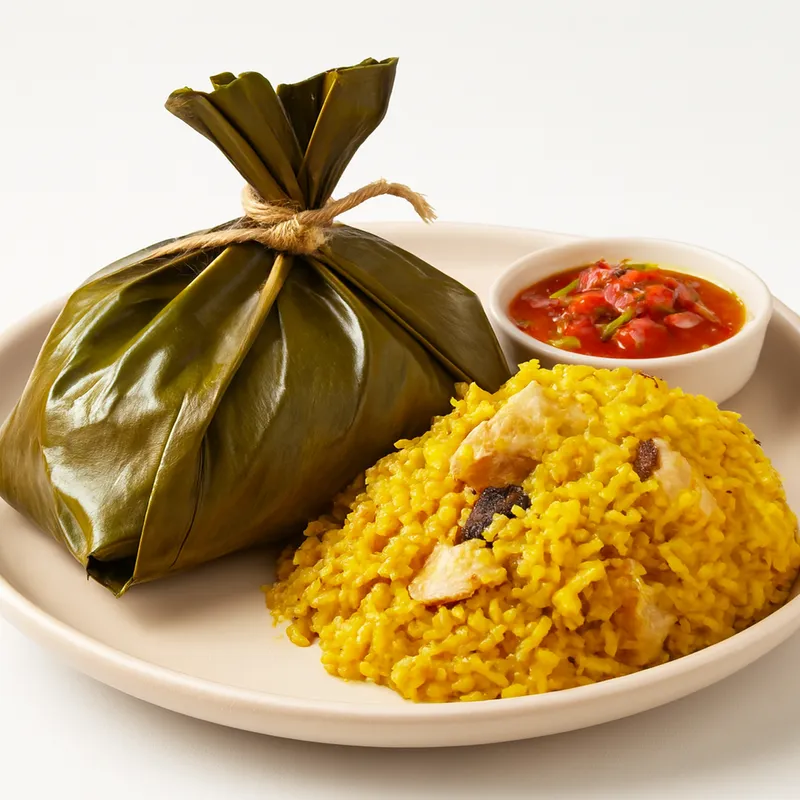
Select leaves 30-40cm long, deep green with no yellowing — older leaves tear, very young ones lack aromatic load. Pass each leaf 2-3 seconds per side over open flame until the surface glosses and turns slightly olive. Brush off ash, lay shiny-side-in, fill with seasoned rice/fish/meat (juane: rice, chicken, olives, egg), fold envelope-style and tie with leaf fiber or palm strips. Steam or simmer 45-90 minutes depending on contents. Failure mode: skipping the flame pass leaves leaves brittle — they crack along the midrib and leak.
Background
Emerging from the dense rainforests of the Peruvian Amazon, the technique of using bijao leaves for cooking can be traced back to the indigenous tribes of the region. The practice began centuries ago, as the lush environment provided an abundant supply of bijao, whose large, sturdy leaves were perfect for wrapping and cooking food over open fires or buried in hot coals. In a land where resources were closely tied to the environment, this method was not just practical but deeply cultural, a binding thread in community feasts and daily meals.
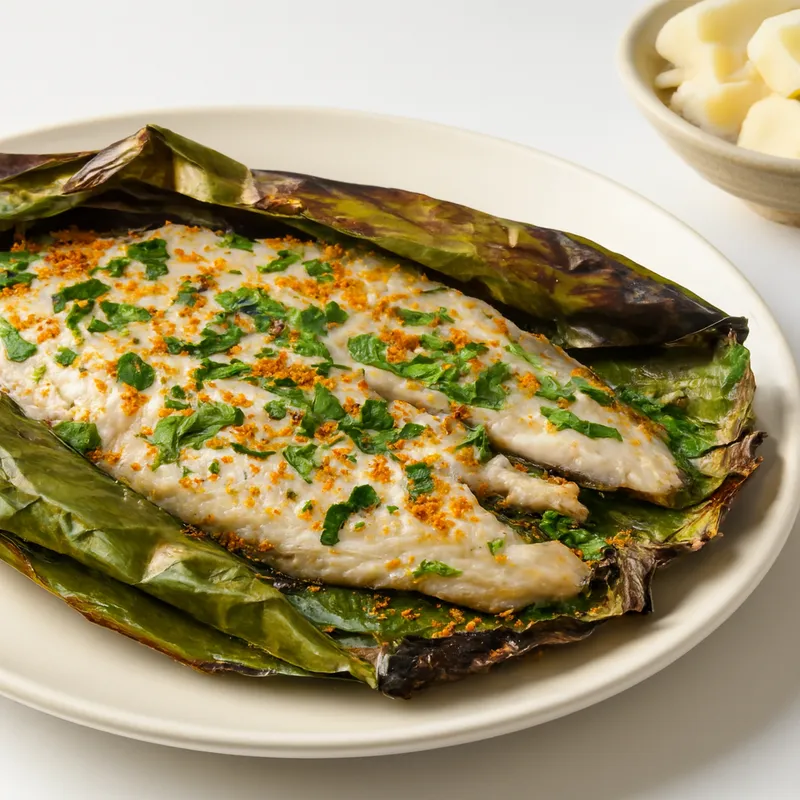
As the Spanish colonized Peru in the 16th century, they encountered this technique and adapted it to their own culinary repertoire. While similar methods like banana leaf wrapping exist in other tropical regions, bijao leaves impart a unique flavor profile distinctive to the Amazon. Today, dishes such as Juane and Patarashca showcase the essence of this approach, with bijao-leaf wraps becoming synonymous with Amazonian cuisine.
How It Works
Calathea lutea leaves are 0.2-0.4mm thick with a waxy abaxial cuticle. Flame-passing at 200-300°C softens the lignin and ruptures surface oil glands, releasing terpene aromatics — cineole and limonene-relatives — that bond to fat in the parcel. The closed wrap traps steam at ~100°C, while the cuticle keeps soluble flavor compounds inside; the leaf itself donates herbal-green notes to whatever sits against it.
Through Time
Pre-Columbian Amazonian practice; the Shipibo-Conibo and Cocama peoples of the Ucayali basin used Calathea wraps as both cooking vessel and traveler's portable meal. Recorded in 17th-century Jesuit chronicles (Padre Manuel Biedma's accounts). Modern documentation through Pedro Miguel Schiaffino's Malabar in Lima (opened 2004) brought juane-craft into the Peruvian high-cuisine canon; chef Virgilio Martinez's Mater Iniciativa research codifies regional leaf varieties.
Related cooking knowledge
Banana-leaf cooking (Mexican tamales, Indian patrani machhi, Indonesian pepes) shares the steam-vessel + aromatic-donor logic with a different leaf chemistry. Lotus-leaf lo mai gai uses the same principle for sticky rice. Hoja santa and corn-husk tamales are smaller-scale Mesoamerican parallels.