In Practice
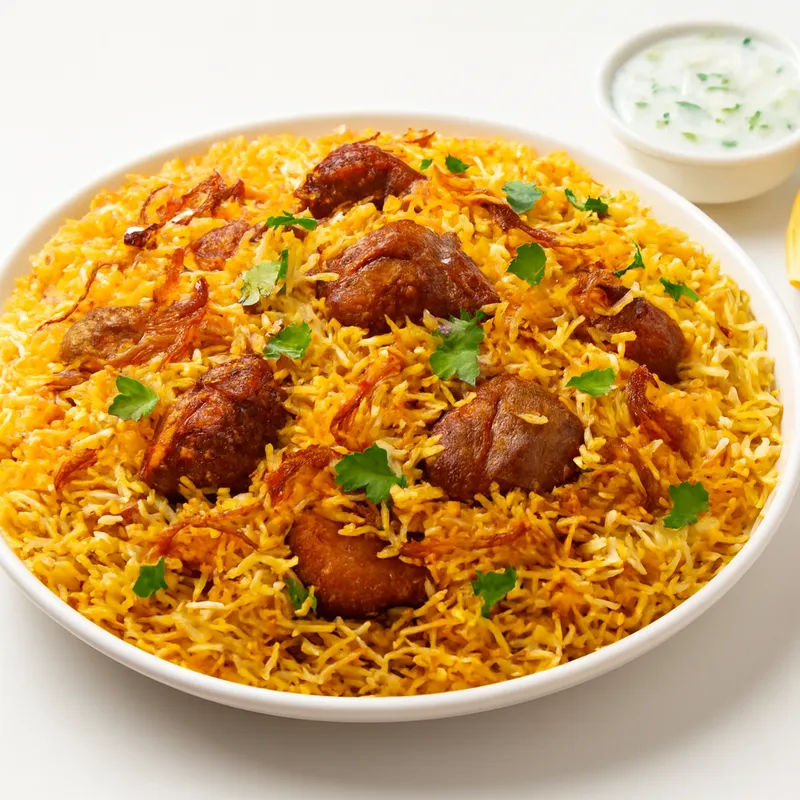
Layer parcooked rice (70% done) over marinated meat in alternating tiers with saffron milk and ghee. Dough seal (atta + water) rolled into rope and pressed around the rim. Bottom heat 220°C for 5 min to build initial steam, drop to 90°C and add coals on lid for 30-45 min. Open at the table — releases trapped aroma. Failure modes: imperfect dough seal lets steam escape and rice steams unevenly; too much liquid in base scorches the bottom layer (a tradition in Sindhi biryani, a flaw elsewhere).
Background
Dum cooking traces its roots back to the 16th century in the kitchens of the Mughal Empire, where the opulence of the court necessitated a cooking style that was both elaborate and efficient. The unique technique of slow-cooking under pressure allowed for the infusion of rich flavors without the constant supervision required by open flames. This method thrived in the royal kitchens of North India, where the abundance of spices and ingredients called for a cooking process that could do justice to their complexity.
Over time, dum cooking spread beyond the opulent courts to the homes of the common people, adapting to regional tastes and available ingredients. In Lucknow, the technique became synonymous with the delicate flavors of Awadhi cuisine, while in Hyderabad, it merged with local spices to create the iconic Hyderabadi Biryani. Each region added its own flair, but the core principle of sealing and slow-cooking remained constant, preserving the integrity and depth of flavor that dum is celebrated for.
How It Works
A heavy-bottomed pot (degh) is sealed with dough (purdah) to trap aromatic-laden steam; live coals placed on the convex lid mimic an enclosed oven. Internal temperature climbs to 95-105°C with slight positive pressure as moisture evaporates. Volatile aromatics — terpenes from cardamom, eugenol from cloves, rosewater esters — saturate the rice and meat layers rather than escaping. Rice grains absorb fat-soluble compounds during the steam phase.




Through Time
Mughal court cuisine of 16th-17th-century Delhi and Lucknow; Awadhi chefs perfected pukki biryani in nawab Asaf-ud-Daula's kitchens c. 1780. The *Khwan-i-Niamat* manuscript records dum techniques. Madhur Jaffrey's *An Invitation to Indian Cooking* (1973) introduced dum to Western audiences; Pratibha Karan's *Biryani* (2009) is the modern canonical text.
Related cooking knowledge
Tandoor is the sibling Mughal-era technology — dum's enclosed steam contrasts with tandoor's radiant char. Tagine encloses similar steam in a clay-cone vessel. Pachamanca uses earth instead of dough as the seal. Steaming is the parent mechanism without the aromatic infusion layer.