A mild red chili of the Basque Country, dried and ground to a deep-red powder or sold whole on cords, with a fruity, smoky warmth rather than sharp heat. The only chili authorized in appellation-controlled French cuisine, it is the signature spice of the ten communes around the village of Espelette.
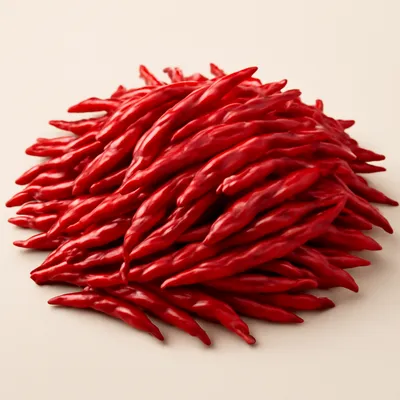


The Espelette pepper is a Capsicum annuum cultivar introduced to the Basque Country in the sixteenth century, traditionally said to have been brought back from the Americas — Mexico in particular — and at first used medicinally before becoming a culinary staple by the seventeenth century. The product earned its Appellation d'Origine Controlee in 2000 and was registered as a European Protected Designation of Origin in 2002; the appellation zone is restricted to ten communes around the village of Espelette, in the Pyrenees-Atlantiques. The cultivar grown is the Gorria variety of Capsicum annuum. With a heat of roughly fifteen hundred to twenty-five hundred Scoville units, it counts as mild-to-medium, prized for its fruity aroma rather than its pungency — and as the only chili traditionally cultivated as a spice in mainland France to hold such an appellation, it holds a singular place in the country's regulated pantry.
Espelette pepper is deep brick-red, with a warm, fruity, slightly smoky aroma and a gentle heat that builds slowly and never peaks sharply. On the tongue it is rounded and almost sweet, with none of the sharp capsicum burn of hotter chilies. The whole dried cords and the ground powder taste notably different — the cords mellow and woody, the powder brighter and more concentrated — but both carry the same recognizable Basque fragrance.
Espelette pepper is processed by sun-drying, which concentrates both its pigments and its aromatics. Fresh peppers are hand-harvested from August onward, strung into long cords — the brott or kordok — and hung in the sun against farmhouse facades for roughly fifteen days; some modern producers finish in temperature-controlled ovens. Drying reduces the moisture to roughly ten percent, which prevents mold growth while preserving the volatile aromatic compounds — the carotenoid pigments that give the deep red color and the capsaicinoids that carry the heat. The slow drying is what allows the fruity, smoky character to develop; fast oven-drying at high temperature, by contrast, drives off the volatiles and leaves a flatter flavor. Once dried to the right point, the peppers are oven-finished and ground to the powder sold in the characteristic flat tins.
Variations
Sold as whole dried cords, ground powder, or as a paste; in Basque cooking it seasons piperade, axoa, cured meats, egg dishes, and fish, and is sometimes rubbed onto Bayonne ham in artisanal curing.
On the Palate
Where Piment d'Espelette sits in the French flavor cloud
Ingredients
Serves 20How it's made
6 steps · 15 min
- 15 min
Harvest ripe red Espelette peppers from the Gorria cultivar.
- 25 min
String them into long cords and hang in the sun against a south-facing wall for about fifteen days.
Watch outHang the strung peppers in full sun on a south wall about 15 days — slow drying to ~10 percent moisture is what saves the color and aroma; rushed heat dulls both.
- 35 min
Turn and inspect regularly, discarding any that spoil.
Watch outTurn and inspect regularly, tossing any that spoil — one moldy pod will taint the whole cord.
- 420 min
Finish the drying in a low oven until fully dry and brittle.
- 515 min
Stem and seed the dried peppers, then grind to a fine deep-red powder.
- 65 min
Store the powder airtight, or leave whole peppers on their cords for slower use.


