The French refinement of mashed potato: high-starch potatoes steamed or boiled dry, passed through a ricer for a perfectly smooth base, then enriched by emulsifying a remarkable quantity of cold butter into the hot potato and loosening with warm milk. Silky, glossy, and almost pourable, it is the side dish against which other mashed potatoes are measured.
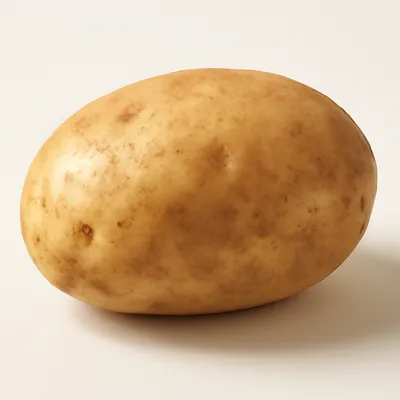



Pomme puree is the French refinement of mashed potato, a dish whose earliest documented recipe appears in Hannah Glasse's 1747 The Art of Cookery, made in a saucepan with milk and butter. The French tradition distinguishes itself by technique and by the quantity of butter: documented French recipes use up to one part butter for every two parts potato by weight — a ratio that produces the silky, glossy texture that defines the dish. The use of a potato ricer to produce a perfectly smooth, lump-free base, and the emulsification of cold butter into the hot potato over low heat, are the techniques that separate pomme puree from plainer mashes. The late-twentieth-century chef Joel Robuchon made the dish his signature, popularizing an exceptionally high butter ratio that approached the upper bound of the documented French tradition.
A forkful of pomme puree is unlike ordinary mashed potato: it is silky and glossy, almost pourable, with a richness that reads as more butter than potato. There is no grain, no lump, no paste — only a smooth, emulsified mass that coats the tongue and carries the clean flavor of potato under the butter. The surface catches the light; a ridged swirl holds its shape momentarily on the plate before settling.
Pomme puree is an emulsion, achieved through a ricer and careful temperature control. High-starch, floury potatoes — varieties high in amylose — are chosen because their cells separate readily when cooked, producing a light, fluffy texture rather than the waxy density of low-starch potatoes. The cooked potatoes are passed through a ricer, which physically separates the cells into a fine, uniform, lump-free mass without rupturing them and releasing free starch, which would make the result gluey. Cold butter is then beaten vigorously into the hot potato over low heat: the butterfat disperses into tiny droplets coated by the potato's starches and proteins, forming a stable emulsion — the same principle as a bechamel or a mayonnaise, but with potato as the continuous phase. Warm milk is added last to loosen the emulsion to the desired consistency. The result is silky, glossy, and almost pourable, with a richness impossible to achieve by simply mashing.
Variations
The butter ratio varies by house; Robuchon's signature approaches the upper bound of the documented French tradition at roughly one part butter to two parts potato. The potato variety — classically 拉特 in Robuchon's version — is the other major variable.
On the Palate
Where Pommes Puree sits in the French flavor cloud
Ingredients
Serves 6How it's made
6 steps · 25 min
- 115 min
Peel high-starch potatoes, cut them even, and steam or boil them until completely tender.
- 25 min
Drain and dry the potatoes briefly over low heat to drive off surface moisture.
Watch outDry the drained potatoes over low heat to steam off surface water — leftover moisture makes a slack, watery puree no amount of butter fixes.
- 35 min
Pass the hot potatoes through a ricer into a wide pan set over low heat.
Watch outRice the potatoes while hot — never blitz them — ricing keeps the cells whole; a blender ruptures them and releases starch that turns it glue.
- 415 min
Beat in cold cubed butter vigorously, a few cubes at a time, until the mass turns silky and glossy.
Watch outBeat in cold butter cube by cube until the mass turns silky and glossy — adding it all at once or too warm keeps it from emulsifying smooth.
- 55 min
Loosen with warm milk, beating it in gradually to the desired consistency.
- 65 min
Season with salt, pipe or spoon onto the plate, and serve at once.


