In Practice
Mayonnaise canonical: 1 yolk + 5g mustard + 5g vinegar + 1g salt, room temperature, whisked while drizzling 200-250ml neutral oil. Start drop-by-drop until the base whitens and thickens (~30ml in), then thin stream. A balloon whisk in a stable bowl beats a stand mixer for control. Vinaigrette: 3:1 oil:vinegar, mustard as emulsifier, transient (re-shake before serving). Hollandaise: yolk + lemon + butter at 65-70°C — over 75°C eggs scramble. Failure modes: cold oil into warm yolk shocks the emulsion; pouring oil too fast at start overruns lecithin's coating capacity; broken emulsion can be rescued by drizzling the broken mass into a fresh yolk.
Background
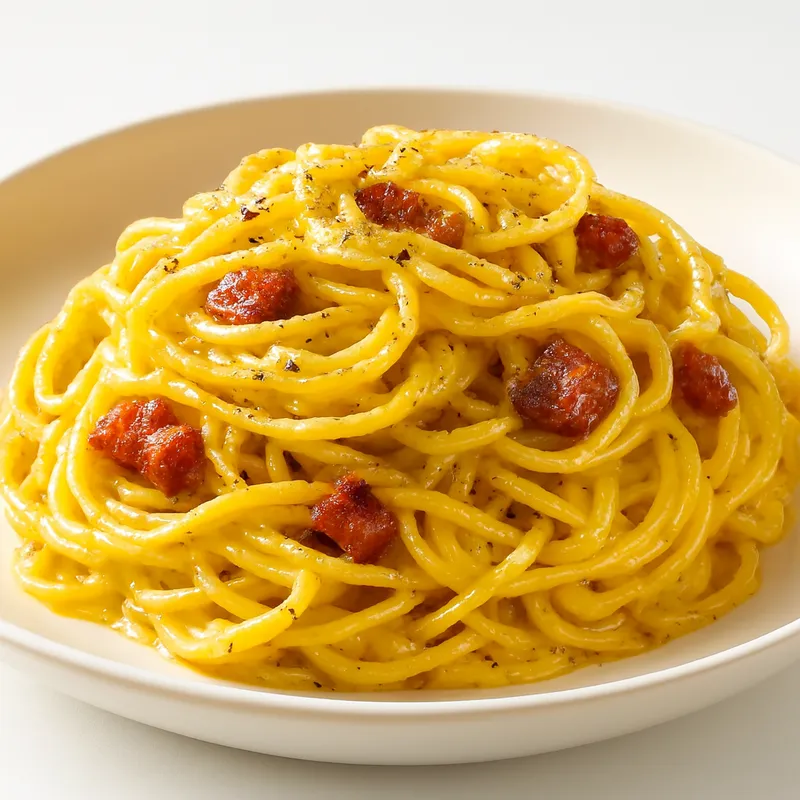
Emulsification, a technique harnessed across many culinary traditions, is essential for creating harmonious blends of oil and water. In Italian cuisine, it's exemplified in the creamy texture of Carbonara, where eggs and cheese meld seamlessly into pasta. French cuisine showcases it in the silky smoothness of a Chocolate Mousse, where the delicate balance of cream and chocolate is achieved. Mexican cooking employs this technique in Guacamole, where lime juice and avocado create a luscious, cohesive dip.
How It Works
Two immiscible liquids — typically oil and water — are forced into a dispersion by mechanical energy, then stabilized by an emulsifier with both hydrophilic and lipophilic regions. Egg yolk's lecithin (phosphatidylcholine) wraps oil droplets in a polar shell; mustard's glycosides and Dijon's mucilage do the same. Droplet size below ~5μm gives the perception of creaminess. Each gram of yolk can stabilize ~100ml oil; beyond that capacity, the emulsion breaks as droplets coalesce.
Four Ways to Bind
the mental modelEvery emulsion answers the same question — what keeps the droplets apart? — in one of a few ways. Learn these and you can read any sauce on the table: which will hold for days, which you must serve at once, and how to save one that splits.
Cook One

Dish examples
519 dishes · 62 cuisines


Through Time
Mayonnaise traces to Mahon, Menorca, 1756 — French Duc de Richelieu's chef adapted local olive-oil-egg sauce after the Siege of Port Mahon. Marie-Antoine Careme and Auguste Escoffier formalized the mother-sauce taxonomy including mayonnaise and hollandaise. The chemistry was understood after Wolfgang Ostwald's 1907 colloid-chemistry work. Harold McGee's 1984 *On Food and Cooking* and Robert Wolke's *What Einstein Told His Cook* (2002) brought the science to the home cook level.
Related cooking knowledge
Mantecatura is functionally a starch-stabilized emulsion built in risotto without an external emulsifier. Beurre blanc is butter-into-reduction emulsion with no yolk — relies on butter's own milk solids. Aioli is mayonnaise's garlic-driven Provencal sibling. Toum (Lebanese garlic emulsion) uses garlic alone as emulsifier. Modern Pierre Gagnaire-style espuma uses gelatin or lecithin in nitrous-charged foams as the same emulsion logic at gas-phase scale.


