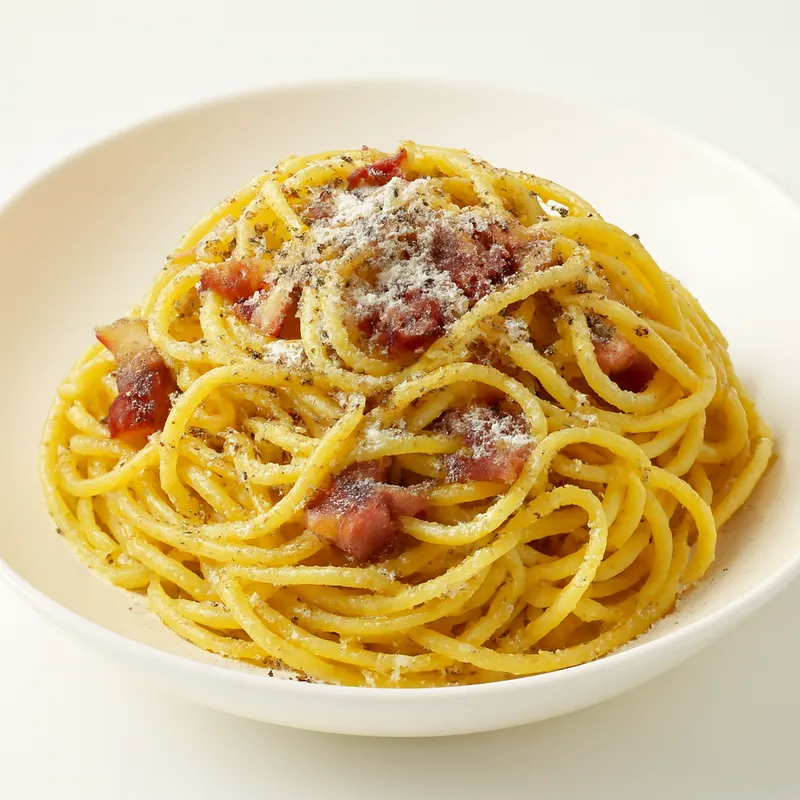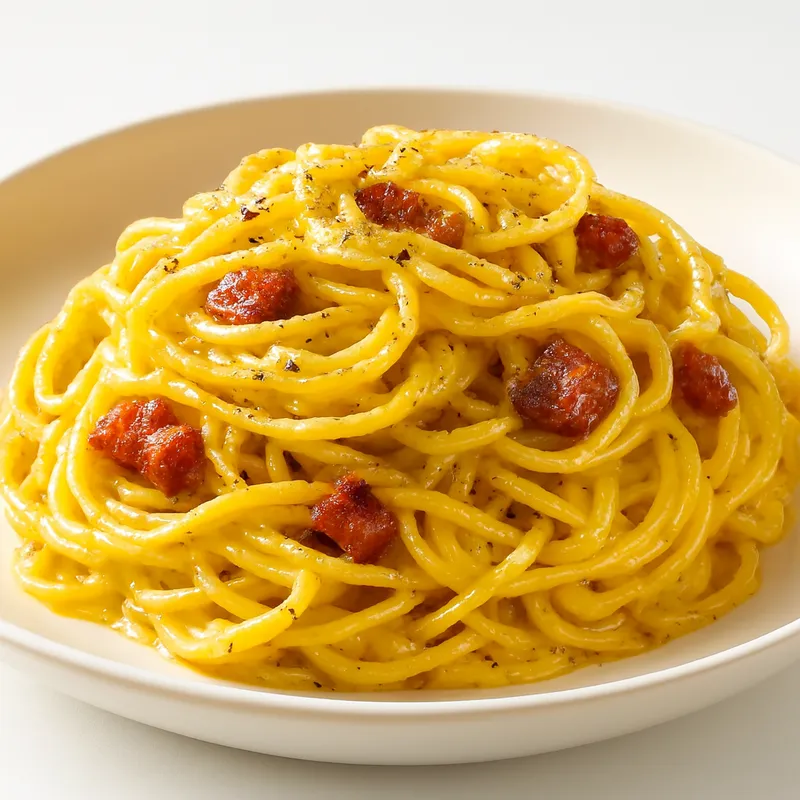
Roman pasta legend of spaghetti tossed with guanciale, egg yolks, Pecorino Romano, and black pepper in a silky emulsion.



Surfaces in Rome around 1944, after Allied liberation — the most-repeated popular theory has Roman cooks combining U.S. Army ration bacon and eggs with local pasta and Pecorino. Its first printed recipe appears in 1952 (Chicago, of all places, in a tourist guide); by the 1960s it was codified as a Roman dish. The four canonical ingredients (guanciale, egg, Pecorino, pepper) hardened only later.
Four ingredients, no cream, no garlic, no peas. Roman cooks will fight you over any one of those.
Spaghetti or rigatoni glossed with a pale yellow sauce that clings, not pools. Crisp guanciale cubes drop fat through every bite; black pepper hits sharp; Pecorino Romano carries the salt. No cream, no garlic, no onion. If the egg has scrambled into yellow flecks, the pan was too hot when it went in.
It's an emulsion, not a custard. Pasta water — starchy, around 80°C after the pasta drains — gets whisked into raw yolks off-heat, then tossed with hot pasta and rendered guanciale fat. The residual heat thickens the yolk just to coating; direct flame curdles it. Guanciale (cured jowl) over pancetta matters: more fat, sweeter, no smoke.
Variations
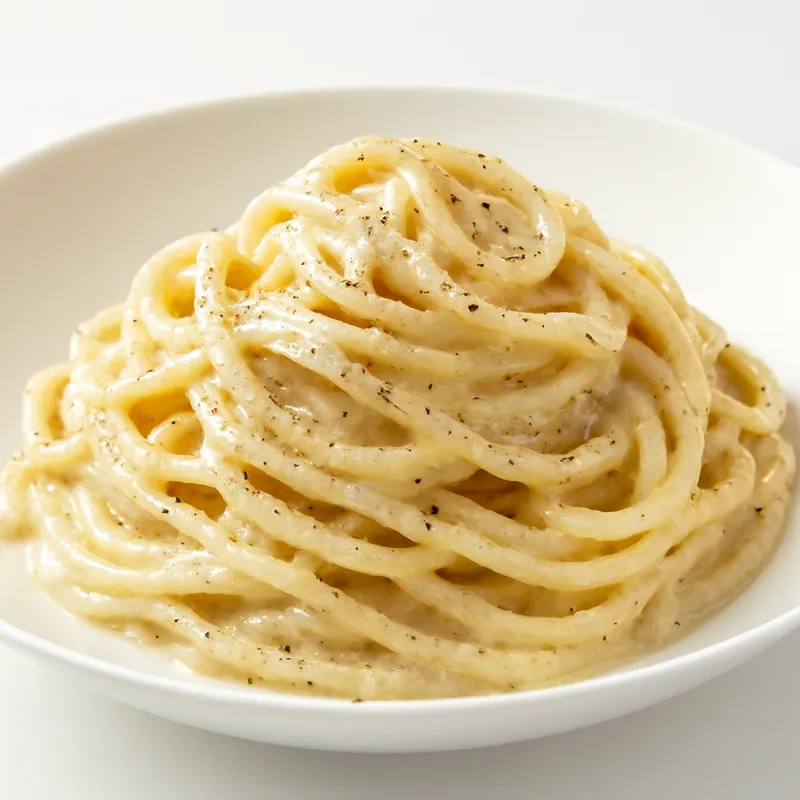
Cacio e pepe drops the egg and pork, gricia drops the egg, amatriciana adds tomato — all Roman, all variations of the same kitchen logic.
On the Palate
Where Carbonara sits in the Italian flavor cloud
It's an emulsion, not scrambled eggs: whisk the yolks and cheese off the heat, then bind them with hot starchy pasta water and the toss of the pan — never over a live flame, or the yolk curdles into bits instead of a glossy cream.
Ingredients
Serves 4How it's made
5 steps · 21 min
- 110 min
Bring a large pot of water to a rolling boil and salt it moderately. Add the spaghetti, stirring occasionally, until cooked al dente.
Watch outMake sure the water is at a rolling boil before adding the spaghetti to prevent it from becoming mushy.
- 25 min
In a large pan, fry the guanciale over medium heat until it is crispy and golden, releasing its flavorful fat.
Watch outRender the guanciale low and slow until the fat turns clear and the meat goes crisp and golden — rush it hot and the fat burns bitter before it lets go.
- 32 min
In a bowl, whisk together egg yolks, grated Pecorino Romano, and a generous amount of black pepper until smooth and creamy.
- 43 min
Drain the spaghetti, reserving some pasta water. Off the heat, add the hot pasta to the guanciale, then pour in the egg mixture, tossing quickly to coat the strands without scrambling.
Watch outOff the heat, toss fast and constantly for a full half-minute — you want the sauce to turn from runny to a glossy cream that ribbons off the strands, not puddle at the bottom.
- 51 min
Adjust the consistency with reserved pasta water if needed, ensuring a glossy, creamy sauce that clings to each strand.
Watch outLoosen with a splash of the hot pasta water if it tightens — add it a spoonful at a time until the sauce flows glossy and clings to every strand.
Archive tool suggestions — not reviewed
These legacy suggestions have not been evidence-reviewed and are not presented as required tools.