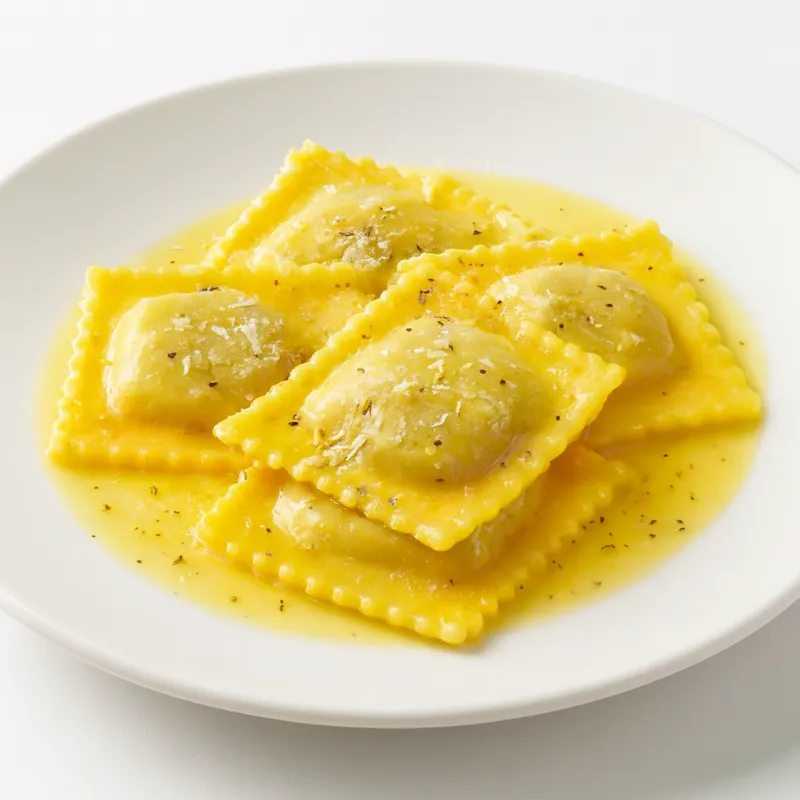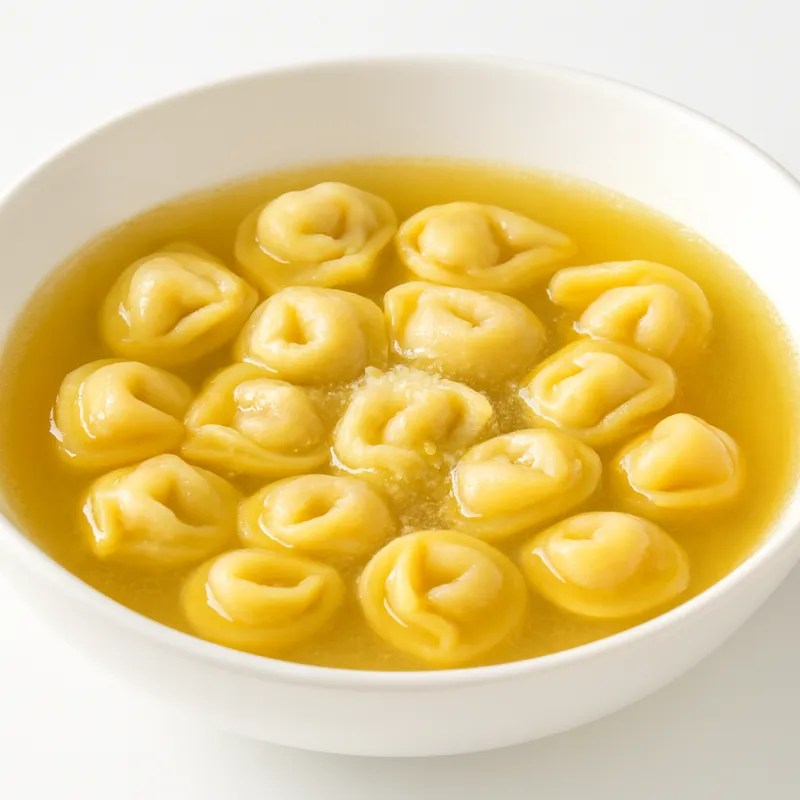
Delicate tortellini float in a golden broth, each bite revealing the luxurious blend of meats and the nutty essence of Parmigiano-Reggiano.




Tortellini's traditional birthplace is Castelfranco Emilia, between Bologna and Modena. The legend (recorded in a 1908 poem by Giuseppe Ceri) is that an innkeeper, having glimpsed Venus's navel through a keyhole, shaped pasta in its image. The first written recipe appears in the 1570s in Bartolomeo Scappi's cookbook. By the 19th century the brodo version was the formal Christmas Eve dish across Emilia-Romagna.
Castelfranco Emilia's belly-button pasta, first written down in Bartolomeo Scappi's 1570s cookbook. Five must fit on a tablespoon — anything bigger is tortelloni, a different dish.
A wide bowl of clear gold capon broth, dozens of tiny belly-button-shaped pasta floating in it — each tortellino is barely bigger than a fingernail. Inside: a paste of pork loin, prosciutto, mortadella, parmigiano, nutmeg. The pasta gives instantly; the filling tastes cured, salty, deeper than ground meat. Spoon-eaten, ten or twelve at a time. Christmas food in Bologna.
The brodo (broth) carries the dish — capon (castrated rooster) is the traditional prestige bird — more fat than hen, less gamey than rooster, its bones making a clearer, sweeter broth than beef. The recipe deposited by the Dotta Confraternita del Tortellino at Bologna's Chamber of Commerce (7 Dec 1974) actually fixes the broth as beef plus free-range chicken. Skim relentlessly during the simmer; cloudy brodo means the heat went too high. The tortellini themselves are sized to fit five on a tablespoon — anything larger is tortelloni, a different dish.
Variations
Modena fills with more prosciutto and less pork loin; Bologna keeps mortadella central; Romagna's leaner cappelletto cousin sometimes drops cured pork entirely for veal and Parmigiano.
On the Palate
Where Tortellini in Brodo sits in the Italian flavor cloud
The broth is the dish, so keep it at a bare, trembling simmer and skim the foam relentlessly — the moment it rolls to a boil the fat emulsifies in and the brodo turns cloudy, which no straining can fix.
Ingredients



How it's made
5 steps · 55 min
- 110 min
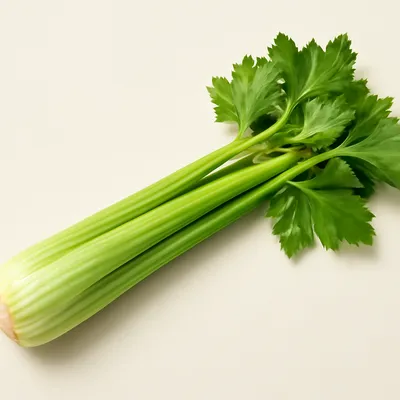
In a large pot, place the capon, carrot, celery, and onion. Cover with water and bring to a simmer, skimming any foam that rises to the surface.
Watch outFoam surges up just as the water nears a simmer — lift it off then, before it sinks back and muddies the pot.
- 215 min
Reduce the heat to maintain a gentle simmer. Let the broth cook until the capon is tender and the vegetables have imparted their flavors.
Watch outWatch the surface, not the clock — if it starts to boil, ease the heat down until only a bubble or two rises.
- 310 min
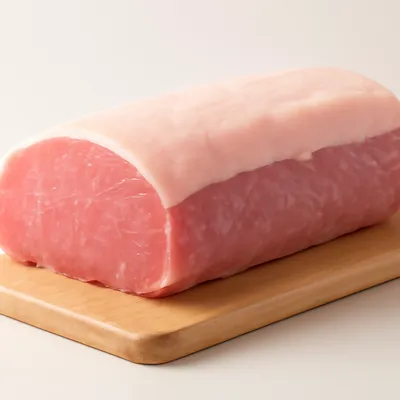
Meanwhile, make the tortellini filling by finely chopping the pork loin, mortadella, and prosciutto. Mix with grated Parmigiano-Reggiano and a pinch of nutmeg.
- 415 min
Roll out the pasta dough thinly, then cut into small squares. Place a small amount of filling onto each square, fold and seal the edges to form tortellini.
Watch outEnsure the edges are sealed well to prevent the filling from leaking during cooking.
- 55 min
Bring the broth back to a gentle boil. Drop in the tortellini, cooking until they float to the surface, indicating they are done.
Watch outThe tortellini are done seconds after they bob to the top — fish them out promptly or the thin skins go slack.
Archive tool suggestions — not reviewed
These legacy suggestions have not been evidence-reviewed and are not presented as required tools.