The kitchen's most unassuming magician, transforming dishes with its rich binding powers.
Creamy and versatile, eggs offer a rich source of flavor and texture, from silky custards to fluffy meringues. Their ability to bind and enrich makes them a cornerstone of culinary applications worldwide.
Where it comes from
Eggs have been a dietary staple across cultures for millennia, revered for their nutritional value and versatility, often utilized in both simple home cooking and elaborate culinary creations.
In the kitchen
Eggs are used for binding in baking, enriching sauces, and creating emulsions, while their ability to create structure is key in dishes like soufflés and quiches.
Across cuisines
The backbone of classical French technique. Whole eggs emulsify aioli and mayonnaise via slow oil incorporation; yolks set crème brûlée and flan at 82 °C before the albumen firms. Soufflés rely on stiff whites folded into a base roux — oven heat expands trapped air for a three-minute window. Tarts use a pâte sucrée enriched with yolk, blind-baked before a crème pâtissière or fruit filling.
Japan exploits every thermal stage of the egg. Chawanmushi is a savory custard steamed at 80 °C — dashi-to-egg ratio near 3:1 keeps it barely set and silky. Tamagoyaki (rolled omelet) layers thin sheets in a rectangular pan with mirin and dashi, pressed for bento. Onsen tamago (hot-spring egg) holds at 65–68 °C for a hour: white just opaque, yolk flowing. Dashimaki uses a higher dashi proportion for a looser, more custardy roll than standard tamagoyaki.
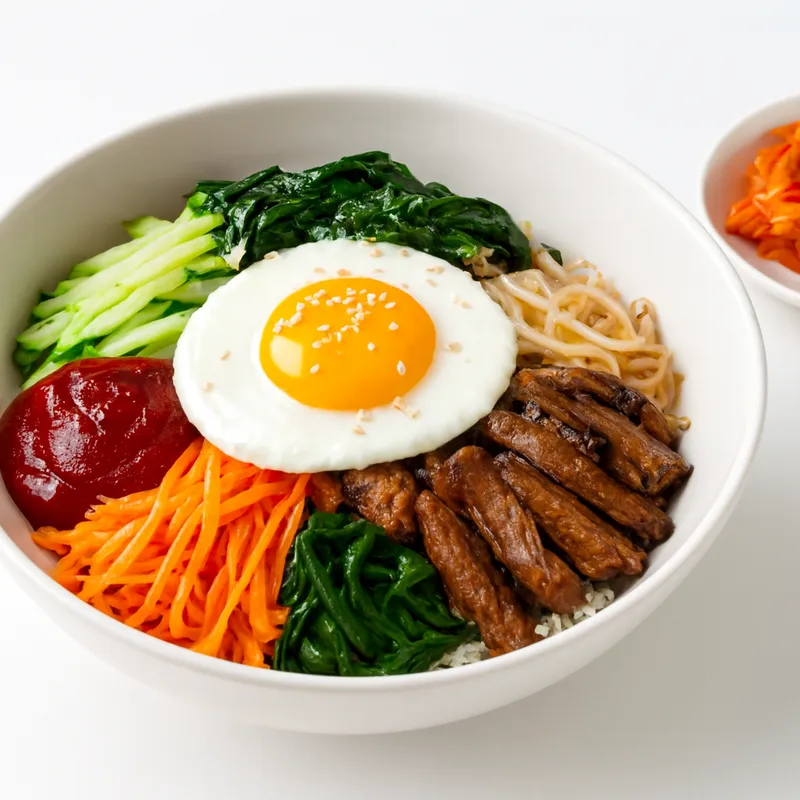
Gyeran-jjim (계란찜) is a steamed egg custard cooked in an earthenware jjigae pot, beaten with dashi broth and finished with sesame oil; the ratio of broth to egg is higher than Japanese chawanmushi, giving a lighter, bubblier texture. Gyeran-mari (계란말이) is a tighter rolled omelet — less dashi, more filling (scallion, carrot, ham). Bibimbap crowns each bowl with a fried egg, yolk intact, to be broken and stirred at table.
Notable varieties
Free-range hens produce yolks with more xanthophyll pigment (deeper orange) and a slightly higher fat-to-water ratio, relevant for custard color and richness. No significant protein difference, but pH of fresh whites is lower (6.5 vs 9.0 aged), affecting foam stability.
Larger than hen eggs — roughly 35% more volume per egg. Higher fat and albumin content yields a creamier, richer custard and denser baked goods. In Vietnam and Philippines, fertilized duck eggs (balut/trứng vịt lộn) are a street food. In China, salted duck eggs are brined for 30–60 days; the yolk turns grainy and intensely savory.
Five quail eggs equal roughly one hen egg by volume. Thin shells and a high yolk-to-white ratio (proportionally about 36% yolk vs. 31% for hen) make them prized for a richer, more intensely flavored bite — pickled as bar snacks in Japan and Korea, served in Chinese cold dishes, and used for garnish in French fine dining.
Duck or hen eggs cured in a strong alkaline medium (traditionally ash, salt, clay; industrially NaOH) for 2–8 weeks. The white turns translucent grey-black and gelatinous; the yolk turns dark green and creamy, with a sulfurous-ammonia edge that dissipates in cool broth. pH reaches 9–12. Standard pairing: cold silken tofu or congee (皮蛋瘦肉粥).
Nutrition (per 100g)
AI-estimated; model and run unavailable.
Pairs well with