A luxurious variation of classic Mexican jamoncillo (milk fudge) made with milk, sugar, and toasted piñón nuts (pine nuts — specifically the pine nuts of the Mexican pine, larger and richer than European pine nuts). The piñón nuts give the candy a distinctive buttery, nutty flavor. A regional specialty of central Mexico where piñón pines grow, jamoncillo de piñón is a festive sweet sold at dulcerías and made for celebrations.

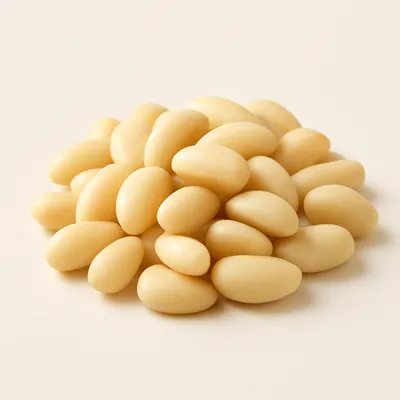


El jamoncillo de piñón is a regional variation of the classic Mexican jamoncillo de leche (milk fudge), enriched with piñón (Mexican pine nuts). Mexico has its own native pine species (Pinus cembroides and others) that produce edible pine nuts (piñones), larger and richer than the European pine nuts; these have been harvested in central and northern Mexico since pre-Hispanic times. Combining the milk-fudge tradition (colonial-era Spanish) with the native piñón gives a candy that is distinctly Mexican. Jamoncillo de piñón is a specialty of central-Mexican states (Estado de México, Puebla, Hidalgo) where pine forests produce piñones; it is sold at dulcerías and made for weddings, Day of the Dead, and Christmas.
A square of jamoncillo de piñón presents a pale, dense milk fudge studded with toasted pine nuts. The first bite gives a dense, creamy sweetness — the milk caramel flavor of jamoncillo, with the buttery crunch of toasted piñones; their distinctive resinous, nutty flavor complements the candy's richness. Eaten in small bites, often with coffee.
Jamoncillo de piñón's texture depends on the milk-sugar reduction and the pine nuts. Whole milk and sugar simmer together for 1-2 hours; as water evaporates, the sugar concentration rises past the soft-ball stage (around 112°C), so the mixture sets firm on cooling. The milk proteins undergo Maillard browning with the sugar, giving the pale tan color and complex flavor. The piñón nuts are toasted separately (developing their buttery, resinous flavor through Maillard reactions on their own proteins and oils), then folded into the fudge near the end of cooking. The combination is a luxurious Mexican candy — the fudge's smoothness against the nuts' crunch.
Variations
Some use pecans or walnuts; the nut-to-fudge ratio varies; vanilla and cinnamon are common flavorings.
On the Palate
Where Jamoncillo de Piñón sits in the Mexican flavor cloud
Ingredients
Serves 12How it's made
6 steps · 1 hour 30 min active + 30 min waiting
- 18 min
Toast piñón nuts (Mexican pine nuts, or substitute regular pine nuts) on a comal until golden and fragrant; cool.
Watch outToast the pine nuts only to pale gold and fragrant — they carry the flavor, and past gold they turn bitter fast.
- 25 min
Combine whole milk and sugar in a heavy pot; add a cinnamon stick; bring to a simmer, stirring to dissolve.
- 375 min
Add a pinch of baking soda; simmer uncovered, stirring frequently, 1-1.5 hours.
- 41 min
Continue cooking until the mixture reaches soft-ball stage (112°C) or forms a soft ball in cold water.
Watch outTest in cold water: a drop should form a soft, pliable ball you can pinch — that's soft-ball stage; go too far and the fudge sets grainy and hard.
- 55 min
Remove from heat; remove cinnamon stick; stir in the toasted piñón nuts.
- 61 min
Stir vigorously until the fudge thickens and loses its gloss; pour into a buttered pan; cool; cut into squares.
Watch outBeat off the heat until the shine dulls and it stiffens under the spoon — that's the sign it will set into fudge, not stay a runny caramel.

