
Concentrated guava paste blocks wrapped in dried bijao leaf — eaten alone or with fresh white cheese for a sweet-salty contrast.
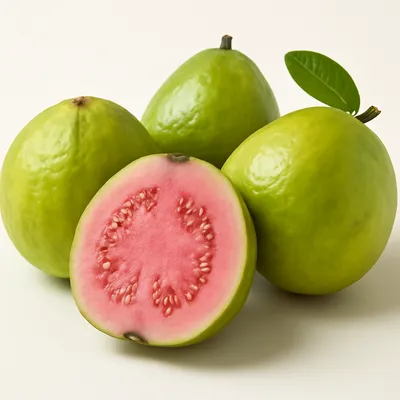


Vélez, Santander, has been the bocadillo capital since the late 19th century — the town's microclimate and the use of regional red guava (vs. white guava for the pale layers) gives the paste its red color and floral acidity. Vélez bocadillo received protected designation of origin in 2017.
The signature two-tone bocadillo (red guava + white sliced guava layer) is called bocadillo veleño — its specific shape and bijao wrap are part of the 2017 PDO. Annual Feria del Bocadillo in Vélez every August.
Deep red, hard-set but yielding to teeth, intensely sweet with floral guava acid behind. Bijao leaf gives a faint herbaceous note. Pair with cheese (bocadillo con queso) and the salt-fat cuts the sugar — Colombia's afternoon snack.
Ripe guavas are pulped, sieved, and cooked with sugar in 1:1 ratio for 90+ minutes until the mixture pulls clean from the pot bottom (around 75° Brix). Poured into bijao-lined molds and cooled overnight. The leaf wrap prevents crystallization.
Variations
Bocadillo veleño (Vélez PDO): the traditional form, two-tone with a red guava center and white guava sides (~3cm); PDO zone spans 5 municipalities (Vélez, Puente Nacional, Barbosa, Guavatá in Santander; Moniquirá in Boyacá). Bocadillo de feria: solid red, cheaper, larger. Bocadillo con almojábana: paired with the cassava-cheese roll.
On the Palate
Where Bocadillo sits in the Colombian flavor cloud
Cook the guava-and-sugar mixture until it pulls cleanly away from the pot bottom in a sheet — that thick, glossy set is the whole point, and stopping short leaves you with runny jam.
Ingredients
Serves 8How it's made
4 steps · 1 hour 17 min active + 4 hours waiting
- 160 min
Cook 1 kg deseeded ripe guavas with 800 g sugar to thick paste, 1 hr.
Watch outIt's ready when a spoon drawn across the bottom leaves a clean channel that doesn't flood back in.
- 2240 min
Pour into shallow lined tray; cool to set.
Watch outPour it while still hot and pourable; it firms up fast as it cools, so don't dawdle.
- 315 min
Cut into 5 cm blocks; wrap in dried bijao leaves.
- 42 min
Serve with cubes of fresh white cheese for contrast.
Archive tool suggestions — not reviewed
These legacy suggestions have not been evidence-reviewed and are not presented as required tools.


