Whole head-on prawns slow-braised in oil, soy, and rock sugar until the shells turn lacquer-orange and the sauce reduces to a glossy coat — Jiaodong coastal classic.




Jiaodong's Bohai and Yellow Sea fisheries have supplied the kitchens of Yantai, Penglai, and Qingdao with large prawns for centuries; the dish is one of the canonical preparations in the Shandong coastal repertoire. Local cooks insist on Penaeus chinensis (Chinese white prawn) when in season — the shells render more orange fat than tiger or whiteleg, which is why imitations made elsewhere never look the same. The braising-in-oil technique (yóu mèn) is shared with Shandong vegetable preparations like braised eggplant, but here the shells do all the seasoning work.
Jiaodong's coastal staple uses Penaeus chinensis — the Chinese white prawn renders more orange head fat than tiger or whiteleg. Press the head with a spatula to release the tomalley, or the dish stays pale.
Pick up a prawn by the tail and bite head-first — the shell is so saturated with seasoned oil it crackles and dissolves, and the head's orange tomalley floods out sweet and briny. The flesh underneath is firm, just-cooked, glazed in soy and sugar without a hint of mushiness. You eat the whole thing including the legs. If the shells stay tough or pale, the oil never got hot enough to render the head fat into the sauce.
The orange color and seafood sweetness come almost entirely from the head — the hepatopancreas (tomalley) is rich in astaxanthin and free amino acids that release into hot oil when you press the head down with a spatula. Skip that press and the dish goes pale and flat, no matter how much soy you add. The covered braise then forces the oil-borne flavors back into the shell from the outside; uncovering too early thins the sauce, and reducing too long toughens the flesh. Five minutes covered, ninety seconds open is the working window.
Variations
Yantai version runs sweeter with rock sugar; Qingdao uses live prawns straight from the morning boats; the Beijing-shipped restaurant version subs in tiger prawn and is judged inferior by Shandong cooks.
On the Palate
Where Braised Prawns in Oil sits in the Chinese flavor cloud
Ingredients
Serves 3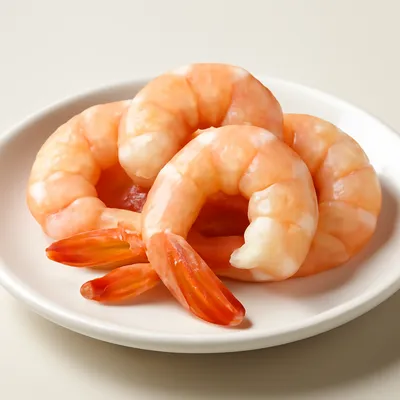
How it's made
5 steps · 15 min
- 18 min
Prepare 600g head-on, shell-on Bohai prawns: trim antennae and rostrum (the head spike) with scissors, devein along the back through the shell with a toothpick. Pat dry — wet prawns won't sear.
- 23 min
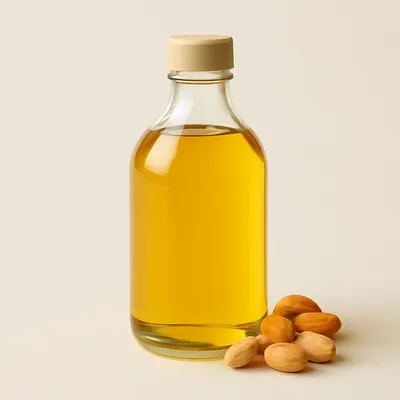
Heat 80ml peanut oil in a wide pan over medium-high. Add prawns in a single layer. Press each one down with a spatula so the heads release their orange tomalley into the oil — this is the dish's color and flavor backbone.
Watch outPress each head down hard as it hits the oil — you want the orange tomalley to bleed out and stain the oil; that press is the dish's whole color and sweetness.
- 32 min
Flip prawns when shells are bright red on the underside. Push to one side. Add 4 ginger slices and 2 scallion sections to the cleared oil, fry 30 seconds until aromatic.
Watch outFlip the moment the underside shell flashes bright red — that color tells you the shell-side is seared and the flesh underneath is just set.
- 46 min
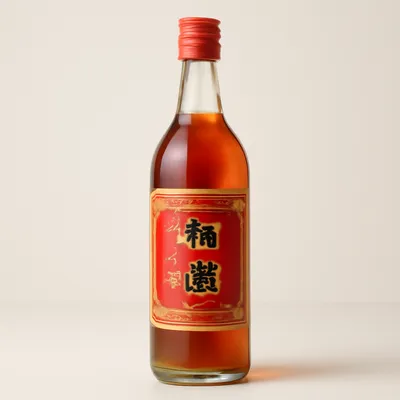
Add 30ml Shaoxing wine around the rim — let it sizzle off. Add 25ml light soy, 15g rock sugar, and 100ml hot water. Cover, simmer over low heat 5 minutes, turning prawns once.
- 52 min
Uncover, raise heat. Reduce until sauce coats the back of a spoon and clings to the shells, about 90 seconds. Plate prawns and pour the glossy oil-sauce over them. Eat shell and all.
Watch outReduce only until the sauce clings and glosses the shells, about ninety seconds — push it longer and the prawn flesh tightens up and goes rubbery.