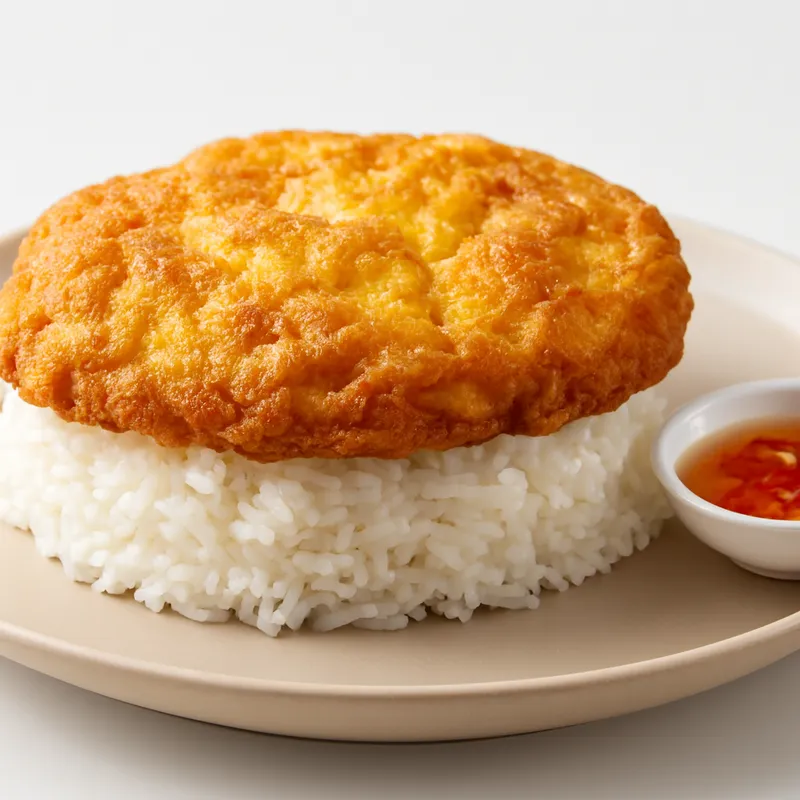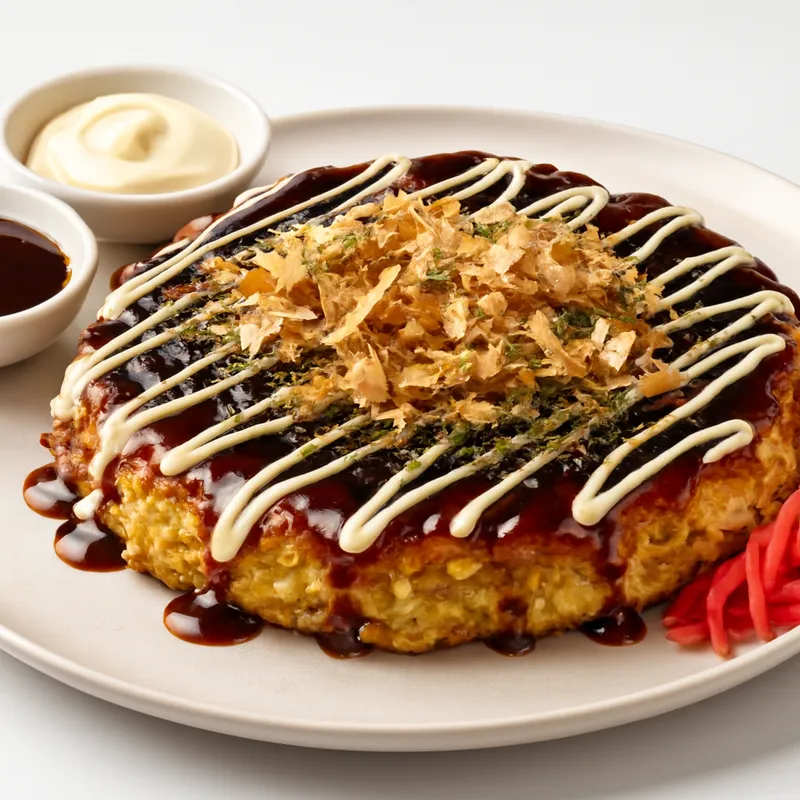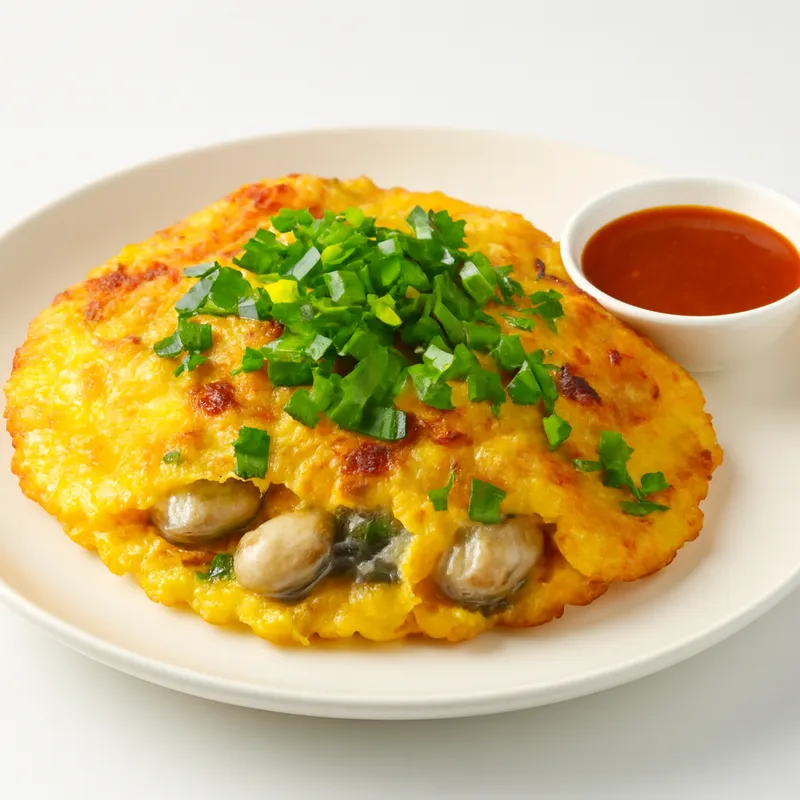
Crispy on the outside with a tender, juicy interior, this omelette bursts with the oceanic flavor of fresh oysters.


O-a-jian (蚵仔煎 in Minnan) is a Hokkien dish from southern Fujian and Taiwan, with origins traced loosely to 17th-century Tainan during the Dutch–Koxinga conflict — legend says food shortages forced cooks to stretch oysters with sweet potato starch. Whether folklore or fact, the dish is now most associated with Taiwan night markets, but the Fujianese version is older and uses smaller, brinier oysters.
Taiwanese oyster omelette folds oysters and egg into a loose sweet-potato-starch batter. Cook it until the starch forms chewy, translucent patches and the edges turn crisp, then add the sauce.
A loose, lacy disc with crisp edges and a custardy center, dotted with small fresh oysters that pop salty when bitten. The batter is egg cut with sweet potato starch — that's the chew, almost translucent in spots. Eaten with a thin sweet-spicy sauce on the side. Made on a flat griddle, so you get griddle char on the bottom and softness on top.
Sweet potato starch is the load-bearing ingredient — wheat flour or corn starch gives a flat, brittle pancake. The starch slurry is poured on the hot griddle first, oysters scatter on top, beaten egg goes over that, leafy greens (often tang oh / 茼蒿) tucked in last. Flipped once. The translucent gel-pockets where the starch hasn't fully set are the texture people come for; cooked dry, the dish is wrong.
Variations
Taiwanese night-market style (Shilin, Raohe) runs sweeter sauce and pinker; Xiamen Fujian version uses smaller, brinier oysters and 茼蒿 greens; Singapore-Penang orh luak goes flat and crisper with garlic-chili lime sauce.
On the Palate
Where Oyster Omelette sits in the Chinese flavor cloud
Sweet potato starch is what makes it — its gel gives the signature chewy, half-translucent pockets, so don't overcook it dry and don't swap in wheat flour or cornstarch.
Ingredients


How it's made
5 steps · 10 min
- 12 min
In a bowl, mix sweet potato starch with a little water to form a smooth batter. Set aside.
- 22 min
Heat a tablespoon of oil in a non-stick pan over medium heat. Pour in the batter and spread evenly to form a thin layer.
Watch outSpread the slurry thin and let the bottom set on high heat until the edge lifts — that early set is what keeps it from gumming up.
- 33 min
Crack the eggs over the batter and gently stir to combine. Cook until the eggs are just set, about 3 minutes.
Watch outAvoid stirring too vigorously; you want the eggs to meld with the batter, not scramble.
- 42 min
Scatter the oysters over the omelette. Cook until the oysters are just warmed through, about 2 minutes.
Watch outAdd oysters only at the end and just warm them through — over-cooked oysters go rubbery and shrink.
- 51 min
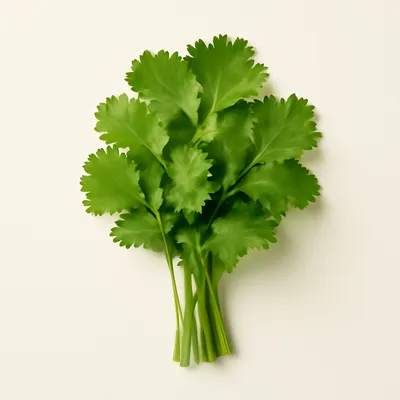
Garnish with chopped scallions and cilantro. Serve immediately with a side of chili sauce.