
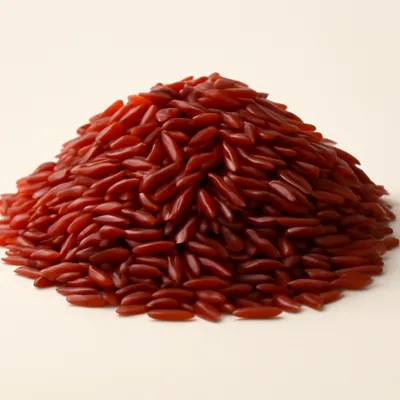


Bhutanese red rice is one of the world's few traditional pigmented rices, grown almost exclusively in Bhutan's Paro Valley and Punakha-Wangdue Valley at altitudes between 1,500-2,500 m. The variety is protected by Bhutanese geographic indication (GI). The semi-milled processing keeps the bran layer mostly intact, providing higher fiber and B vitamins than white rice. Exported in small quantities under brand names like 'Lotus Foods'.
Spoon a mound of Bhutanese red rice — the grains are russet-brown, plump, slightly glossy with the cooking water. Bite plain: a clean nutty flavor with the toasted-bran depth of brown rice but lighter and slightly stickier; the centre of each grain retains a tiny chew. Eaten under ema datshi or phaksha paa, the rice catches and holds the sauce in its open porous structure better than smooth white rice — the meal is incomplete without it.
Soaking 20-30 min hydrates the bran-encased grain so it cooks evenly without splitting. The 1:2 rice-to-water ratio is correct for semi-milled red rice (vs 1:1.5 for white rice) — the intact bran needs more water to soften. The undisturbed simmer ensures even steam distribution; opening the lid releases steam and creates uneven cooking. The 8-10 min off-heat rest allows residual steam to fully soften the centre of the grain.
Variations
Plain red rice (most common). Red rice with butter (festive). Red rice with caraway (Bumthang valley). Red rice with herbs (modern restaurant). Mixed red-and-white rice (cost-saving). Quick-cook red rice (pressure cooker, 8 min).
On the Palate
Where Bhutanese Red Rice sits in the Bhutanese flavor cloud
Semi-milled red rice keeps its bran, so use a 1:2 rice-to-water ratio, simmer covered and undisturbed 22-25 minutes, then rest off the heat — the intact bran needs the extra water and steam to soften the grain evenly without splitting.
Ingredients
Serves 4How it's made
9 steps · 5 min active + 30 min waiting
- 13 min
Rinse 400 g Bhutanese red rice in cold water 3 times until the water runs clearer (it won't run fully clear; this is normal).
Watch outRinse until the water only runs a bit clearer — it never goes fully clear, and that's fine.
- 230 min
Soak the rice in cold water for 20-30 min. Drain.
- 31 min
Combine rinsed rice with 800 ml fresh water (a 1:2 ratio is standard) and 1/2 tsp salt in a heavy-bottomed pot with a tight-fitting lid.
- 41 min
Bring to a hard boil over high heat with the lid OFF.
- 51 min
Once boiling, stir once, reduce heat to lowest possible, cover with the lid.
- 624 min
Simmer covered for 22-25 min undisturbed (do not lift the lid).
Watch outLid stays shut the whole simmer — no peeking, or the steam escapes and cooking turns uneven.
- 79 min
Remove from heat; rest covered 8-10 min to finish steaming.
- 81 min
Fluff gently with a fork. The grains should be tender, separate, with a faint chew at the centre.
Watch outDone when grains are tender and separate with just a faint chew left at the centre.
- 91 min
Serve as the base for any datshi, paa, or maru.


