



Created before 1834 by monks at the Jerónimos Monastery in Belém, west of Lisbon. Religious orders used egg whites to starch laundry and clarify wine, which left huge volumes of yolks; the monks turned the surplus into custard tarts. After Portugal's 1834 monastic dissolution, the recipe was sold to a nearby sugar refinery, which opened Pastéis de Belém in 1837 — still operating, still using the original (sealed) recipe.
Jerónimos monks in Belém invented them before 1834, using up yolks left over from starching laundry with whites. After the 1834 monastic dissolution the recipe sold to the sugar refinery that opened Pastéis de Belém in 1837. The 280–320 °C oven is what scorches the top black.
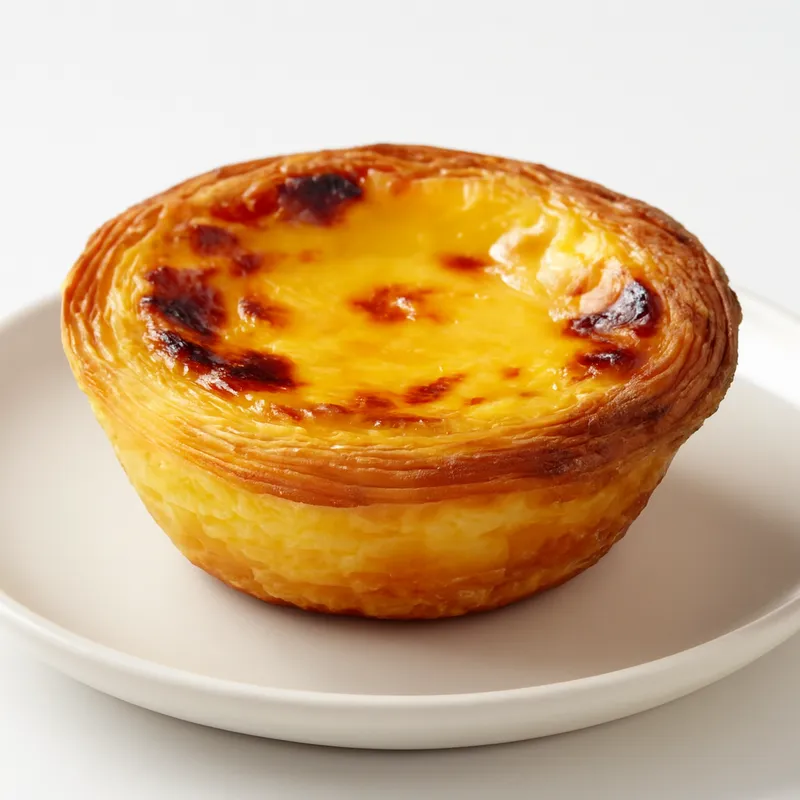
A small custard tart, two-bite size, eaten warm with cinnamon and powdered sugar shaken on at the counter. The shell is laminated puff pastry — shatteringly crisp, hundreds of paper layers — and the top of the custard is scorched almost black in spots, the rest deep yellow. Eaten standing, in three bites max, with an espresso (bica). Cold from a fridge case, it's a different food.
Two technical pieces: the puff (laminated with butter or lard, often baked at extreme heat — 280–320 °C — to puff fast before the custard sets) and the custard (a cooked base, not raw — flour-thickened milk, then yolks and sugar tempered in, so it survives the high oven without curdling). The black-spot scorch is from sugar caramelizing on the surface, only achievable with intense top heat.
Variations
Pastéis de Belém (1837) is the original sealed-recipe version; Manteigaria in Lisbon's Chiado is the modern challenger with hotter ovens; Macau's Lord Stow's Bakery in Coloane runs the British-Portuguese hybrid that birthed the KFC Asia tart; Hong Kong dan tat is a different beast (shortcrust, no scorch).
On the Palate
Where Pastéis de Nata sits in the Portuguese flavor cloud
Ingredients



How it's made
4 steps · 30 min
- 110 min
Preheat your oven to 250°C (480°F). Roll out the puff pastry on a lightly floured surface and cut into circles to fit your tart tins. Press the pastry into the tins, ensuring it reaches the edges.
Watch outEnsure the pastry is not too thick to allow for even baking.
- 25 min
In a saucepan, combine sugar and a splash of water. Heat gently until the sugar dissolves completely, forming a syrup. Allow to cool slightly.
Watch outAvoid boiling the mixture too vigorously to prevent crystallization.
- 35 min
In a separate bowl, whisk together egg yolks and cream until smooth. Gradually pour in the syrup, whisking continuously to prevent curdling.
Watch outAdd the syrup in a slow thread while whisking hard so the yolks warm through without scrambling.
- 410 min
Pour the custard mixture into the prepared pastry cases, filling them about three-quarters full. Bake in the preheated oven until the custard is set and the tops are golden brown, about 10 minutes.
Watch outFill only three-quarters up and pull them when the tops blister with dark caramel spots — those scorch marks mean the oven was hot enough.
Archive tool suggestions — not reviewed
These legacy suggestions have not been evidence-reviewed and are not presented as required tools.

Hand-held wire loop tool for beating eggs, whipping cream, emulsifying dressings, and incorporating air into batters. Balloon whisks (large round head) for whipping cream and meringues; French whisks (narrow tear-drop) for sauces in pots; flat whisks (gravy) for pan sauces. Stainless steel is universal; silicone-coated for non-stick pans.

Round metal pot, 14-26 cm diameter, with vertical walls and a long handle, designed for sauces, soups, oatmeal, rice, boiled vegetables. The vertical walls minimize evaporation (vs. a sauté pan). Sizes: 1 qt for melting butter, 2-3 qt for sauces, 4 qt for soups. Stainless-steel-clad aluminum or copper is best for conduction; cast-iron is too thick for delicate sauces.