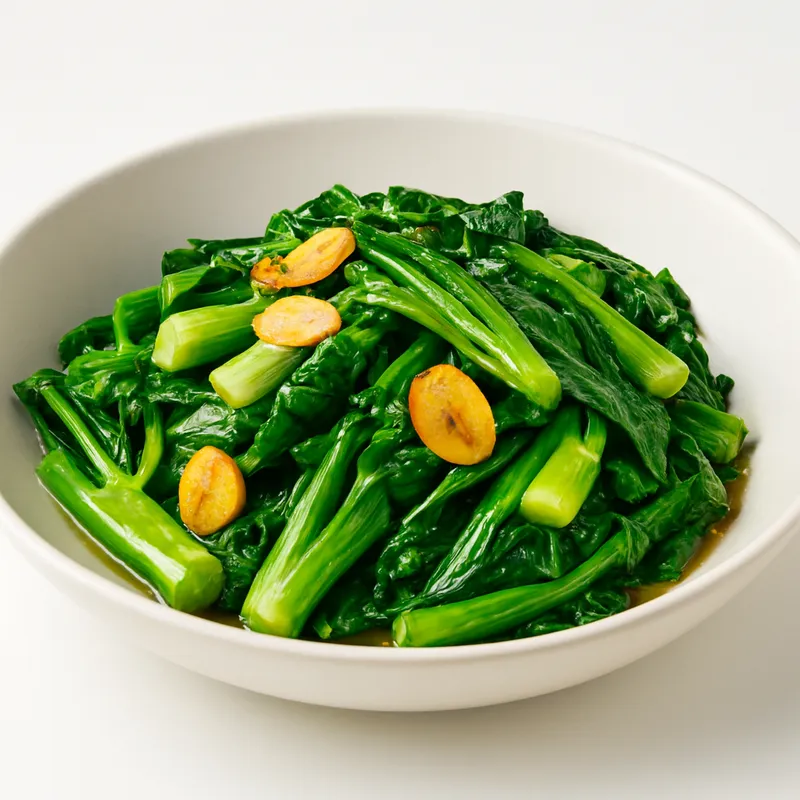
A pan-fried confection from Lintong, outside Xi'an, in which the fire-crystal persimmon—a cultivar so ripe its flesh dissolves to a fragrant purée—replaces all the water in the dough, producing a hauntingly soft, sticky shell. Osmanthus paste, rose petal paste, and crushed walnut fill the centre; pan-frying crisps the exterior to deep gold.


According to tradition, when rebel leader Li Zicheng established the short-lived Dashun regime in Xi'an in 1644, famine had swept Guanzhong. The people of Lintong mixed their surplus of ripe fire-crystal persimmons with a little flour to bake travel bread for the army. Successive generations of cooks refined the recipe—adding osmanthus paste, rose paste, lard, and walnut—until the filled cake had become one of the classic snacks of Chang'an, praised as a 'celebrated pastry of Guanzhong'.
The golden crust shatters gently under the first press, releasing a cloud of osmanthus and rose fragrance; within, amber-orange persimmon dough yields sticky-soft, enveloping a walnut filling sweetened with floral oil and faintly caramelised at the pan.
Fire-crystal persimmons at peak ripeness contain over 15% soluble sugar and abundant pectin; their tannins are fully converted to insoluble form, eliminating astringency. When the purée is kneaded into flour, the pectin bonds with gluten proteins, producing a dough that is extensible and sticky rather than elastic—no water is needed or wanted. During pan-frying, the outer surface rapidly loses moisture and sets to a crisp golden shell, while the persimmon sugars undergo caramelisation at around 160°C, generating vanillin and furanic aroma compounds. Meanwhile, the osmanthus paste (rich in linalool and beta-ionone) and rose paste (geraniol) volatilise in the hot oil, building a layered floral top-note above the sweet caramel base.
Variations
A simpler folk version uses brown sugar alone as filling, without osmanthus or rose. Some households substitute red-bean paste or date purée for the walnut mixture outside of autumn. A deep-fried variant (less common) produces a crisper shell but loses the persimmon dough's characteristic sticky interior.
On the Palate
Where Huanggui Persimmon Cake sits in the Chinese flavor cloud
Ingredients
Serves 4


How it's made
7 steps · 20 min
- 110 min
Prepare the filling: roughly chop walnuts; combine with osmanthus paste, rose paste, finely diced lard, white sugar, candied citrus peel strips, and 2 tbsp of cooked wheat flour; mix until cohesive and press into a compact mass.
- 210 min
Make the persimmon dough: peel fire-crystal persimmons and push the flesh through a fine sieve to obtain a smooth purée; combine with wheat flour and knead by hand 5 minutes until a soft, sticky dough forms—add no water.
Watch outKnead the persimmon purée straight into the flour with no water at all — its own moisture and pectin bind the dough; add water and it turns to slop.
- 310 min
Rest: cover the dough with a damp cloth and rest at room temperature for 10 minutes.
- 415 min
Divide and fill: pinch the dough into 25g portions; flatten each in your palm to a disc; place 15g of filling in the centre; gather the edges, pinch firmly to seal, and press gently into a disc 5cm across and 2cm thick.
- 52 min
Heat the pan: set a flat-bottomed pan over medium heat; add 2 tbsp of cooking oil and heat until shimmering.
- 65 min
Fry first side: lay the cakes in the pan in a single layer; cook 4–5 minutes undisturbed until the bottom is deep golden; flip carefully, drizzle a little more oil around the edges.
Watch outFry the first side undisturbed until deep golden — moving it early tears the soft shell before the caramel crust sets.
- 74 min
Finish and serve: cook the second side a further 4 minutes until uniformly golden and cooked through; transfer to a wire rack and serve warm.
Archive tool suggestions — not reviewed
These legacy suggestions have not been evidence-reviewed and are not presented as required tools.