A thin-skinned, pan-fried meat pie from Haicheng, Liaoning, with a pork-beef filling seasoned with ten-spice brine and sesame oil. The crust shatters on contact; inside the filling is juicy and fragrant. Inscribed on the Liaoning Provincial Intangible Cultural Heritage list in 2011, it is traditionally paired with eight-treasure congee.






Haicheng xianbing traces to the late Qing, when two families in Haicheng County developed competing recipes: the Muslim Ma family (beef fillings) and the Han Chinese Mao family (pork-beef blend). By 1920, their descendants Ma Fuen and Mao Qingshan operated rival shops on Fire God Temple Street. In 1939, Mao Qingshan relocated to Shenyang as Lao Shan Ji, spreading the dish's reputation across Northeast China. In July 2011, Haicheng-Niuzhuang xianbing was inscribed on the fourth batch of Liaoning Provincial Intangible Cultural Heritage.
Bite through the thin, taut crust and it shatters with a crisp crack before giving way to a juicy, herb-fragrant filling. The pork-beef blend carries pork's richness and beef's chew simultaneously; the ten-spice brine — clove, cardamom, cinnamon in the base — surfaces as an elusive warmth. A dip of garlic paste and chilli oil sharpens the savoury depth.
The dough is mixed with warm (not boiling) water, leaving starch granules partially hydrated and gluten only lightly developed — creating a pliable skin that holds its shape without toughness. During pan-frying, the dough surface in contact with the hot iron rapidly loses moisture and exceeds 140 °C, triggering Maillard browning between amino acids and reducing sugars to generate the golden-red colour and roasted aroma. Meanwhile the filling's own moisture vaporises inside the sealed pocket, gently steaming the inner dough layers and keeping the meat succulent.
Variations
Pure beef halal version: the Ma family's original recipe used only hand-chopped beef — still found in halal versions today. Seafood upgrade: Shenyang restaurant versions substitute shrimp, sea cucumber and scallop for the meat filling. Seasonal vegetable changes are standard: spring chive-pork is the most popular; summer cucumber-pork and autumn pumpkin-pork follow the harvest. The upstream Niuzhuang xianbing (the heritage artisan root) strictly follows a 7:3 pork-to-beef ratio.
On the Palate
Where Haicheng Xianbing (Stuffed Pan-Fried Pie) sits in the Chinese flavor cloud
Ingredients
Serves 4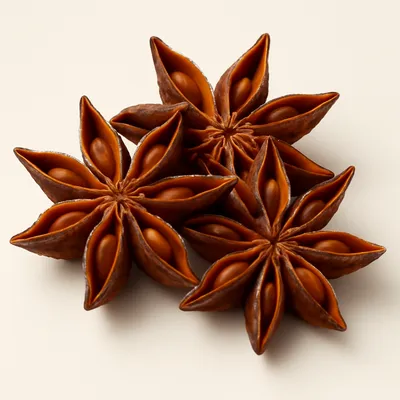


How it's made
7 steps · 30 min
- 120 min
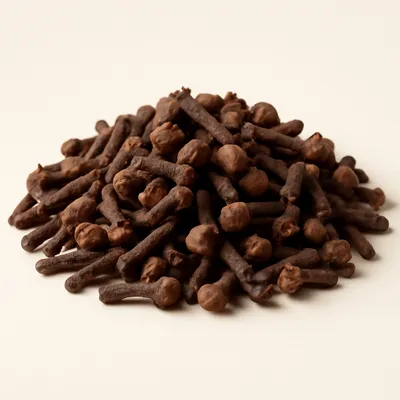
Steep ten spices (clove, cardamom, cinnamon, star anise, bay leaf, galangal, Sichuan pepper, fennel seed, white pepper, dried ginger) in 100 ml just-boiled water for 20 minutes; strain and cool to room temperature.
- 210 min
Combine ground pork and beef in a 7:3 ratio (about 280 g pork, 120 g beef); add soy sauce, sesame oil, salt, scallion, ginger and the cooled ten-spice brine; stir vigorously in one direction until the filling binds and holds shape.
Watch outBeat the filling in one direction until it turns sticky and cohesive — that bind is what keeps the juices trapped inside the sealed pie.
- 320 min
Mix 300 g wheat flour with warm water and a pinch of salt into a smooth, non-sticky dough; rest covered for 20 minutes.
Watch outMix the dough with warm — not boiling — water so it stays soft and pliable; boiling water kills the stretch and the skin turns tough.
- 415 min
Divide dough into 30 g portions; roll each into a thin disc about 12 cm in diameter. Place 40 g filling on one half, fold into a half-moon and crimp edges firmly to seal.
- 55 min
Gently flatten each filled parcel to about 1.5 cm thick with the palm of the hand.
- 68 min
Heat a thin film of oil in a flat-bottomed pan over medium heat; place pies in and fry using the 'two-flip, three-roast' method — turn twice, applying heat three times — about 3–4 minutes per side until both surfaces are golden-red.
Watch outFry over steady medium heat, flipping twice, until both faces are an even golden-red — too hot scorches the skin before the filling steams through.
- 72 min
Serve immediately with garlic paste, chilli oil and mustard on the side; optionally pair with eight-treasure congee.
Archive tool suggestions — not reviewed
These legacy suggestions have not been evidence-reviewed and are not presented as required tools.


