A small, golden-crusted baked pastry from Ningqiang County in southern Shaanxi: triple-fermented wheat dough enclosing a salted, spiced walnut paste that has itself been fermented with Sichuan pepper. Crisp outside, dense and aromatic within, it was an imperial tribute item in the final years of the Qing dynasty and is now inscribed in Shaanxi's first batch of intangible cultural heritage.


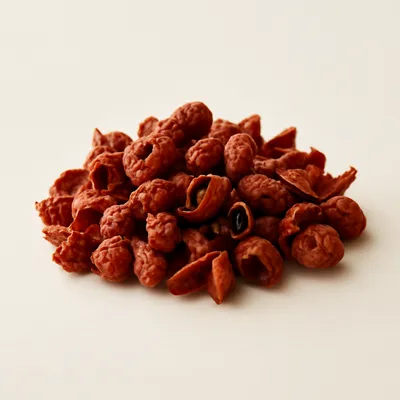


Ningqiang Walnut Flatbread traces to the Wang family of Ningqiang County, founded in the late Ming or early Qing period — roughly 300 years ago — according to oral history passed down by the craft's living inheritors. The son of a disgraced Tianjin military official fled to Ningqiang with a cook and married into the Wang family; the cook combined the county's abundant walnut harvest with his northern pastry skills to create this baked cake, which the Wangs then sold in the county seat across three continuous centuries. In the 26th year of the Guangxu reign (1900), when Empress Dowager Cixi and Emperor Guangxu fled to Xi'an following the Boxer Uprising, local officials presented Wang family flatbreads as imperial tribute in a 'dragon-eye' form with phoenix-motif borders, known as the 'Manchu-Han Dragon-Phoenix Cake.' In May 2007 the craft was inscribed in Shaanxi Province's first batch of intangible cultural heritage items.
A crisp shell that cracks open at slight pressure to reveal the fermented walnut paste within — dense, savory, and subtly numbing from the Sichuan pepper, unlike anything else baked in the Qinba Mountains.
Three-stage fermentation builds flavor and structure progressively: the first rise activates yeast (CO2 production and alcohol formation) to establish dough architecture; the second rise, after fresh flour is folded in, refines crumb texture; the third brief rise with oil allows fat to micro-emulsify within the gluten matrix, so that during baking the expanding oil vapor creates distinct flaky strata. The walnut paste undergoes its own fermentation: protease enzymes degrade walnut proteins into free glutamate (contributing umami), while partial oxidation of polyunsaturated fatty acids (linoleic and linolenic acid) generates the volatile aldehydes responsible for the characteristic toasted-nut aroma.
Variations
The original Wang family version uses plain walnut paste seasoned only with salt and Sichuan pepper. Modern variants include a sweet version with brown sugar and sesame in the filling, and a richer version replacing vegetable oil with lard in the dough. Some makers blend walnut paste with rose-petal jam for a floral note. Industrial producers use convection ovens rather than traditional clay ovens, gaining output but losing some crust texture.
On the Palate
Where Ningqiang Walnut Flatbread sits in the Chinese flavor cloud
Ingredients
Serves 12
How it's made
8 steps · 30 min
- 160 min
Mix 500g all-purpose flour with 5g active dry yeast and enough warm water (about 250ml) to form a soft, smooth dough; cover and let rise until doubled, about 60 minutes.
Watch outLet the dough rise until it's truly doubled and springs back slowly — under-proofed here means a dense, tight bread that never flakes.
- 245 min
Knead 100g fresh flour into the risen dough to adjust ratio and refine texture; cover and let rise a second time until puffed, about 45 minutes.
- 3120 min
While the dough rises, prepare walnut paste: soak 200g walnut kernels 30 minutes, peel, chop very fine; mix thoroughly with salt, ground Sichuan pepper, and 1 tbsp vegetable oil; rest at room temperature at least 2 hours until deeply fragrant.
- 430 min
Fold 3 tablespoons of vegetable oil into the twice-risen dough, kneading until fully absorbed; let rest 30 minutes.
- 515 min
Divide dough into 12 equal portions; flatten each into a thin round; place a generous teaspoon of walnut paste in the center; gather edges and pinch firmly to seal.
Watch outPinch the seam shut tight and complete — any gap and the walnut paste leaks out and scorches on the tray.
- 65 min
Turn each filled ball seam-side down and press gently into a round cake about 1cm thick; spread a thin layer of walnut paste over the top surface.
- 715 min
Arrange cakes on a lightly oiled baking tray; let rest uncovered 15 minutes to relax the gluten before baking.
- 820 min
Bake in a preheated oven at 220°C for 18–22 minutes until the surface is deep golden and the edges feel firm; cool on a rack before serving.
Watch outPull them when the tops are deep gold and the edges feel firm — pale means the flaky layers inside haven't set yet.
Archive tool suggestions — not reviewed
These legacy suggestions have not been evidence-reviewed and are not presented as required tools.


