Nocciolini di Chivasso are thumb-sized cracked meringue-macaroon biscuits from the town of Chivasso in Piedmont's Canavese district, barely a centimetre across. Made from just three ingredients — Tonda Gentile delle Langhe hazelnuts, sugar, and egg white — they are light as meringue, cracked on top like miniature amaretti, and fragrant with roasted nut. The dialect name noasèt derives from the French noisette, reflecting Piedmont's centuries of cultural ties with France. Traditionally served alongside zabaione.
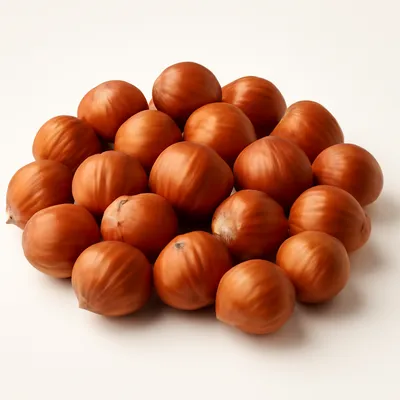


Giovanni Podio, a pastry-cook from Chivasso in Piedmont's Canavese district, created nocciolini around 1850. The dialect name noasèt is drawn from the French noisette (hazelnut), evidence of the deep culinary cross-pollination between Piedmont and France. In 1900, Podio's son-in-law Ernesto Nazzaro presented the confections at the Paris Exposition Universelle, where they won acclaim and brought this Canavese sweet to international attention. Nocciolini are now listed as a Piedmontese traditional agri-food product (PAT). A confraternity dedicated jointly to zabaione and nocciolini exists in Chivasso, attesting to the canonical pairing.
Ethereally light and barely a mouthful, each biscuit dissolves on the tongue in a warm breath of roasted hazelnut and restrained sweetness. A faintly crisp shell gives way to a cloud-like interior, with a clean, lingering nut-oil finish that invites another.
Beaten egg whites form a stable foam of denatured proteins surrounding air bubbles; hazelnut oil released during grinding partially disrupts the protein film of some bubbles, giving the batter a texture midway between meringue and macaron. During baking at around 140 °C, surface moisture evaporates rapidly and the outer shell sets while steam pressure inside continues to expand the mass, causing the characteristic surface cracking. Residual sugars caramelise lightly at the edges, producing the pale gold colour and thin, brittle crust.
Variations
Strict traditionalists use only the three canonical ingredients. Some producers grind the hazelnuts more coarsely for added textural crunch; others add a hint of vanilla or a scrape of lemon zest. A few artisans reduce sugar slightly to let the hazelnut's natural bitterness come forward. The classic accompaniment is zabaione; nocciolini are also dipped into Passito or Moscato d'Asti.
On the Palate
Where Nocciolini di Chivasso sits in the Italian flavor cloud
Ingredients
Serves 8How it's made
6 steps · 20 min
- 110 min
Preheat oven to 170 °C. Spread hazelnuts on a baking tray and toast for 10 minutes until golden and fragrant. Tip into a clean cloth and rub briskly to remove the skins while still warm.
- 25 min
Combine toasted hazelnuts and sugar in a food processor; pulse and grind to a fine, slightly oily meal — the texture should resemble damp sand.
- 35 min
Whip egg whites with a pinch of salt in a clean, grease-free bowl to stiff, glossy peaks.
Watch outWhip the whites in a spotless grease-free bowl to stiff glossy peaks — any fat and they won't hold; this foam is what gives the cookies their lift and crackle.
- 43 min
Add the hazelnut-sugar meal to the beaten whites in two additions, folding gently with a spatula using a cutting motion to keep as much volume as possible.
Watch outFold the hazelnut meal in gently with a cutting motion — the nut oil deflates the foam fast, so keep as much air as you can or the cookies bake flat and dense.
- 55 min
Drop level teaspoons of batter onto parchment-lined baking trays, spacing 2 cm apart; each drop should be roughly 1 cm in diameter.
- 635 min
Bake at 140 °C for 18–20 minutes until pale gold and cracked across the surface. Cool completely on the tray before lifting — they firm up as they cool. Store in an airtight tin.
Archive tool suggestions — not reviewed
These legacy suggestions have not been evidence-reviewed and are not presented as required tools.


