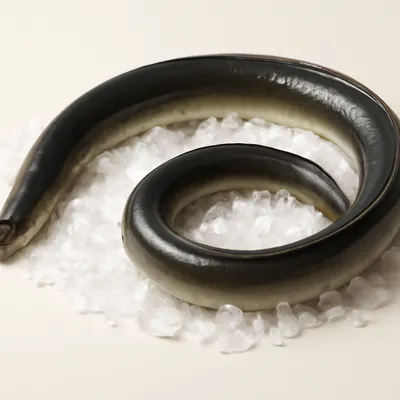
A Murano island dish in which lagoon eel is cut at intervals, laid on a thick bed of bay leaves, splashed with vinegar, covered with more bay, and baked slowly in its own fat — the method named for the refractory stone slab on which glassblowers once left freshly blown pieces to cool. Served with soft white polenta.




The name comes from the ara, the refractory stone slab used in Murano's glassblowing furnaces to set freshly blown pieces to cool and anneal. After the working day ended and the furnace heat lingered in the stone, workers placed eel — caught abundantly in the Venetian lagoon — on a bed of bay leaves over the warm slab to cook slowly through the night, an economy of fuel that produced a dish of remarkable fragrance. Italian Wikipedia's entry on Venetian cuisine confirms the preparation: a large eel baked for hours on bay leaves. A local legend holds that Doge Andrea Gritti, who died in Venice on 28 December 1538, was so devoted to eel that he is said to have eaten to fatal excess at the Christmas table; the tale is unverified by contemporaneous record but reflects the esteem in which bisato was held across Venetian society.
The flesh is yielding and unctuous, threaded with rendered fat and carrying a warm resinous bay fragrance; the skin, tightened by the vinegar, yields cleanly at the tooth without any slick or muddy note.
Eel is naturally high in fat (15–25% by weight). During slow baking at 160°C, intramuscular fat renders out progressively, self-basting the flesh and maintaining a moist cooking environment. Bay leaves release volatile aromatics — principally 1,8-cineole, linalool, and eugenol — at baking temperatures, while their mass insulates the eel from direct radiant heat and catches dripping fat, generating aromatic wisps of smoke that perfume the meat from below. The acetic acid in the vinegar denatures surface proteins and tenderises the skin while brightening the overall flavour. Long, gentle heat converts the collagen in the eel skin and connective tissue to gelatin, giving the finished flesh its characteristic silky cohesion.
Variations
Some Murano cooks tuck crushed garlic cloves between the bay leaves for an extra layer of savour. Modern preparations often use a lidded roasting pan to replicate the enclosed heat of the original stone-slab method. The traditional accompaniment of soft white polenta may be replaced with grilled polenta slices.
On the Palate
Where Bisato su l'ara sits in the Italian flavor cloud
Ingredients
Serves 4How it's made
8 steps · 30 min
- 115 min
Scale, gut, and remove the head from the eel; cut it into 6 cm segments, rinse thoroughly under cold water, and pat completely dry with kitchen paper.
- 25 min
Season the eel segments lightly on all sides with sea salt and coarsely ground black pepper.
- 33 min
Lay a 2 cm deep bed of dried or fresh bay leaves across the base of a heavy clay baking dish or thick-based roasting pan.
- 43 min
Arrange the eel segments skin-side down in a single layer over the bay leaves.
- 52 min
Splash the eel evenly with 4–5 tablespoons of white wine vinegar.
- 62 min
Cover the eel completely with a second generous layer of bay leaves, pressing gently to ensure full contact.
Watch outBury the eel fully under a second thick layer of bay — the leaves shield it from direct heat and their smoke perfumes the flesh from above.
- 770 min
Bake in a preheated oven at 160°C for 65–75 minutes; the eel fat will render and pool, and the bay leaves will darken but should not char.
Watch outBake until the fat renders and pools and the bay darkens but doesn't char — blackened leaves turn the whole dish acrid.
- 85 min
Remove the upper bay layer, transfer the eel segments to a warmed serving platter, and serve immediately with soft white polenta.
Archive tool suggestions — not reviewed
These legacy suggestions have not been evidence-reviewed and are not presented as required tools.