Tirunelveli halwa is a dense, jewel-dark sweet made from starch extracted from soaked and germinated whole wheat, slow-cooked for hours in a heavy bronze vessel with ghee and jaggery until it achieves a uniquely chewy, pull-apart texture. The Iruttu Kadai — the 'dark shop' — in Tirunelveli town opens only after sundown, serves by kerosene lamp, and has dispensed this single item since the late nineteenth century, drawing pilgrims from across Tamil Nadu.



Halwa as a food category reached southern Tamil Nadu through Arab trade networks connecting the Coromandel coast with the Persian Gulf — the word itself derives from Arabic ḥalwā, meaning simply 'sweet.' In Tirunelveli, the local adaptation replaced semolina or tahini-based preparations with starch extracted from germinated whole wheat, a more labor-intensive method that produces a uniquely elastic texture when slow-cooked with local jaggery and ghee. Dedicated halwa shops had established themselves in Tirunelveli town by the late nineteenth century, the earliest run by the Singh family and traced to the 1880s. The most celebrated is the Iruttu Kadai in the old town, founded around 1900 by Krishna Singh, a Rajput migrant: it opens only after dark, lit by a single lantern, sells no other item, and has become one of Tamil Nadu's most famous single-product food destinations — a ritual as much as a sweet.
The first bite is unexpectedly yielding — the halwa tears rather than crumbles, releasing warm caramel and toasted wheat aromas layered with a deep, bittersweet molasses note from the jaggery. The texture is dense and slightly elastic, and a film of clarified butter coats the tongue, making each mouthful feel simultaneously rich and clean.
Whole wheat berries are soaked overnight to begin germination; sprouting activates amylase enzymes that start breaking down surface starch chains, which slightly modifies the final texture toward a more cohesive chew. Vigorous kneading under cold water separates starch granules from the bran and gluten matrix; the milky water settles into a dense slurry. During the long cook, starch granules gelatinize above 60°C, absorbing water and swelling into a thick, translucent paste. Continuous stirring in the heavy bronze vessel prevents localized scorching and promotes even hydration. Jaggery, added progressively, undergoes Maillard browning and partial caramelization at the sustained temperatures, building the mahogany color and complex bittersweet depth. Ghee — added in quantities sometimes approaching equal weight to the starch — acts as a plasticizer: fat molecules coat and lubricate the starch chains, preventing tight cross-linking and producing the characteristic oily, pull-apart consistency that distinguishes this halwa from all other Indian sweets.
Variations
Paal halwa (milk halwa) from the same Tirunelveli tradition substitutes reduced whole milk for wheat starch, producing a softer, lighter sweet. Some makers add cardamom or edible camphor to the halwa, though the Iruttu Kadai school uses neither spice, relying on caramelized wheat and ghee alone. Cashew halwa and moong dal halwa are widespread alternatives found across Tamil Nadu but belong to separate traditions. In North India, wheat-based suji halwa uses semolina rather than extracted starch, yielding a grainier, lighter result.
On the Palate
Where Tirunelveli Halwa sits in the Indian flavor cloud
Ingredients
Serves 6How it's made
8 steps · 30 min
- 11440 min
Soak 500g whole wheat berries in cold water for 18–24 hours until the berries are swollen and just beginning to sprout.
- 230 min
Drain the wheat and knead it firmly in a large bowl under successive rinses of cold water, working the grain vigorously until the rinsing water runs consistently milky-white; collect all starchy water in a large vessel.
- 3120 min
Allow the starch slurry to settle undisturbed for at least 2 hours; carefully decant and discard the clear water sitting on top, leaving only the dense white starch sediment.
Watch outLet the starch slurry settle at least two hours, then pour off only the clear water — disturb the sediment and you lose the starch that gives the halwa its body.
- 430 min
Pour the starch slurry into a heavy bronze uruli or thick-bottomed steel pan; cook on medium heat, stirring constantly with a long wooden paddle, until the mixture thickens and begins to pull from the sides.
- 520 min
Add 400g grated jaggery in three stages, incorporating each addition fully before adding the next; continue stirring vigorously to prevent sticking.
- 615 min
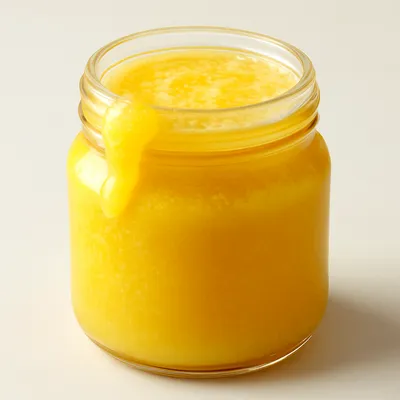
Stream in 200–250ml ghee gradually, a few tablespoons at a time, stirring to emulsify each addition fully into the thickening paste.
- 775 min
Reduce to low heat and cook for a further 60–90 minutes without pausing the stirring, until the halwa is deep mahogany-brown, glossy, and pulls cleanly from the pan with each stroke.
Watch outCook stirring until it turns deep mahogany and pulls cleanly from the pan — stop while it still stretches and yields; cook past that and it sets brittle instead of chewy.
- 810 min
Transfer to a greased plate; allow to cool for 10 minutes before portioning — the halwa firms slightly as it cools but should remain chewy and yielding, never brittle.
Archive tool suggestions — not reviewed
These legacy suggestions have not been evidence-reviewed and are not presented as required tools.


