A thin, warming gruel from Rajasthan's desert heartland, made by dry-roasting bajra (pearl millet) flour and stirring it into hot buttermilk or water with jaggery, fenugreek seeds, ghee, and garlic. Raab has been the Rajasthani antidote to winter cold for generations—given especially to new mothers, the elderly, and anyone needing restoration after illness.






Raab is a centuries-old staple of Rajasthani rural life, born of the desert region's grain-and-dairy economy. Pearl millet has been cultivated in Rajasthan's arid zones since antiquity, and buttermilk—a by-product of butter-making—became the natural medium in which roasted grain flours were dissolved and cooked. The resulting gruel, enriched with jaggery for iron and fenugreek seeds recognized in Ayurvedic tradition as galactagogues, became the prescribed postpartum restorative across Rajasthan and neighboring Gujarat. Ayurvedic dietetics classifies pearl millet as a heating grain suitable only in winter, confining Raab preparation to roughly October through February—a seasonal restriction still observed in Marwari households today.
Hot, slightly thick, and faintly sour from buttermilk; jaggery adds molasses sweetness while fenugreek delivers a mild herbal bitterness and garlic a faint pungency. Warming without heaviness, it coats the throat smoothly.
Dry-roasting the bajra flour triggers Maillard browning at the starch surface and drives off residual moisture, generating nutty aromatic compounds. When whisked into hot buttermilk around 70–80°C, the starch granules swell and gelatinize, thickening the liquid into a pourable gruel. Fenugreek seeds contribute mucilaginous galactomannan polysaccharides that further smooth and bind the texture. Jaggery dissolves uniformly in the hot base, and ghee carries fat-soluble aromatics while adding mouthfeel.
Variations
The methi variant uses roasted whole fenugreek seeds as the base instead of bajra flour—darker, more bitter, and particularly prescribed for postpartum recovery. A sweet jaggery-dried-ginger version is the classic new-mother preparation. Khatti Raabdi thickens the same buttermilk-flour base overnight into a fermented sour porridge, served the next morning thinned with fresh buttermilk.
On the Palate
Where Raab sits in the Indian flavor cloud
Ingredients
Serves 2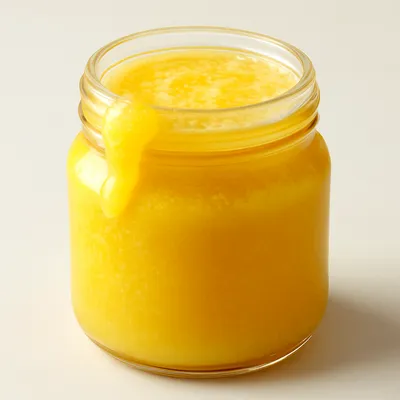

How it's made
7 steps · 5 min
- 14 min
Dry-roast the bajra flour in a heavy-bottomed pan over low heat for 3–4 minutes, stirring constantly, until lightly golden and smelling nutty. Remove from heat and cool for 2 minutes.
Watch outRoast the bajra flour just to lightly golden and nutty-smelling — pull it before it darkens, or a scorched flour turns the whole raab bitter.
- 22 min
In a bowl, whisk together the buttermilk and water until completely smooth and lump-free.
- 32 min
Gradually whisk the cooled, roasted bajra flour into the buttermilk mixture until fully incorporated with no lumps.
- 41 min
Heat ghee in the same pan over medium heat. Add fenugreek seeds and let them splutter and darken slightly, about 30 seconds.
- 51 min
Add the roughly crushed garlic and sauté for 30 seconds until fragrant.
- 61 min
Pour in the bajra-buttermilk mixture. Add salt and jaggery. Reduce heat to low and stir continuously to prevent scorching.
- 710 min
Cook for 8–10 minutes, stirring constantly, until the raab is smooth, lightly thickened, and steaming throughout. Taste for salt and sweetness balance. Serve hot.
Watch outKeep it on low and stir the whole time — the buttermilk base scorches and curdles the instant it catches the bottom.
Archive tool suggestions — not reviewed
These legacy suggestions have not been evidence-reviewed and are not presented as required tools.


