Sacred whole-wheat halwa of the Sikh gurdwara, cooked in precisely equal weights of atta, ghee, and sugar in a cast-iron karahi, then distributed without distinction to every visitor; its preparation and mandatory equal sharing are codified in the Sikh Rehat Maryada.

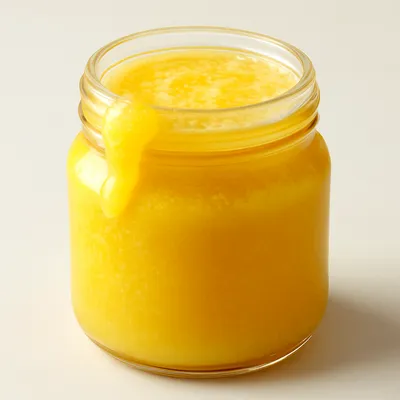


The langar (community kitchen) tradition established by Guru Nanak (c.1469–1539) embedded communal, equal-share meals as a pillar of Sikh practice. Karah Prashad has accompanied gurdwara worship as a sacred flour-and-ghee offering for generations; its precise equal-weight formula and the ritual of universal distribution are codified in the Sikh Rehat Maryada, formally promulgated by the Shiromani Gurdwara Parbandhak Committee in 1945—making it one of the few sacred foods worldwide whose preparation is governed by an institutional religious code.
Warm, dense, and smooth from generous ghee, with a subtly grainy whole-wheat undertone beneath the sweetness; the fat coats the palate completely, and the residual warmth lingers long after each bite.
As atta is roasted in hot ghee at around 160–180℃, the Maillard reaction between reducing sugars and amino acids in the flour produces nutty, browned flavor compounds; starch granules simultaneously begin absorbing fat and lightly toasting. When boiling sugar syrup is poured in, the starch granules rapidly gelatinize—absorbing water and swelling to form a dense gel network—while the ghee coats the gelatinized granules, creating a smooth, cohesive, glossy mass. The moment free ghee releases and pools at the karahi wall signals that all excess water has evaporated and the starch-fat complex has fully stabilized.
Variations
Cardamom-scented version adds crushed green cardamom pods during the roasting stage for a floral note; jaggery (unrefined palm sugar) substitutes white sugar for an earthier, mineral-edged sweetness; a thinner, pourable consistency achieved by increasing water is sometimes prescribed in convalescent diets; some households use half ghee and half neutral oil to reduce cost, though gurdwara-standard Karah Prashad uses only pure ghee.
On the Palate
Where Karah Prashad sits in the Indian flavor cloud
Ingredients
Serves 8How it's made
7 steps · 5 min
- 12 min
Measure equal weights of whole-wheat atta, ghee, and sugar; separately measure water at twice the weight of the sugar.
- 22 min
Melt ghee in a cast-iron karahi over medium-high heat until fully liquid and shimmering.
- 312 min
Add the atta to the hot ghee and roast, stirring constantly with a wooden ladle, until the mixture turns golden-brown and smells nutty, about 10–12 minutes.
Watch outRoast the atta in the ghee, stirring constantly, until it turns golden-brown and smells nutty — under-roasted it tastes raw and pasty, so don't rush the ten minutes.
- 44 min
In a separate saucepan, dissolve the sugar in the water and bring to a full rolling boil.
- 52 min
Carefully pour the boiling sugar syrup into the roasted atta in a slow, steady stream while stirring vigorously—stand back as steam will billow sharply.
Watch outPour the boiling syrup into the roasted flour in a slow stream while stirring hard — and stand back, it billows steam and spits fiercely.
- 66 min
Continue stirring over medium heat, scraping the bottom of the karahi, until the mixture thickens and becomes glossy and the ghee releases and pools at the sides.
Watch outKeep stirring until the mixture turns glossy and the ghee releases and pools at the sides — that's the moment it's done.
- 71 min
Remove from heat and serve warm in small, equal portions to all present.
