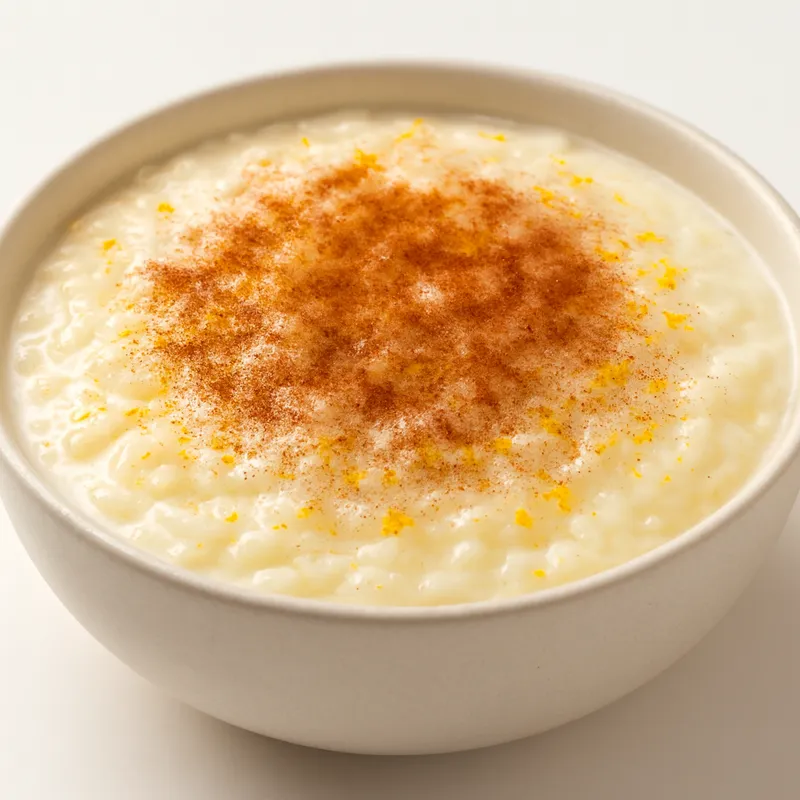
Long-baked rice pudding (5+ hours at low temperature) of whole milk, sugar, and cinnamon in earthenware — the name means twists-the-snout in old Norman dialect, referring to the burned skin you crack through.





Teurgoule emerged in 18th-century Normandy; one documented account credits François-Jean Orceau de Fontette, intendant of Caen under Louis XV, with importing rice around 1757 during a food shortage and spreading the recipe, while a popular legend says Norman corsairs seized rice and cinnamon from Spanish galleons — Norman ports were among the European entry points for spice-trade cinnamon and cane sugar coming via the West Indies, and Normandy folded both into a peasant rice dish (rice itself imported via the same trade routes). The name is old Norman patois — teurd-goule / tord-gueule, meaning twists the mouth, most often explained by the pudding being eaten scaldingly hot (it burns and makes you pull a face). The Confrérie de la Teurgoule de Normandie still certifies cooks to a strict recipe.
18th-century Honfleur and Pays d'Auge — Norman ports were European entry points for spice-trade cinnamon and cane sugar. Name is old Norman patois teurd-goule, twists the snout. Five hours at 150°C in a tall narrow pot Maillards the milk-sugar surface to dark-cinnamon skin while rice cooks at 95°C below.
Crack through a near-black, almost charred-cinnamon skin into a custard-thick rice below — pale beige, dense, the rice grains softened to mush in places, intact in others. Traditionally eaten hot, straight from the oven (hot enough to scald — the source of the name); the milk-fat sets and the texture firms as it cools, but the dish is a hot one; the texture is closer to clafoutis than to risotto. Cinnamon dominates the front of the palate — used here in quantities rare for French baking. If the skin doesn't crack with audible resistance, it baked too short or covered.
Five hours at 150°C does what fast cooking cannot — milk proteins slowly Maillard-react with sugar at the surface, building the dark cinnamon skin while the rice underneath cooks at 95°C in still-liquid milk. The narrow tall pot is functional: the small surface-to-volume ratio concentrates evaporation onto a small skin while the depth keeps the rice submerged. UHT milk fails because its proteins are already partially denatured and won't form the custard texture; pasteurized whole milk only.
Variations
Confrérie de la Teurgoule de Normandie certified version (strict recipe); Honfleur original (5 hours at 150°C); Caen variant uses brown sugar; UHT-milk attempts always fail because pre-denatured proteins won't form the custard texture.
On the Palate
Where Teurgoule sits in the French flavor cloud
Ingredients
Serves 6How it's made
5 steps · 15 min active + 5 hours 45 min waiting
- 10 min
Use a deep narrow earthenware pot (terrine teurgoule, 18cm diameter, 14cm tall) — the shape is functional, not aesthetic. No substitute works the same.
- 25 min
In the pot mix 150g short-grain rice (Arborio or Camargue round), 200g sugar, 8g ground cinnamon, 5g salt. Stir to coat — the cinnamon must be evenly through the dry mix.
- 33 min
Pour 2L cold whole milk (full fat, never UHT — needs proteins intact). Stir once. The rice must be totally submerged, the pot still 4cm from rim — milk expands slightly during the long bake.
Watch outUse pasteurized whole milk, never UHT — UHT proteins are already denatured and won't set into the custard; and leave a few centimeters below the rim, the milk climbs as it bakes.
- 4320 min
Set in a 150°C oven uncovered. Do not stir. Bake 5-6 hours — the surface develops a deep amber, almost burnt skin. The rice underneath swells fully and absorbs the milk into a thick custard.
Watch outDon't stir once it's in the oven — the whole point is a dark skin forming on top while the rice cooks submerged below; bake until the surface goes deep amber, almost scorched.
- 55 min
Cool completely — 4 hours minimum, ideally overnight. Eat cold, scooping through the dark cinnamon skin into the creamy rice below. Serve in the pot, with falue (Norman brioche) on the side.
Watch outCool it right down before eating — warm teurgoule is loose and raw-tasting; the custard only firms and the cinnamon deepens after hours cold, ideally overnight.
Archive tool suggestions — not reviewed
These legacy suggestions have not been evidence-reviewed and are not presented as required tools.