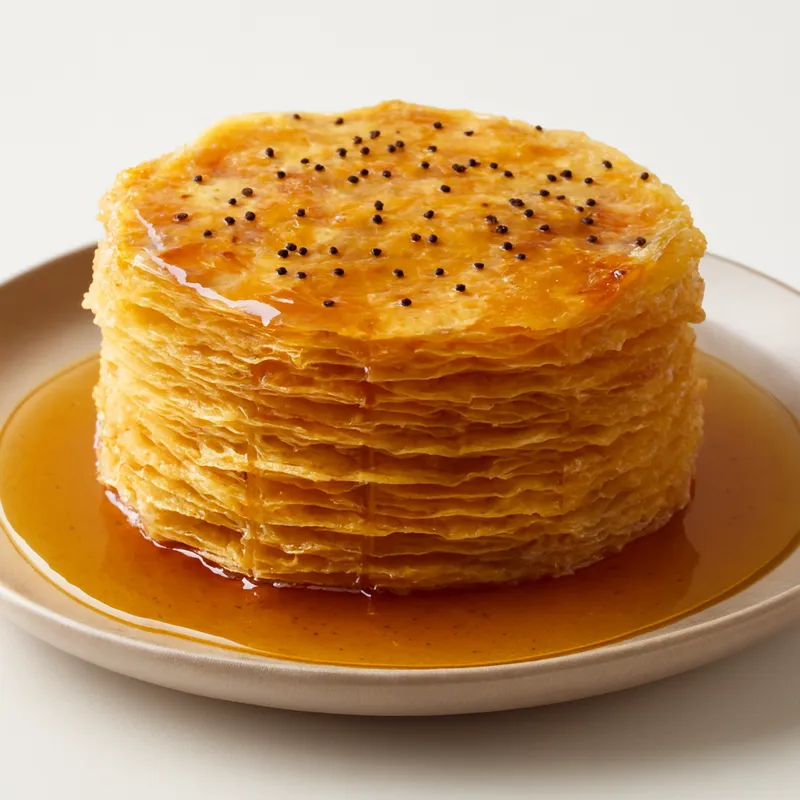
Yemeni fermented sponge-pancake: a thin batter of sorghum or all-purpose flour fermented overnight, cooked on a hot griddle on one side only — producing a spongy, bubble-pocked round flatbread with a tangy aroma. Eaten for breakfast with honey, ghee, fava beans (fool), or saltah; the Sana'a morning bread.


Lahoh (also called laxoox in Somalia) is the Yemeni-Horn of Africa flatbread shared across the Red Sea cultures. Made fresh daily; eaten while warm. The overnight fermentation creates lactic-acid tang and the signature bubble structure. Sold from morning bakeries and made in every Yemeni household for breakfast.
Tear off a piece of lahoh — soft, spongy, full of tiny bubble holes from the fermentation, with a tangy fermented aroma. The cooked side is lightly golden; the bubble side is open and porous. Bite: tender-chewy texture, lemony tang from the lactic acid, mildly bread-y flavor. Spread with honey; the bread absorbs the sweetness. Or use to scoop saltah; the bubble structure traps the stew. The Yemeni morning bread.
Overnight yeast fermentation produces both CO2 (the bubbles) and lactic acid (the tang) from sugar metabolism. The thin batter allows bubbles to rise and lock in place during the one-sided cook — flipping would collapse them. Sorghum flour (when available) gives distinctive earthy flavor; wheat flour is the common substitute outside Yemen. No oil ensures the dry top remains a perfect-holes sponge.
Variations
Sorghum lahoh uses traditional sorghum flour for the original taste. Multi-grain lahoh uses millet/barley mix. Sweet lahoh adds extra sugar and is eaten with milk. Restaurant version makes them thicker for sturdier breakfasts.
On the Palate
Where Lahoh sits in the Yemeni flavor cloud
Ferment the thin batter overnight so it goes bubbly and tangy, then cook each lahoh on one side only — never flip — so the rising bubbles set into that signature holey sponge.
Ingredients
Serves 6How it's made
8 steps · 30 min active + 11 hours 30 min waiting
- 1725 min
Make starter: combine 250 g sorghum flour (or 200 g all-purpose flour + 50 g whole-wheat flour as substitute) + 1 tsp instant yeast + 1 tbsp sugar + 350 ml warm water + ½ tsp salt. Whisk to smooth thin batter. Cover; ferment overnight (8-12 hours) at room temperature.
- 21 min
Before cooking: stir the batter gently. It should be bubbly and slightly sour-smelling. If too thick, add splashes of warm water.
Watch outThe rested batter should be visibly bubbly and smell lightly sour before you cook.
- 33 min
Heat a flat non-stick skillet (or traditional Yemeni tawa) over medium-low heat. No oil needed (lahoh is dry-cooked).
- 41 min
Pour ⅓ cup batter into the center; tilt the skillet to spread it to a 20-cm round, or use a ladle to spread.
Watch outPour a third of a cup and tilt or ladle it out to an even 20 cm round.
- 52 min
Cook 90 seconds — DO NOT FLIP. The bubbles will rise to the surface; the top should look dry-set; the bottom should be lightly golden.
Watch outCook 90 seconds without flipping — watch the holes open across the top and the surface set dry.
- 61 min
Remove with a spatula. Place on a clean cloth; cover with another cloth to keep warm and soft.
Watch outLift onto a cloth and cover with another so they stay warm and pliable.
- 716 min
Repeat for the remaining batter (should make 6-8 lahoh).
- 82 min
Serve warm for breakfast, with honey + ghee, alongside saltah, or with mashed fava beans.