Fermented shrimp paste, the pungent purple-grey ferment that is northern Vietnam's most polarizing condiment. The dense paste is whipped to order with lime juice, sugar, and a little hot oil until it lightens and foams into a frothy purple dip. It is the non-negotiable partner to bun dau and to Hanoi's grilled fish dish cha ca, and a back-note in many braises and soups.
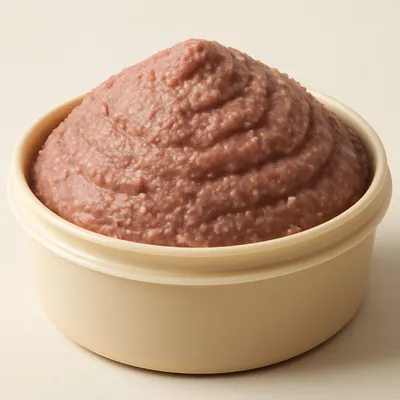


Mam tom is made by salting and fermenting tiny shrimp or krill into a thick paste, a preservation method shared across coastal Southeast Asia and akin to the shrimp pastes of neighboring cuisines. In Vietnam it is a northern specialty, central to Hanoi's food identity, where small estuarine shrimp are salted and left to break down over months until they become a homogeneous paste with a powerful aroma. The salt both preserves and drives the fermentation, while enzymes and bacteria deepen the savor into intense umami. Its precise origin is undocumented, but it is inseparable from two Hanoi institutions, bun dau mam tom and cha ca, where no substitute is accepted.
Raw from the jar it is fierce, salty, and unmistakably fishy with a deep funk that fills the room. Whipped with lime and a little hot oil, it transforms: the acid and air lighten the color to lavender-purple and foam it up, the sugar rounds the edges, and the aroma, while still strong, opens into something savory rather than merely pungent. On the tongue it is intensely umami and salty, a tiny dab carrying enormous flavor. Brushed onto fried tofu or grilled fish it is electric; used neat it overwhelms.
The paste itself is the product of slow enzymatic fermentation under heavy salt, which breaks the shrimp proteins down into glutamate-rich, deeply savory compounds while preventing spoilage. The whipping at the table is the second mechanism: a vigorous beat with lime juice and a spoon of smoking-hot oil aerates the paste, the acid and fat emulsifying it into a light foam. This both tempers the raw pungency and changes the color, while a pinch of sugar balances the salt. The hot oil is poured in last for its bloom of fragrance. A splash of rice wine is sometimes added to soften the smell further.
Variations
The bun dau dip is whipped loose and frothy with plenty of lime and hot oil; the cha ca version may be thinner and balanced against dill and turmeric fish. Some cooks add a little rice wine, kumquat instead of lime, or sliced chili. Beyond the dip, a spoonful of unwhipped paste is stirred into broths and braises such as certain bun rieu and beef stews for depth. Mam tep is a related paste made from even smaller shrimp, often eaten as a side with boiled pork and herbs.
On the Palate
Where Mam Tom sits in the Vietnamese flavor cloud
Ingredients
Serves 4How it's made
6 steps · 10 min
- 11 min
Spoon the fermented shrimp paste into a bowl.
- 21 min
Add sugar and a generous squeeze of fresh lime juice.
- 34 min
Beat vigorously with chopsticks or a fork until the paste lightens in color and begins to foam.
Watch outBeat vigorously until the paste lightens in color and starts to foam — that aeration is what tames the raw pungency into something eatable.
- 42 min
Heat oil until smoking, then pour a little over the paste and beat again to froth it up.
Watch outPour the smoking-hot oil over last and beat again — the bloom of hot oil is where the fragrance lifts and the froth sets.
- 51 min
Adjust with more lime, sugar, or sliced chili to taste.
- 61 min
Serve immediately as a dip for fried tofu, grilled fish, or boiled pork.


