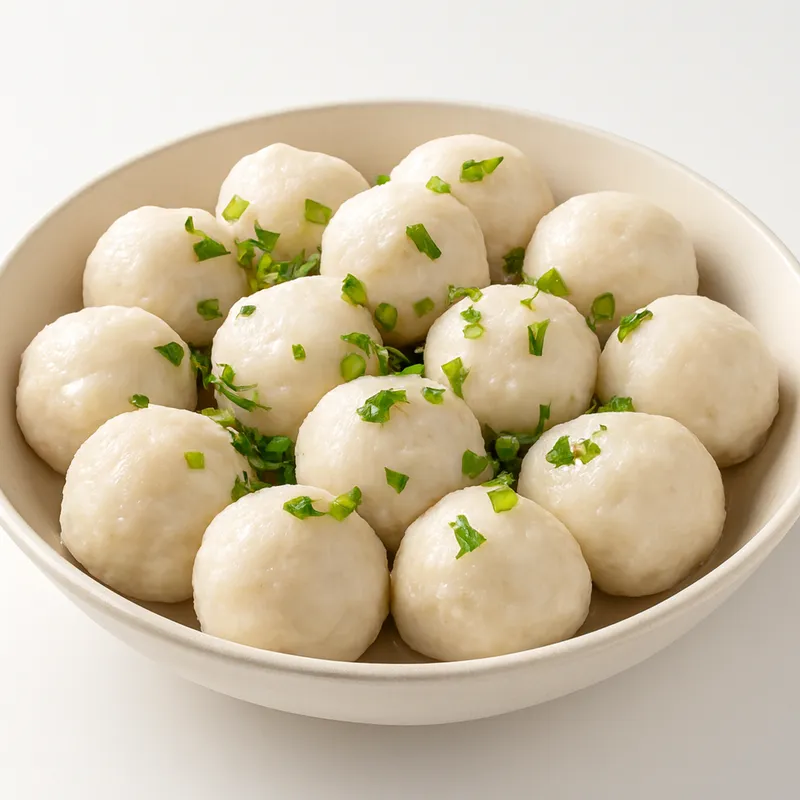





From Fuzhou, Fujian, documented since the late Qing (19th century) when coastal Min cuisine refined fish-paste cooking. Fuzhou sat on rich fishing grounds and developed at least four distinct fish-paste forms — fish balls, fish noodles, yan pi (fish-paste wrappers for wonton), fish cakes. The hollow stuffed ball is the technically hardest of the four; mastering it was a Fuzhou cook's credential.
Late-Qing Fuzhou fish-paste tradition built on rich Min coastal grounds — at least four distinct fish-paste forms (balls, noodles, yan pi wrappers, cakes). The hollow stuffed ball is the technically hardest. Salt goes in early or myosin won't extract, leaving a mushy wall; poach gently — boiling cracks the skin and lets the pork juice escape.
A clear soup with white, ping-pong-sized balls floating in it. Bite one and the wall splits to a hollow center filled with seasoned minced pork — a hot juice burst. The wall itself is bouncy, pale, almost rubbery in the best way; pure fish, no flour padding. Soup is light: bone broth, white pepper, a little scallion. The trick is biting in carefully or the pork juice scalds your mouth.
The fish wall is hand-pounded fish paste (eel, shark, or yellow croaker) beaten until the proteins (myosin and actin) cross-link into a springy gel — like making a sausage emulsion, but with fish and no fat added. Salt is essential and must go in early; without it, myosin won't extract and the wall stays mushy. The hollow center is shaped by hand around a pork ball, then poached gently — boiling cracks the wall.
Variations
Fuzhou old town shops (永和鱼丸, since 1934) use eel for the wall; Mawei (马尾) suburban version uses shark; Taiwanese 福州鱼丸 in Tainan and Keelung often run smaller and sweeter; Hong Kong dim sum 鱼皮饺 borrows the fish-paste wall but folds rather than spheres.
On the Palate
Where Fuzhou Fish Balls sits in the Chinese flavor cloud
Ingredients

How it's made
5 steps · 24 min
- 15 min
In a large bowl, combine the fish and pork until smooth and sticky. Use your hands to knead the mixture until it becomes a cohesive paste, about 5 minutes. The mixture should feel smooth and slightly elastic.
Watch outEnsure the paste is well-kneaded; under-kneading will result in crumbly fish balls.
- 210 min
Shape the paste into small balls, about 1 inch in diameter. Use wet hands to prevent sticking, and place them on a tray lined with parchment paper.
- 35 min
Bring a pot of water to a simmer over medium heat. Gently drop the fish balls into the water and cook until they float to the surface, about 5 minutes. The fish balls should be firm and springy to the touch.
Watch outAvoid vigorous boiling; it can break apart the fish balls.
- 42 min
In a separate pan, heat a tablespoon of oil over medium heat. Add sliced ginger and scallions, stirring until fragrant, about 2 minutes. Add soy sauce and a splash of water to create a light sauce.
- 52 min
Add the cooked fish balls to the pan and toss them gently in the sauce for 2 minutes. The fish balls should be evenly coated and glossy.
Archive tool suggestions — not reviewed
These legacy suggestions have not been evidence-reviewed and are not presented as required tools.