
Teochew lard mooncake is the Mid-Autumn mooncake of Chaozhou and Shantou, built on a flaky, layered lard pastry rather than the soft syrup skin of the Cantonese mooncake. Lao is the Chaoshan word for lard, and the cake is named for it: a water-lard dough and a flourless lard-shortening dough are folded and rolled together so the baked skin bakes up pale, crisp and built of fine leaves, wrapped thickly around a rich sweet paste — classic fillings are black-bean paste, mung-bean paste or taro, sometimes with candied winter melon, sesame or a salted yolk. Where the Cantonese mooncake is soft-skinned and thin-filled, the Teochew lard cake is thin-skinned but crisp, with a generous, clean-tasting filling. It is a treasured gift of the Teochew Mid-Autumn and a taste of home for Teochew people overseas.




In Chaoshan the mooncake is called lao-bing — lao, in the Chaoshan dialect, meaning lard — because lard is worked into the flour to make the skin; the cake is, literally, a "lard cake." Its making is a long-standing Mid-Autumn tradition of the region, though its exact origins are not securely dated; gifting lard mooncakes at Mid-Autumn has long been local custom, and the cake is a carrier of homesickness for Teochew communities abroad. What sets it apart belongs to its pastry, not legend: the Teochew lard mooncake is a true flaky pastry of the same family as the Suzhou-style mooncake — a laminated skin of repeatedly folded and rolled lard shortening and water-lard dough — and so stands wholly apart from the Cantonese mooncake's soft golden syrup skin. Famous makers are associated with the craft, among them century-old houses of the old Chaozhou city and the lard mooncakes of Guiyu in Chaoyang, and the cakes are most esteemed thin-skinned and crisp, with a filling that is thick yet clean on the palate.
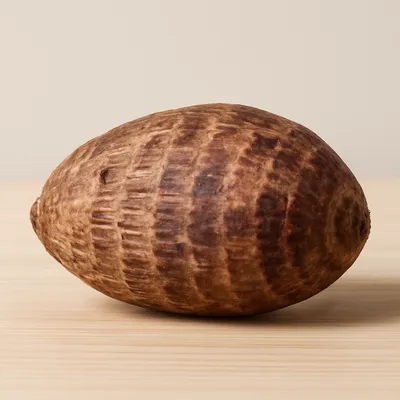
The skin shatters into thin, dry, pale leaves that flake and fall as you bite — short and crisp from the lard, with the faint savor of it under the sweetness — quite unlike the dense, chewy give of a syrup-skin mooncake. Beneath is a thick layer of filling: black-bean paste deep and smooth, mung-bean paste cool and clean, or taro soft and fragrant, the sweetness rich but not heavy, sometimes cut by translucent bits of candied winter melon or a thread of salt from a yolk. The pleasure is the contrast of a fragile, leaf-crisp lard crust against a dense, smooth, generous paste — light to the bite where a Cantonese mooncake is soft and dense.
The flake is laminated pastry. Two doughs are made: a water-lard dough of flour, lard and water, and a flourless shortening dough of flour rubbed only with lard. The water dough is kneaded until its gluten forms an extensible film — some cooks scald part of the flour first, gelatinizing a little of its starch — so it stretches without tearing; the lard dough, having no water, develops no gluten at all and so stays soft and short. The water dough is wrapped around the shortening, then rolled and folded again and again, building dozens of alternating layers of dough and fat. In the oven the lard between the leaves melts and the water in the dough flashes to steam, and that steam, trapped layer by layer, pushes the sheets apart and sets them crisp and separate — the puffing that makes the skin flaky. This is the same flaky-pastry principle as the Suzhou-style mooncake and stands apart from the Cantonese mooncake, whose skin is a soft dough of flour bound with invert syrup, alkaline water and oil that bakes dense, supple and glossy rather than layered. A high oven heat is needed for the shortening to expand and the leaves to lift.
Variations
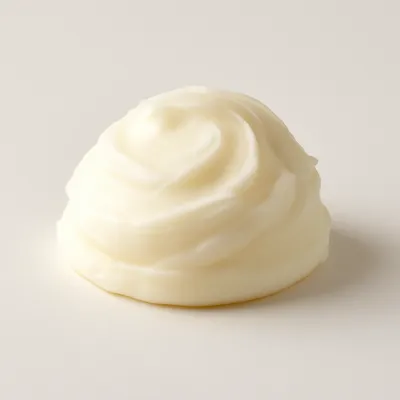
The classic fillings are black-bean paste, mung-bean paste and taro, and a "crystal" version is made with candied winter melon and candied fruit bound translucent; sesame, melon seeds, candied winter-melon bits, lard pieces and a salted yolk all appear, and the filling can run sweet or, in some shops, edge savory. The pastry itself is sometimes folded for a smooth flat top and sometimes for a marbled spiral that shows the layers. By place there are differences of skin and filling across Chaozhou, Shantou, Puning, Chenghai and the well-known lard mooncakes of Guiyu in Chaoyang. It should not be confused with the Cantonese mooncake: that is a soft syrup-skin cake with a thin filling and salted yolk, where the Teochew lard cake is a crisp, layered, lard-pastry cake with a thick paste.
On the Palate
Where Teochew Lard Mooncake sits in the Chinese flavor cloud
Ingredients
Serves 8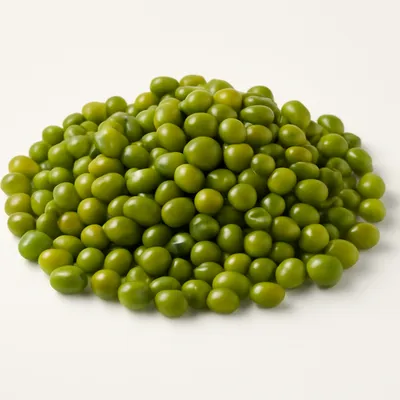

How it's made
8 steps · 1 hour 15 min active + 1 hour 15 min waiting
- 130 min
Make the filling: cook black-bean, mung-bean or taro paste with sugar and a little lard until thick and smooth, then cool and roll into balls.
- 215 min
Make the water-lard dough by kneading flour, lard and water until smooth and elastic enough to pull a thin film; rest it covered.
Watch outKnead the water-lard dough until it pulls a thin, translucent film — that gluten window means it'll stretch through the folds without tearing; too slack and the layers rupture when you roll.
- 310 min
Make the shortening dough by rubbing flour with lard alone into a soft, cohesive paste, no water added.
- 425 min
Wrap a piece of water dough around a piece of shortening, then roll out and fold, and roll and fold once or twice more, building many fine layers; rest between rolls.
- 515 min
Cut and roll the laminated dough into rounds, wrap each thickly around a filling ball, and seal into a smooth cake.
- 610 min
Press or shape the cakes, set them on a tray, and brush or mark the tops as desired.
- 725 min
Bake in a hot oven, around 180-200°C, until the skin is set, pale-gold and flaked into crisp layers.
Watch outBake hot until the skin sets pale-gold and flakes into crisp layers — the lard melts and steam splits the leaves apart; underbaked, the layers stay soft and merge instead of separating.
- 820 min
Cool fully on a rack so the pastry firms and crisps before serving.
Archive tool suggestions — not reviewed
These legacy suggestions have not been evidence-reviewed and are not presented as required tools.


