Strange-Flavor Fava Beans (怪味胡豆) is the defining street snack of Chongqing — whole fava beans (locally called húdòu) deep-fried crisp, then tumbled in a brittle shell of spiced sugar glaze: chili, Sichuan pepper, five-spice, toasted sesame, and hot maltose syrup cooked to the soft-ball stage. The finished beans are amber-brown and rough-textured, almost resembling mulberries. One bite releases all seven Sichuan taste notes simultaneously — sweet, salty, numbing, spicy, sour, savory, and fragrant — in a balance that defies any single label. That untranslatable quality is precisely the meaning of the word guài: strange, and impossible to put down.




The origins of Strange-Flavor Fava Beans are not fully documented and accounts vary. One tradition traces them to Beibei district in Chongqing, where a vendor named Xiong Rongcheng and his wife developed the spiced sugar-coat formula in the early 1920s under the Diehua brand; a competing account places the name's wider circulation only after 1949. What is better attested is that during the Sino-Japanese War, Beibei became a cultural refuge for much of China's literary community, and it was during this period that the snack grew famous. Local Chongqing records hold that the writer Lao She tasted the beans, praised them warmly, and reportedly suggested 'Strange Flavor' as their name — though this account rests on a single local source. After the 1958 nationalization of private business, the recipe was absorbed into the Chongqing Jinyun Food Factory, which formalized 'Jinyun Strange-Flavor Fava Beans' as a registered local specialty. The name húdòu itself echoes the bean's Silk Road origin: classical texts including the Tang-dynasty Taiping Yulan cite the tradition that the Han-dynasty envoy Zhang Qian brought fava seeds back from Central Asia, and the name — beans from the barbarian lands — has remained in use across Sichuan and Chongqing ever since.
Pick up a bean and feel the rough, speckled shell between your fingers — dried sugar crusted over chili flake and Sichuan pepper. Bite down: a hard crack, then all seven flavors arrive together. The sweetness of maltose hits first, immediately flanked by the electric lip-numbness of Sichuan pepper, then chili heat from behind, a thread of sourness from the sweet bean sauce, five-spice warmth deepening underneath, and toasted sesame closing it out. No single flavor leads; none fades. The bean inside is dry-crisp and nutty, not chewy. They are designed to be impossible to eat just one of.
The signature crunch is built across three stages. First, a ten-hour soak in alum solution (potassium alum dissolved in water): alum cross-links with pectin in the bean hull, stiffening the skin so it survives the high-heat fry without splitting or peeling away. Frying at 200°C for 10–15 minutes drives moisture from the bean interior outward, leaving a porous, dry-crisp core. The coating comes last: white sugar and maltose are cooked together to about 115°C, the soft-ball stage. At this temperature the syrup is viscous enough to coat every grain of chili flake and pepper; as it cools around the spice-dusted beans it crystallizes into a glassy shell that seals all seven flavor layers simultaneously. Maltose is crucial here — unlike plain sucrose, it retards crystallization and keeps the shell smooth and non-grainy. The reason all seven tastes arrive at once is that sweet, salty, numbing, spicy, sour, savory, and fragrant activate different receptor pathways in parallel: they do not cancel or merge, but land in concert. This is the philosophical core of the guàiwèi flavor type — complexity through simultaneity, not blending.
Variations
The classic Jinyun and Diehua formula holds all seven flavors in equal balance, using Pixian chili, Hanyuan Sichuan pepper, and a sugar blend of white cane sugar and maltose. Modern factory lines typically simplify toward sweeter and milder, reducing the numbing Sichuan pepper. Chengdu home versions often replace the alum soak with baking soda, yielding a thinner shell and a softer, sweeter result. The same strange-flavor technique is also applied to peanuts (怪味花仁) and cashews, skipping the initial frying and relying solely on the spiced sugar shell — a lighter variation sold widely across Sichuan.
On the Palate
Where Strange-Flavor Fava Beans sits in the Chinese flavor cloud
Ingredients
Serves 4

How it's made
7 steps · 45 min active + 30 min waiting
- 115 min
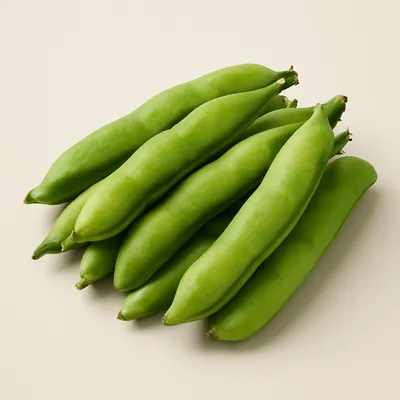
Soak dried fava beans overnight in warm water with a pinch of baking soda until swollen to double their size; drain. Use a small knife to score each bean at the hilum (the dark eye scar) to prevent bursting. Dissolve 5g food-grade alum in 500ml water; submerge the beans and soak for 10 hours. Drain and pat thoroughly dry.
- 220 min
Heat oil to 200°C in a wok or deep pot. Deep-fry the beans in two or three batches for 10–15 minutes per batch, stirring occasionally. They are ready when deep golden-brown and they sound hollow when tapped against the wok. Drain on a wire rack; cool for 5 minutes.
Watch outFry at 200°C until the beans sound hollow when tapped against the wok — a dull thud means the core is still moist and won't crunch.
- 35 min
In a clean wok over medium heat, add a small drizzle of oil and fry the sweet bean paste for 2–3 minutes, stirring constantly, until fragrant and glossy. Scrape into a large heatproof mixing bowl.
- 45 min
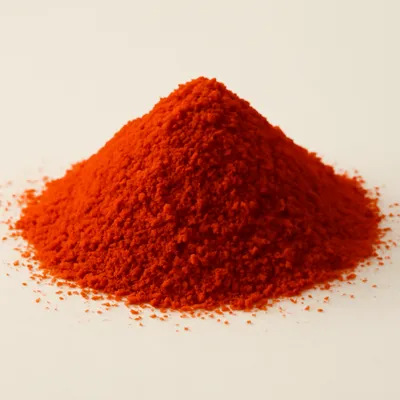
Add the fried beans to the bowl. Sprinkle over chili powder, ground Sichuan peppercorn, five-spice, toasted sesame, and salt. Toss vigorously until every bean is coated in the spice-and-sauce mixture.
- 510 min
In a small saucepan, combine sugar, maltose, and 80ml water. Stir over medium heat until dissolved. Increase heat and cook without stirring until the syrup reaches 115°C — it will form a thin thread when dripped from a spoon.
Watch outCook the syrup to about 115°C, where it strings a thin thread off the spoon — under that it won't set to a shell, past it turns hard and brittle.
- 65 min
Working quickly, pour the hot syrup over the spiced beans in a slow steady stream, tossing constantly with a spatula to distribute evenly. Immediately tip the beans onto a lightly oiled tray and separate any clumped beans while the syrup is still fluid.
Watch outToss fast while the syrup is still fluid, then break clumps apart at once — let it stiffen and the beans cement into one lump.
- 730 min
Leave to cool at room temperature, undisturbed, until the sugar shell has fully hardened and is no longer sticky — about 30 minutes. Store in an airtight container. Best within 3 days.


