Traditional Arabic ice cream famous for its chewy, stretchy, melt-resistant texture — achieved with mastic resin and salep (orchid-root flour) — pounded until sticky and coated in crushed Aleppo pistachios. Inseparable from Damascus's Bakdash parlor, founded c.1885.


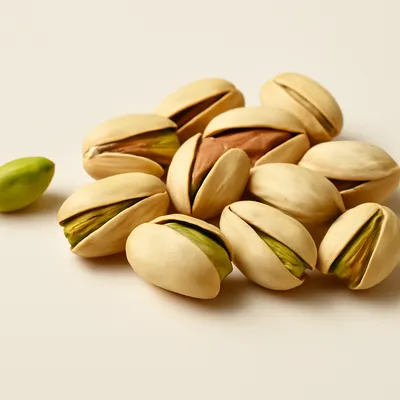
Boza (Arabic ice cream) is inseparable from Damascus through Bakdash, the legendary ice cream parlor founded in the Al-Hamidiyah Souq between 1885 and 1895 during the late Ottoman period — widely regarded as the oldest and most famous Arabic ice cream shop in the Arab world, its pounding of the booza in chilled drums a Damascene spectacle. While Bakdash dates to the late 1800s and hosted Ottoman officials, the recipe itself is centuries older, rooted in ancient Damascene and broader Levantine-Mesopotamian frozen-dessert traditions that used snow from nearby mountains. The Damascus pistachio-coated booza is the iconic form.
Unlike Western ice cream, this resists the tongue — chewy, almost taffy-like, it stretches and pulls. The mastic gives a faint piney-resin perfume; the salep lends a smooth, almost elastic body that never quite melts into liquid. The crushed pistachio coating adds green nuttiness and crunch. It is eaten with effort and pleasure, an ice cream you chew.
Two ingredients set booza apart. Mastic — the resin of Pistacia lentiscus — is a hydrophobic gum that, when dissolved into the warm milk base, forms a stretchy polymer network on cooling, giving the characteristic chew. Salep, flour ground from orchid tubers, is rich in glucomannan, a polysaccharide that absorbs water to form a viscous, elastic gel — it suppresses ice-crystal growth (keeping the texture smooth) and raises the melting point (so the ice cream resists melting). The traditional pounding (beating the chilled mixture in a drum) mechanically aligns and aerates the network, developing the stretch. Pistachio coating is applied by rolling the pounded mass in crushed nuts.
Variations
Qashta (clotted cream) booza is a popular flavor. Modern makers add cocoa or fruit. The Turkish dondurma is a close cousin using the same two ingredients.
On the Palate
Where Booza sits in the Syrian flavor cloud
Ingredients
Serves 8How it's made
5 steps · 1 hour
- 15 min
In a heavy pot, warm 500ml whole milk with 300ml double cream and 150g sugar, stirring until dissolved; do not boil.
- 23 min
Dissolve 1 tsp mastic tears (ground to powder with a pinch of sugar in a mortar) and 2 tbsp salep powder in a little cold milk; whisk into the warm milk base.
- 320 min
Cook over low heat, stirring constantly, for 15-20 minutes until the mixture thickens noticeably and turns glossy; stir in 1 tsp orange-blossom water; cool, then chill at least 2 hours.
Watch outCook the mastic-salep base low, stirring constantly, until it thickens noticeably and turns glossy — the salep is what gives it a smooth, stretchy body; rush the heat and it scorches on the bottom.
- 4120 min
Transfer the chilled base to the freezer; every 30 minutes, remove and beat vigorously with a wooden mallet or sturdy mixer paddle for 3-4 minutes — repeat 4-5 times until the mixture is thick, stretchy and elastic (this pounding develops the chew).
Watch outBeat it vigorously every thirty minutes as it freezes, four or five times — this pounding is what develops the signature chew; skip it and you get plain hard ice cream, not the stretchy booza.
- 54 min
Final freeze until firm; to serve, scoop with a mallet (it is too elastic for a normal scoop), pulling stretchy portions, and roll each portion in crushed Aleppo pistachios.
Archive tool suggestions — not reviewed
These legacy suggestions have not been evidence-reviewed and are not presented as required tools.


