A moulded chocolate bonbon with a thin tempered shell enclosing a soft ganache, nut cream or caramel filling. Invented by Brussels chocolatier Jean Neuhaus II in 1912, it transformed Belgium's chocolate trade and remains the defining product of the country's confectionery culture—sold by Neuhaus, Godiva, Leonidas and hundreds of independent maisons.



Jean Neuhaus, a Swiss immigrant, opened a confectionery shop in 1857 inside the Galeries Royales Saint-Hubert in Brussels, initially coating medicines in chocolate to mask bitterness—a common 19th-century pharmacy practice. His grandson Jean Neuhaus II invented the filled chocolate praline in 1912: a thin, moulded chocolate shell enclosing a soft filling, the first self-contained filled chocolate bonbon of its kind. His wife Louise Agostini solved the resulting transport problem by designing the ballotin, a rigid folded-card gift box whose patent was registered on 16 August 1915, launching the luxury gift-chocolate market. Belgian chocolate standards had been codified since 1894, requiring a minimum of 35% pure cocoa by law.
The shell yields with a clean, resonant snap then melts against the tongue at body temperature (32–34°C); ganache inside flows silkily—buttery and cream-rich—releasing vanilla, fruit or roasted-nut notes depending on filling; the full flavour arc unfolds over 20–30 seconds as the cocoa butter fat phase dissolves.
Tempering aligns cocoa butter into stable Form V (beta) crystals: dark chocolate is melted to ~50°C to erase all crystal memory, cooled to ~27°C on a cold surface to seed Form V nuclei, then raised to 31–32°C for moulding. This polymorph melts precisely at body temperature, giving the characteristic snap at room temperature and clean melt on the tongue. The ganache filling is a semi-emulsion: hot cream (water phase, ~85°C) is poured over finely chopped dark chocolate (fat phase); lecithin and phospholipids in cocoa butter act as emulsifiers, stabilising the oil-in-water dispersion; cold butter added off-heat extends stability and adds surface sheen.
Variations
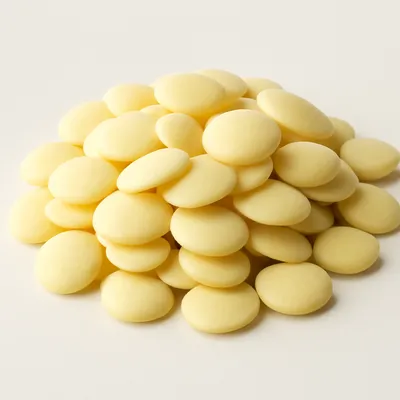
Neuhaus, Godiva, Leonidas and Guylian each maintain distinct house styles: dark, milk or white shells; ganache, nut praliné, marzipan, salted caramel, Champagne or fruit-liqueur fillings. White-chocolate pralines contain no cocoa solids, relying solely on cocoa butter and milk solids for structure. Seasonal editions rotate across all major producers.
On the Palate
Where Belgian praline sits in the Belgian flavor cloud
Ingredients
Serves 10How it's made
8 steps · 1 hour
- 110 min
Melt two-thirds of the dark chocolate to 50°C in a bain-marie; pour onto a cold marble slab and work with a scraper and palette knife until cooled to 27°C.
- 210 min
Scrape the cooled chocolate back into the bowl with the remaining one-third of unmelted chocolate; stir continuously until the mixture reaches 31–32°C—the chocolate is now tempered.
Watch outStir the reserved chocolate in until the whole batch settles to 31–32°C — hitting this exact window is the temper; too warm and it won't set with snap, too cool and it streaks and blooms grey.
- 315 min
Pour tempered chocolate into polycarbonate praline moulds; tap firmly to release bubbles, then invert and drain for 30 seconds, leaving only a thin shell; wipe the mould surface clean and set at 18–20°C for 15 minutes.
Watch outInvert and drain the mould for thirty seconds so only a thin shell clings, then let it set — a shell too thick leaves no room for filling; too thin and it cracks on unmoulding.
- 410 min
Make ganache: heat cream to 85°C, pour over finely chopped dark chocolate in a bowl, wait 30 seconds, then stir in slow circles from the centre outward until emulsified; fold in cold butter cut into cubes.
Watch outPour the 85°C cream over the chopped chocolate, wait, then stir from the center out until it emulsifies into a glossy ganache — stir too soon or too fast and the emulsion splits into a greasy, grainy mess.
- 510 min
Cool the ganache to 28–30°C, then transfer to a piping bag and pipe into each chocolate shell, leaving 2mm headspace at the top.
- 65 min
Re-temper a small amount of chocolate; pour over the filled moulds, scrape flush with a palette knife to create a flat base seal.
- 715 min
Refrigerate the moulds for 10–12 minutes until the base is fully set, then unmould by flexing the polycarbonate tray over a clean surface.
- 85 min
Store finished pralines at 16–18°C away from light and strong odours; consume within 2–3 weeks for optimal ganache texture.


