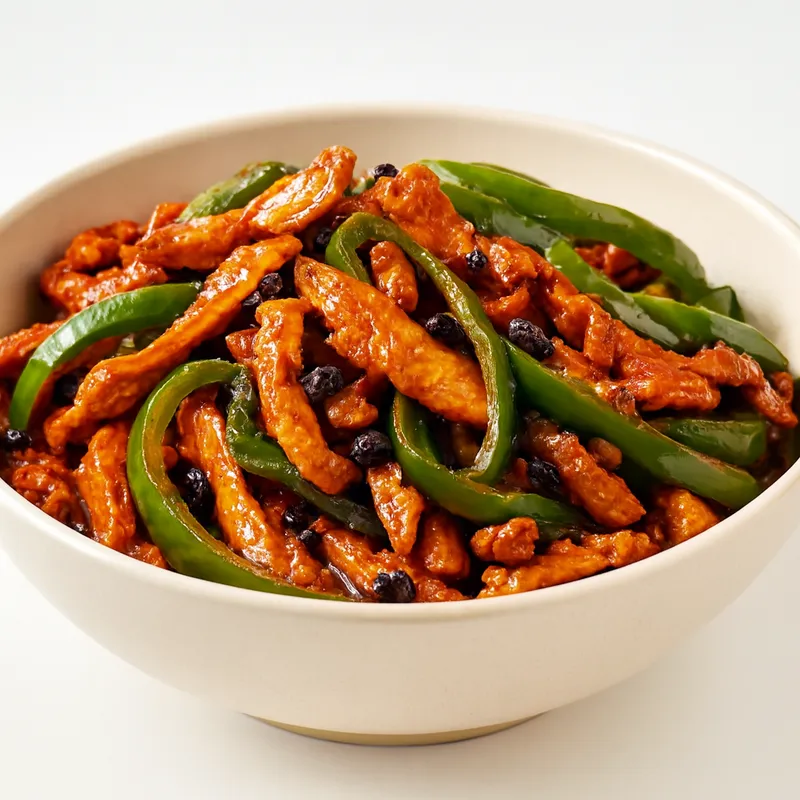
Stir-fried pork belly with green chili and aromatic garlic in a savory sauce.





Nongjia xiao chao rou, the everyday stir-fry of rural Hunan, codified in home kitchens across Xiangtan and Hengyang as the most efficient use of a freshly slaughtered pig — the belly cuts that nobody else wanted. No defined origin date; it's village food that travelled to city restaurants in the 1980s reform era.
Hunan village stir-fry — 农家小炒肉, codified in Xiangtan and Hengyang home kitchens, not invented in any restaurant. Skin-on belly dry-rendered first, no added oil, then long mild Hunan green chili blistered on the wok wall. Douchi goes in late so it doesn't burn.
Pork belly sliced thin with the skin on, dry-rendered in a hot wok until the fat goes translucent and the edges curl. Green chilies — the long, mild Hunan kind — go in next, blistered on the wok wall. Garlic, douchi, a splash of soy. The pork tastes more roasted than fried; the chili is half-cooked, still crunchy. Eat over rice, the rendered fat is the sauce.
The dry-render is the move: no added oil, the belly's own fat lubricates the wok and the Maillard browning happens on bare metal, not in a pool. The chili goes in second so its skin blisters in the rendered fat — that blistering is what separates this from a generic stir-fry. Fresh garlic, never garlic paste; douchi added late so it doesn't burn.
Variations
Xiangtan version keeps skin on and uses 螺丝椒; Hengyang runs a thinner-sliced belly with 朝天椒 for sharper heat; Changsha restaurants like 费大厨 standardize the dish with 紫苏 leaf added late, which villagers don't do; Yongzhou border style adds 干豆角.
On the Palate
Where Farmhouse Stir-Fried Pork sits in the Chinese flavor cloud
Ingredients
How it's made
4 steps · 25 min
- 120 min
Slice pork belly thinly and marinate with soy sauce.
- 23 min
Stir-fry garlic until fragrant, then add pork.
Watch outNo oil in the pan — let the belly render its own fat on bare metal and go from pale to gold with crisp curled edges; that dry-render on hot steel is the browning you're after.
- 31 min
Add green chili and douchi, stir-frying until the pork is cooked through.
Watch outDrop the chili into the pork's rendered fat and listen for the skin to blister and pop — that blistered, tiger-striped skin is what lifts it above an ordinary stir-fry; add the douchi last so it never scorches.
- 41 min
Serve hot, ensuring a balanced mix of meat and chili.