
Basque sheep-milk junket set with rennet, served warm in clay cups with mountain honey poured over and chopped walnuts on top — a Pyrenean shepherd dessert.


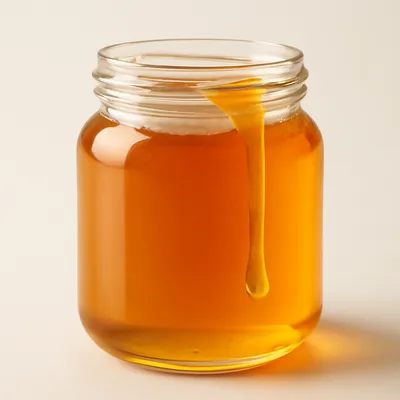
Cuajada con Miel is a transhumance dessert — Basque and Navarrese shepherds carrying their flocks to summer pastures in the Pyrenees would coagulate fresh sheep's milk in wooden kaiku cups using rennet from a lamb's stomach, then top with the honey gathered en route. The kaiku itself was traditionally heated by dropping a fire-glowing river stone into the milk, which gave a faint smoky note still chased by some Basque cuajada makers. The dessert remains a fixture of Navarre and Basque caseríos and turns up in cider houses (sidrerías) as a closing course.
Pyrenees shepherd's dessert: fresh sheep milk set with rennet at 35-45°C in a wooden kaiku. Sheep milk has 50% more casein than cow, which is why it sets firmer and finer.
Surface looks like flat panna cotta but yields differently — the spoon punches in and the curd breaks into soft sheets, never gels into bouncy gelatin. Sheep milk reads as faintly grassy, almost gamey beneath the cream — sweeter than cow milk and thicker. Honey runs in dark veins where you've cut, and the walnuts give a hard crunch against everything yielding. It's a profoundly simple dessert; the entire flavour profile is the milk plus the honey, which is why both should be the best you can find.
Rennet is a chymosin enzyme that cleaves κ-casein in milk, exposing the calcium binding sites that let the protein network gel. Sheep milk has 50% more casein than cow milk, which is why cuajada sets firmer with a finer texture and why the dish is traditional in sheep-herding regions. Temperature window is non-negotiable: 35–45°C. The honey topping is critical to balance — sheep milk's slight wildness needs the floral cover; bland clover honey gives a flat dessert.
Variations
Navarrese version with the river-stone smoke note (still chased by some kaiku makers); Basque caserío style with chestnut honey; sidrería closing course in Gipuzkoa runs walnuts heavier.
On the Palate
Where Cuajada con Miel sits in the Spanish flavor cloud
Ingredients
Serves 4How it's made
5 steps · 10 min active + 40 min waiting
- 13 min
Choose 4 small clay or glass cups (kaiku-style if you have them). Pre-warm by dipping in hot water and drying — cold cups will slow the set.
- 25 min
Heat 600ml fresh sheep's milk (or a 50/50 mix of whole sheep and whole cow milk if sheep is hard to find) in a heavy pan to 40°C — barely warm to a clean fingertip, not hot. Stir gently to avoid scalding.
Watch outAbove 50°C kills the rennet and the milk won't set; below 35°C and the set takes too long and goes rubbery.
- 31 min
Off heat, stir in 4 drops liquid animal rennet (or 1/4 tsp powdered rennet dissolved in 1 tbsp cold water). Whisk only 5 seconds — over-mixing breaks the curd structure before it forms.
Watch outStir minimally; agitation after rennet hits prevents a clean break.
- 440 min
Pour immediately into the warm cups. Cover loosely. Leave at room temperature 30–40 minutes — until the surface trembles as one mass when nudged but doesn't slosh. Don't move during set.
- 53 min
Just before serving (still slightly warm or chilled — both are traditional), spoon 2 tbsp mountain honey over each cup and scatter 1 tbsp coarsely chopped walnuts on top. Eat with a small spoon, breaking through the surface in one cut.
Archive tool suggestions — not reviewed
These legacy suggestions have not been evidence-reviewed and are not presented as required tools.


