
Toasted marshmallow and a square of Hershey's milk chocolate sandwiched between two graham crackers — the campfire's three-ingredient classic.
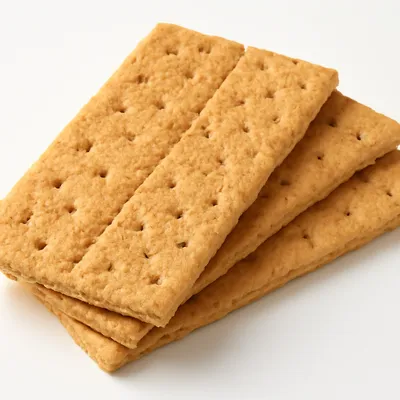

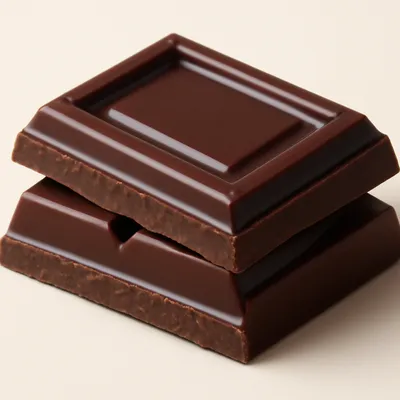
The earliest published s'more recipe appears in a 1927 Girl Scouts handbook (Tramping and Trailing with the Girl Scouts) under the name Some Mores, attributed in the book to a troop leader named Loretta Scott Crew, though Girl Scouts archivists could find no record of her and the name is now widely considered apocryphal. The combination relied on three industrial products that had become widely available by the 1920s: Nabisco graham crackers, Hershey's milk chocolate bars (Pennsylvania, 1900), and mass-produced marshmallows. The name contracted to s'mores by mid-century. Campfire scouting culture drove the spread.
First printed in the 1927 Girl Scouts handbook 「Tramping and Trailing with the Girl Scouts」, credited to troop leader Loretta Scott Crew. Three industrial products converged: graham crackers, Hershey's bars (1900), and mass-produced marshmallows.
First crunch is the graham — honey-wheat dust on the lips. Then the marshmallow gives, hot syrup-stretching from cracker to cracker, and the chocolate has gone half-liquid against the warm sugar. Cracker, crisp; centre, two melted layers behaving as one. Eat too slowly and the chocolate sets back into a shell; eat too fast and you burn the roof of your mouth. The window is maybe ninety seconds long.
Marshmallow's outer crust browns through Maillard reactions on its protein-sugar surface (gelatin + sucrose) at around 170°C, while the interior melts at 60-70°C. That asymmetry — crackly toasted shell, molten inside — is the whole pleasure. Embers (radiant heat ~200°C surface) brown evenly; open flame (~1000°C) carbonises before the centre warms. The hot marshmallow then transfers heat to the chocolate, which begins to melt at 32°C.
Variations
Hershey's milk chocolate is the printed-recipe default; Reese's-cup substitution is the modern Boy Scout move; Tate's-graham-cracker upgrade is the Brooklyn version; toasted-on-a-blowtorch s'mores at Magnolia Bakery (NYC) cheats the campfire entirely.
On the Palate
Where S'mores sits in the American flavor cloud
Ingredients
Serves 1How it's made
5 steps · 5 min
- 10 min
Build a small wood fire and let it burn down to glowing embers — flames char the marshmallow black before the inside warms. If indoors, light a gas stove burner on medium and use a long metal skewer.
Watch outOpen flame burns the surface in 5 seconds; you want radiant heat from coals.
- 21 min
Snap 1 graham cracker (Honey Maid is the U.S. default) along its perforation into two squares. Place one square on a plate. Lay 2 squares of a Hershey's milk chocolate bar (about 14g) on top.
- 32 min
Spear 1 large marshmallow on a roasting stick or skewer. Hold 15-20cm above the embers (not in the flames). Rotate slowly for 60-90 seconds until the surface is uniformly golden-brown and the inside is molten.
Watch outIf it catches fire, blow it out fast. A fully blackened crust is acceptable to some; for the soft-toast camp it's a failure.
- 41 min
Slide the hot marshmallow onto the chocolate. Top with the second graham square and press gently — the marshmallow's heat melts the chocolate against the cracker. Pull the skewer free.
Watch outPress only enough to bond — too hard and the marshmallow squirts out the sides.
- 51 min
Eat immediately while the chocolate is glossy-soft and the marshmallow still flows.
Archive tool suggestions — not reviewed
These legacy suggestions have not been evidence-reviewed and are not presented as required tools.



