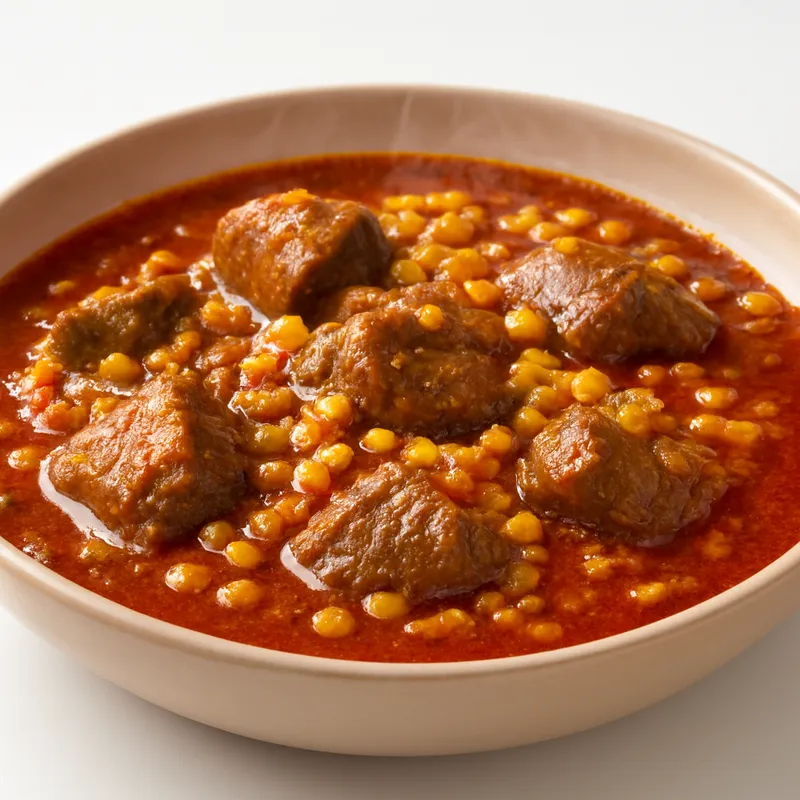
A thick, glossy, dark-brown paste cooked from nothing but sprouted wheat, flour and water — no sugar added. Wheat berries are soaked and germinated for days, then ground and pressed for their sweet milky juice, which is thickened with flour and stirred over a low flame for many hours, often through the night. As the malted sugars caramelize, the paste deepens to a chestnut brown and turns silky and faintly sweet. It is one of the seven symbolic items on the Nowruz haft-sin table, standing for affluence and fertility, and is also eaten at votive gatherings. A few walnuts are sometimes pressed in as a keepsake omen.



Samanu belongs to the wider Persian and Central Asian world and is tied to Nowruz, the spring-equinox new year whose roots reach back to ancient Iran. Its place on the haft-sin spread — the array of seven items each beginning with the Persian letter 'sin' — made it a fixture of the festival table, where it represents affluence and the sweetness won through patience. The dish gained prominence under the Safavid dynasty, when the communal overnight cooking by women, accompanied by folk songs and recited verse, settled into the ritual form still kept today. The same sweet, made by the identical sprouted-wheat method, appears across the region as sumalak or samani in Afghanistan, Tajikistan, Uzbekistan and Azerbaijan, where it likewise marks the new year.
Dense and pudding-thick, it clings to the spoon in a glossy dark ribbon. The taste is gently malty-sweet — closer to barley malt or dark molasses than to table sugar — with a clean wheaten depth and no cloying edge. Warm, it spreads soft and silky; cooled, it firms toward a sliceable paste. The optional walnut gives a sudden buttery crunch against the smooth.
The sweetness is entirely enzymatic, not added. Soaking and germinating the wheat switches on the grain's own alpha- and beta-amylase, the same diastatic enzymes used in brewing; held warm around 55–60°C, they hydrolyze the seed's starch into maltose and glucose, so the pressed sprout-milk is already sweet before any cooking. The flour-thickened slurry is then held over very low heat for hours: the long, gentle cook drives Maillard browning between those sugars and the grain's amino acids, plus light caramelization, which together build the deep chestnut color, the toasty malt aroma and the glossy body. Constant stirring is not ceremony alone — it keeps the starch-rich paste from scorching on the pot floor, where it would catch and turn bitter.
Variations
Recipes differ mainly in how far the cook is pushed: some stop at a pourable pudding, others reduce it to a stiff, near-black spreadable paste. A handful of crushed walnuts or almonds is often stirred in near the end, both for richness and as a divination keepsake fished out by guests. The regional cousins vary the grain and garnish — Central Asian sumalak is sometimes made with a little cottonseed or other oil and stones dropped in to stop sticking, while some Iranian households finish with a whisper of rosewater or a few threads of saffron, though purists keep it to wheat and water alone.
On the Palate
Where Samanu sits in the Persian flavor cloud
Ingredients
Serves 12How it's made
8 steps · 2 hours
- 110 min
Rinse whole wheat berries, soak in cold water for two to three days, changing the water daily until they swell and split.
- 215 min
Drain, spread the wheat on a cloth-lined tray, cover lightly, and let it sprout for three to four days, rinsing daily, until pale shoots appear.
Watch outSprout only until short pale shoots appear — that's peak sweetness from the grain's enzymes; let them grow long and green and the flavor turns grassy.
- 340 min
Grind or pound the sprouted wheat with a little water to a coarse mash, then squeeze and strain it through a cloth to extract the sweet milky juice; repeat with fresh water to wash out all the sweetness.
- 415 min
Whisk the flour into a portion of the cold sprout-juice until smooth and lump-free, then combine with the remaining juice in a heavy pot.
- 520 min
Bring gently to a bare simmer over low heat, stirring constantly with a long spoon to keep the bottom from catching.
Watch outStir the bottom constantly at a bare simmer — this slurry scorches in a heartbeat, and a burnt note will run through the whole pot.
- 6540 min
Continue cooking over very low heat for eight to ten hours, stirring often, as the paste thickens and darkens from tan to deep chestnut brown.
Watch outJudge it by color and gloss — done is when the paste darkens from tan to deep chestnut and turns glossy, the sign the sugars have browned into malt sweetness.
- 75 min
If using, press a few whole walnuts into the surface in the final hour as an omen keepsake.
- 815 min
Cook until thick, glossy and sweet, then ladle into bowls and cool; serve at room temperature as part of the haft-sin table.
Archive tool suggestions — not reviewed
These legacy suggestions have not been evidence-reviewed and are not presented as required tools.