A whole red spanner crab steamed from cold water—so it dies gradually with claws intact—then chilled until the meat firms to dense, pure sweetness. Served cold in the shell, it is the defining dish of Teochew 打冷: the tradition of cold cooked seafood eaten at room temperature or just below. The only accompaniment is rice vinegar and shredded ginger.
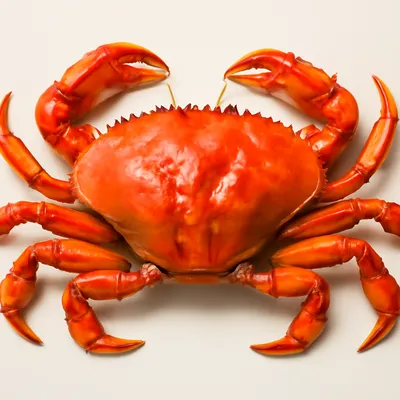




打冷—Teochew cold-plate cuisine—developed as a distinct food category in the Teochew eating houses of Hong Kong from the mid-twentieth century onward. The name carries two competing explanations: one holds that 打冷 derives from the Teochew phrase jiā-kī-lâng (家己郎, 'our own people'), whose final syllable lâng (person) sounds like Cantonese 冷—so the term evokes eating among one's own kin; a simpler account holds that customers would 打个转 (make a pass) along the cold-dish counter before ordering, giving the category its name. The red spanner crab (锈斑蟳, Charybdis feriatus)—recognizable by the striking reddish-brown cross pattern on its shell—became the signature 打冷 item through Hong Kong's cold-dish counters, where its dramatic appearance and firm, sweet claw meat attracted customers. The species had not been especially prized in traditional Teochew coastal cooking, but Hong Kong restaurants elevated it; the practice of chilling it before service was then re-imported back to Chaozhou and Shantou. Behind the aesthetics lies an older habit: Teochew fishing families had always eaten freshly cooked crab cold, simply because the distance from harbor to kitchen meant food cooled before it could be served. The chill became a virtue rather than a compromise.
Cold crab meat has a firm, snapping texture quite unlike the softness of freshly hot-steamed crab—more concentrated, slightly elastic, and suffused with pure brine sweetness. The ginger-vinegar dip cuts through the richness of the roe with acidic brightness, resetting the palate for the next bite.
The cold-water start is the most critical technique: placing a live crab in cold water and raising the temperature gradually prevents the crab from shedding its claws in panic—a stress response to sudden heat—keeping the body intact and the meat undamaged by self-amputation. At steam temperature (about 100 °C), muscle proteins denature and coagulate, setting the meat fully cooked. Subsequent chilling to 4–8 °C causes myosin and actin protein fibers to contract further, expelling a small amount of free water and producing a firmer, denser texture than hot-served crab. Cold also suppresses the volatilization of sulfur-containing compounds responsible for the characteristic 'cooked seafood' aroma, leaving the flavor cleaner and more purely sweet. Ginger contains gingerols and shogaols—phenolic compounds that bind to amine receptors on the tongue, masking residual trimethylamine (fishy odor) and stimulating saliva production to amplify the perception of sweetness.
Variations
Some households use flower crab (梭子蟹) rather than red spanner crab; it is considered richer in roe but less striking in appearance. Dipping sauces vary: Shantou households often favor diluted Puning fermented soybean paste (普宁豆酱) over ginger-vinegar; garlic oil is another common addition. For the Mid-Autumn festival, Teochew families traditionally refrigerate a whole cooked crab overnight and serve it in the cool air of the season, treating the chill as both practical and ceremonial.
On the Palate
Where Teochew Chilled Crab sits in the Chinese flavor cloud
Ingredients
Serves 2How it's made
7 steps · 15 min
- 110 min
Scrub a live red spanner crab (about 700 g) under running water with a stiff brush; remove the triangular apron flap on the underside, then tie the claws with kitchen twine to prevent them detaching during cooking.
- 25 min
Place the crab belly-side up on a steaming rack in a cold steamer; add enough cold water to the pot to generate steam without touching the rack.
- 310 min
Set the steamer over medium-low heat and allow the water to come to a boil slowly—this gradual temperature rise prevents the crab from shedding its claws in panic.
Watch outKeep the heat low so the water rises slowly — a sudden jump to hot makes the crab thrash and throw its claws.
- 420 min
Once steam rises vigorously, increase to high heat and steam for 20 minutes for a 700 g crab, adding 2 minutes for each additional 100 g.
Watch outTime from when the steam turns dense and rolling, not from when you lit the fire; 20 minutes for a 700g crab, plus 2 for each extra 100g.
- 530 min
Remove the crab and set on a wire rack at room temperature for 30 minutes to cool naturally; do not rinse with cold water.
Watch outLet it cool in open air — never splash it with cold water, or the shell cracks and the meat weeps out its juices.
- 640 min
Transfer to the refrigerator and chill for 30 minutes; optionally move to the freezer for 10 minutes to firm the meat further without freezing it.
- 75 min
Mix 3 tbsp rice vinegar with finely shredded ginger and 1 tsp sugar in a small bowl; serve the whole cold crab alongside the dipping sauce and crack the claws at the table.
Archive tool suggestions — not reviewed
These legacy suggestions have not been evidence-reviewed and are not presented as required tools.


